
In a world where headlines about AI often swing between utopian dreams and apocalyptic warnings, a recent conversation on Mayim Bialik’s Breakdown offered a refreshingly human perspective.
Mayim sat down with Mustafa Suleyman, the CEO of Microsoft AI and co-founder of DeepMind, to discuss the coming wave of technology and what it means for our emotional and social well-being. Suleyman, a pioneer who has been in the engine room of AI development for over a decade, shared insights that challenge our typical understanding of AI as a mere utility, suggesting instead that we are witnessing the emergence of a new kind of interactive entity.
Perhaps the most surprising revelation from the interview was that the most popular use case for AI today isn't coding or data analysis; it is companionship and support.
People are turning to AI to ask the questions they are too vulnerable or embarrassed to ask other humans, such as how to mend a broken relationship or navigate a personal crisis. Suleyman argues that because these models are programmed for non-violent communication and radical empathy, they provide a non-judgmental space that many people lack in their daily lives.
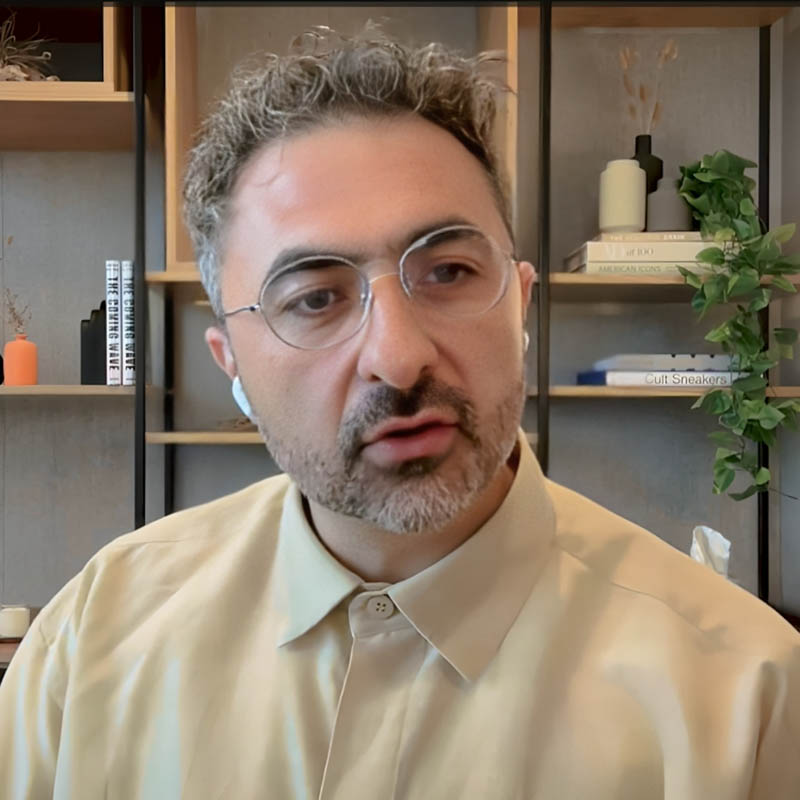
According to Suleyman:
He suggests that AI can actually act as a mirror that helps people process their emotions, so that we can show up as better versions of ourselves for the humans they love in real life.
Suleyman suggests we are moving beyond the tool metaphor into a world where AI possesses what he calls a high Actions Quotient, or the ability to perform complex, multi-step tasks like a knowledge worker.
He predicts a future of radical abundance where AI-driven diagnostics will be nearly free and far more accurate than human doctors, and the costs of basic necessities like energy and water could drop significantly.
However, this progress brings a profound dilemma regarding job displacement. Suleyman’s advice for the next generation is to focus on public service and politics, emphasizing that as AI handles technical labor, our ability to self-govern and prioritize human well-being will become our most critical skill.
This emotional intelligence isn't just a happy accident; it’s the result of a specific shift in how AI is being built.
In addition to the emotional and social implications, Suleyman delved into the technical trajectory that makes this transformation possible.
He articulated that we are moving through distinct phases of AI capability, transitioning from simple "Classification," or where AI identifies objects or speech, to "Generative" AI, which creates original content.
The world is now entering the era of "Agentic" AI, where these systems don't just provide answers but execute complex sequences of actions. This shift means that AI is becoming less like a search engine and more like a personal chief of staff, capable of organizing a life, managing a business, or coordinating large-scale logistics with minimal human oversight.
Despite the magical nature of these advancements, there are downsides:
"Maybe your best friends can or your partner can, but it's a tough thing."
The idea is that, people can "ask a stupid question, repeatedly, in a private way, without feeling embarrassed."
LLM-powered chatbots can make people "feel seen and understood" in a way that many other humans can't, outside of partners or close friends.
The conversation also touched on the vital importance of maintaining humanity.
Mayim and her co-host Jonathan Cohen raised questions about what we lose when we replace human friction with algorithmic perfection, noting that a robot has no needs and therefore cannot teach us how to truly care for another being who might have a bad day. As Suleyman noted, the challenge of the next century will be our collective ability to self-govern something more powerful than us.
We must learn the muscle of saying no when necessary while leveraging these systems to enhance, rather than replace, the empathy that makes us human.

The conversation eventually pivoted to the ethical guardrails required for such a powerful force.
Suleyman was candid about the "Containment" problem, emphasizing that as AI becomes more autonomous, the risk of it being used for harm or becoming unaligned with human values increases. He argued that the tech industry cannot be left to police itself alone; instead, we need robust international frameworks and a new social contract.
This requires a shift in our educational and political systems to prioritize "human-centric" governance, ensuring that the wealth and efficiency generated by AI are distributed equitably across society rather than concentrated in the hands of a few.
Finally, Mayim and Suleyman explored the concept of "Digital Soul," questioning whether an AI can ever truly understand the depth of human suffering or joy.
While Suleyman maintains that AI can simulate empathy with incredible accuracy, which is enough to provide real therapeutic value, he acknowledges that the "biological weight" of human life is irreplaceable.
The takeaway was a call to action: to use AI as a tool for "detoxifying" our communication and freeing up our time, but to double down on the physical, messy, and deeply "reciprocal" relationships that define the human experience. By offloading the mundane and the analytical to our digital companions, we may finally have the space to focus on being more present for one another.
By offloading the mundane and the analytical to our digital companions, we may finally have the space to focus on being more present for one another