When asked whether AI might eventually rank as the greatest productivity multiplier in human history—above electricity, the Industrial Revolution, or even the Agricultural Revolution—Sundar Pichai didn't hesitate to reaffirm a belief he’s held for years.
Back in 2017 or 2018, Pichai as the CEO of both Alphabet and Google, publicly stated that AI would have a bigger impact than fire or electricity.
This time, during the arms race where Google is fighting a fierce battle with OpenAI, Anthropic, Perplexity and others, as well as developing AIs for research and science, Pichai still stands by that statement.
He even went on to conclude that AI may be the most profound technology humanity has ever created.
According to the CEO of Alphabet and Google, past innovations—electricity, anesthesia, the internet—were revolutionary in their time, but they were largely static. Once they were invented, their impact was linear. AI, by contrast, is dynamic and self-improving. It’s the first technology with the potential to amplify itself, making it both a creator and an accelerator of future innovation.
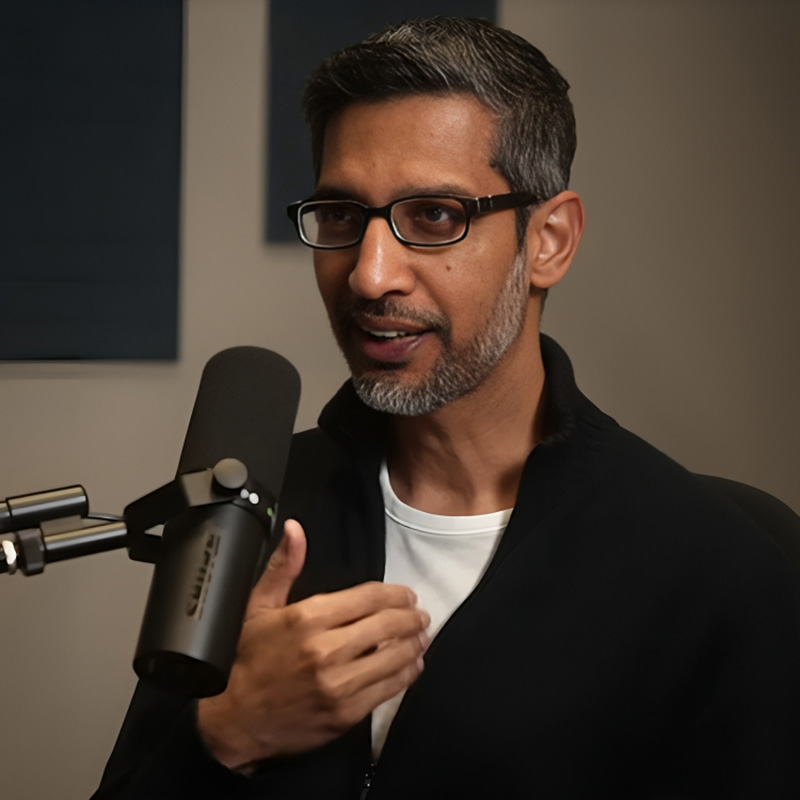
In a podcast with Lex Fridman, Sundar Pichai said that:
Pichai highlighted the concept of recursive self-improvement: the idea that AI can help build better versions of itself.
This, in his view, makes AI unique in history. Where other inventions changed how humans did things, AI may change what humans are capable of altogether—especially when it comes to creation.
And speaking about what makes human a human, though difficult to articulate, he spoke of an intangible essence—consciousness, empathy, kindness—that separates humanity from machines.
And while the line between human and artificial may blur over time, his hope is that a more abundant, AI-assisted world will elevate—not erode—humanity's best qualities.
Pichai emphasized that much of humanity’s conflict stems from the perception of scarcity. We often behave as if we live in a zero-sum world—where one person’s gain is another’s loss. But in a future where AI helps unlock abundance and democratize access, he hopes those human virtues—compassion, understanding, curiosity—will surface more naturally.
That, for him, is the aspirational vision.
Sundar Pichai also spoke about the current and future state of AI, particularly the timeline and nature of AGI (Artificial General Intelligence). Sundar introduces the idea of “AJI” (Artificial Jagged Intelligence) to describe today's AI—remarkably capable in some areas yet flawed in others. While he predicts AGI may not fully arrive by 2030.
But he said that he can a glimpse of it.
"But if your question is will it happen by 2030? Look, we constantly move the line of what it means to be AGI," Pichai said. "There are moments today like sitting in a Waymo in a San Francisco street with all the crowds and the people and work its way through, I see glimpses of it there. The car is sometimes impatient, trying to work its way using Astra like in Gemini Live or asking questions about the world."
On a deeper level, he reflects on AGI's potential to help people understand themselves, much like art or profound conversations do.
But Pichai is more into noting the importance of AI’s role in driving self-discovery.
The idea of having AI for this is not for its capabilities or technical prowess. but instead for its ability to expand human potential.
It's not just about solving known problems—it’s about reframing what questions even matter.
Further reading: Paving The Roads To Artificial Intelligence: It's Either Us, Or Them

















































































































































































































































































