
Linux has long been a cornerstone of the computing world: an open-source operating system powering everything from servers and supercomputers to desktops and smartphones.
At the center of that legacy is Linus Torvalds, whose work on the Linux kernel shaped decades of software freedom and stability. Despite the often-heated "Linux vs Windows" debates, Torvalds offered one of his most even-handed takes: many problems people blame on Windows might not be Windows problems at all.
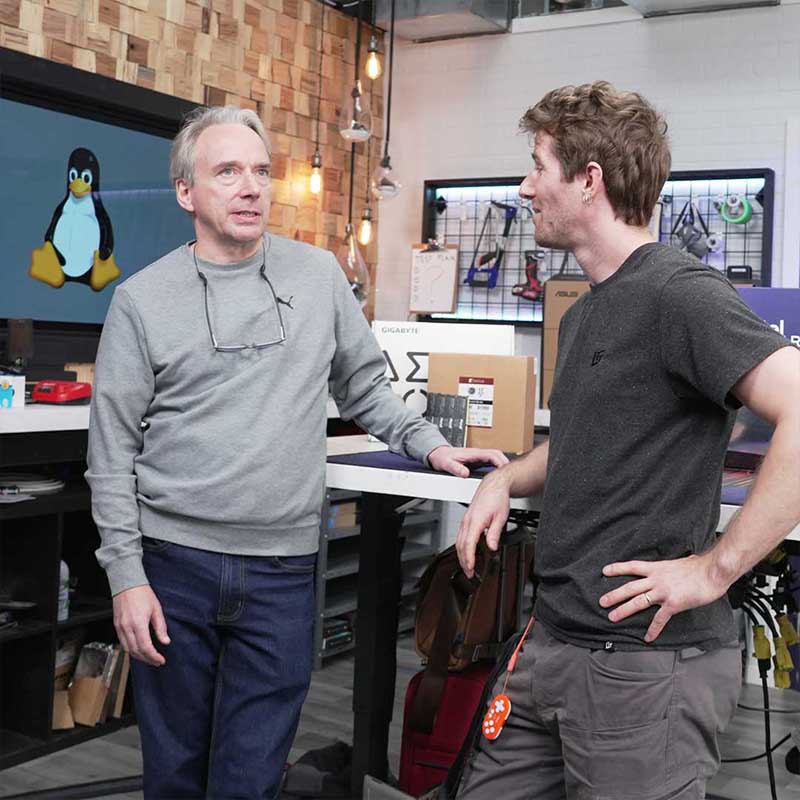
In a new Linus Tech Tips collaboration, Torvalds allowed host Linus Sebastian to build his new Linux PC on camera, offering a rare look at the hardware philosophy behind his personal development machine.
Over the course of nearly an hour, the two Linuses shared jokes, technical anecdotes, pop-culture references (even Highlander and Spider-Man references), and most importantly, a serious reveal of Torvalds’s hardware philosophy.

Rather than chasing flashy specs or gaming benchmarks, his priorities were simple: reliability, stability, and quiet operation.
Torvalds selected the AMD Threadripper 9960X, a 32-core Zen 4 workstation-class CPU designed for heavy parallel workloads. It’s a powerhouse that can compile the entire Linux kernel with ease, and its monstrous
The GPU choice was more surprising: an Intel Arc A580.
As Linus Sebastian noted, the "obvious Linux choice" would have been a Radeon card, with Nvidia being the familiar alternative. But Torvalds wanted neither. He drives dual 6K displays and doesn’t game or render heavily, so an efficient, quiet card with solid Linux drivers fit his real-world workflow better than a noisy gaming GPU.
"Needed something more than integrated graphics,” he said, “but without being an annoying loud or power-hungry gaming-class GPU," he said.
Torvalds also prefers air cooling over liquid solutions, again reinforcing the theme: longevity over spectacle.
His machine isn’t meant to show off. It’s meant to work, and that it must work reliably. With such huge air cooler, the 64-core CPU should be able to not only avoid unnecessary heat, but also noise. It's also more reliable, since less moving parts, and no liquid, since liquid is one of computers' worse enemies.
In all, his CPU and cooling pairing, is perfect for long coding sessions.
The most important choice, however, was ECC memory. Torvalds insists on it, bluntly stating that "I don't understand why people don't require ECC in their machines because being able to trust your machine is the number one thing. And without ECC, your memory will go bad, it's just a question of when."
He recalled once spending days debugging what he thought was a kernel bug, only to discover corrupted RAM was the true culprit.
This philosophy leads to his broader claim: a significant portion of operating-system crashes, including Windows’ infamous Blue Screen of Death (BSOD) aren’t caused by bad software at all.
The BSOD, synonymous with Microsoft’s Windows operating system, is designed to alert users to a critical system failure. When something goes seriously wrong at the hardware or kernel level, Windows halts, displays the error, and forces a reboot to prevent further damage.
Over the years, Microsoft has been heavily trolled for these screens. BSOD jokes became memes, shorthand for the "Windows experience," and a running punchline about instability, especially as crashes seemed to appear at the worst possible times.
Torvalds’ viewpoint reframes that narrative entirely.
With ECC memory, a high-end Threadripper CPU, and an Intel Arc A580, his workstation is intentionally specialized, and most importantly, reliable in the long run. It’s a system that doesn’t need babysitting, doesn't need tweaking, and doesn’t fall apart under heavy workloads.
It’s not a mass-market gaming PC. It’s not cheap. And it’s certainly not something most casual users would ever buy. But for developers, engineers, creative professionals, or anyone who values stability above all else, Torvalds' hardware priorities make perfect sense.
In a world where the “Linux vs Windows” debate often devolves into tribalism, Torvalds offers a more grounded, technical perspective: sometimes the culprit behind a crash isn’t sloppy software.
Sometimes, it’s simply bad memory.