In the cult of modern productivity, no figure looms larger than Elon Musk. Love him or hate him, he has carved himself into history through sheer willpower, obsessive focus, and a work ethic that’s become the stuff of legend.
As the man behind Tesla, SpaceX, xAI, Neuralink, and X, Musk is more than just a name—he’s a force. His companies build rockets, electric cars, AI models, social platforms, and brain-computer interfaces, all at once.
In an age of overbooked calendars and glorified busyness, many wonder how he navigates time—humanity’s most finite resource—as if it were infinitely expandable.
Musk doesn’t just manage time—he dominates it. He isn’t a man who flirts with burnout; he sprints toward it and dares it to slow him down.
For the billionaire, productivity isn’t a trend or a badge of honor—it’s survival.
And here, even Musk himself once admitted that he's doing too much.
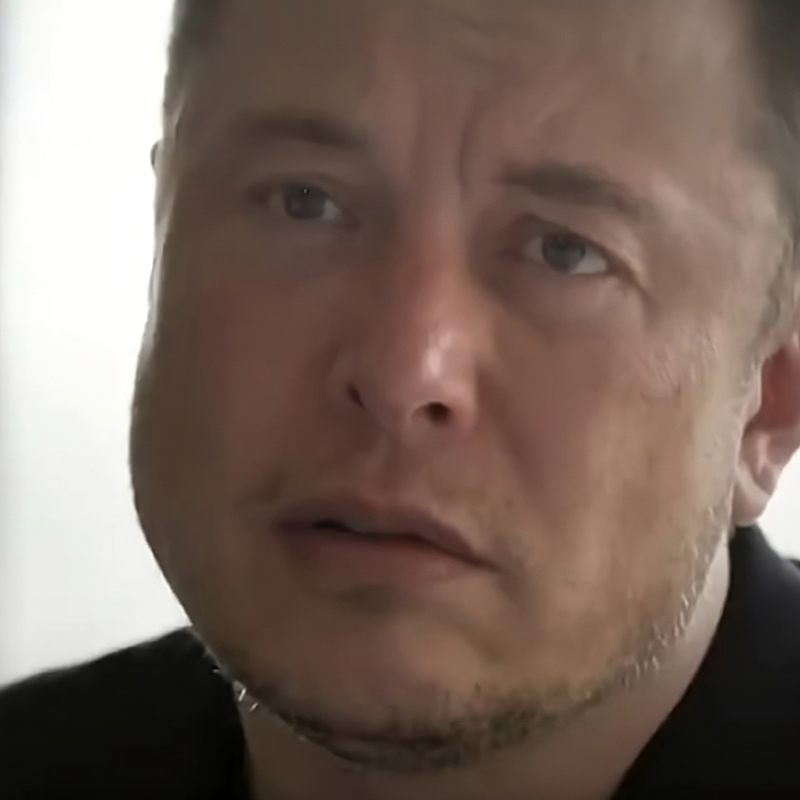
People began to glimpse Elon Musk’s grueling work schedule when photos emerged of him sleeping in the office.
At the peak of Tesla’s production chaos, Musk confessed to working up to 120 hours a week. No exaggeration. He slept on the factory floor, skipped meals, and went days without seeing sunlight.
This happened back in 2018, during Tesla’s Model 3 production crisis, where Musk could be seen working alongside his employees, and sleeping on the factory floor.
"It was life or death. We were losing $50 [million], sometimes $100 million a week. Running out of money," Musk said in an interview.
"I don’t believe people should be experiencing hardship while the CEO is off on holiday."
Musk believes that it's wrong or unfair for employees to suffer through difficult conditions at work while their leader is not there with them. According to Musk, a true leader should share in the struggle, not escape it. If the team is working overtime, under stress, or facing serious challenges, then the CEO shouldn’t be absent or disconnected.
They should be present, involved, and showing solidarity, and if possible, do even more than them.
To be able to do this, his strategy isn’t scattered.
He famously time-blocks his day in five-minute increments. Every second is spoken for—meetings, meals, emails, even bathroom breaks are scheduled. It’s not just about working more; it’s about eliminating waste. Everything is frictionless, focused, and fiercely prioritized.
He once said, “If something is important enough, you do it even if the odds are not in your favor.”
That’s not just a motivational quote—it’s a window into the engine that drives him. In his world, there’s a simple rule: if you want something done, you give everything—and then give some more. Musk’s philosophy is rooted in intensity. Not balance. Not harmony. Just sheer, unapologetic output.
Musk’s leadership style is as polarizing as his social media posts. He’s been called both brilliant and brutal in the same breath. He pushes hard, expects excellence, and never sugarcoats failure. He doesn’t want employees who simply clock in—he wants missionaries, people as obsessed with impact as he is. This ethos has built empires, but it has also burned bridges. He leads like a man trying to outrun time itself—because in his mind, the future won’t wait.
And while Musk doesn’t romanticize what he does, he’s not exactly recommending it either.
He knows he works too much. He’s aware of the toll. And though he may hope (and force) the people around him can match his intensity, he doesn’t really wish this harsh reality on anyone—the brutal fight against time, paid for with body and mind.
Musk reposted an old video of him in an interview, which refers to him as Wartime CEO, as he said that he's back to working 7 days a week and sleeping in the office "if my little kids are away."
Back to working 7 days a week and sleeping in the office if my little kids are away https://t.co/77cc6sRCFZ
— Elon Musk (@elonmusk) July 20, 2025
In the old video Musk can be seen emotionally reflecting on how his grueling his work took a toll on his life.
It's not easy for anyone—even a group of people—to run a publicly traded company and several privately held ones at the same time, many of which are pioneers in their respective industries, while juggling time between them.
For him, it’s about solving problems most people are too afraid to face. It’s about chasing the improbable, daring the impossible, and squeezing every drop out of the time we’re given. It’s not pretty. It’s not soft. But it’s exactly why he continues to defy limits.
But to be able to do all that, it comes at a cost.
Musk has admitted to loneliness, emotional exhaustion, and broken relationships. He’s sacrificed comfort, stability, and often his own peace of mind. His work ethic isn’t sustainable for most, and even admits that it's not healthy.
In other words, Musk’s relentless focus on work has not come without personal cost.
Several of his partners and even one of his children have, in different ways, revealed the strain his lifestyle places on those closest to him. Though not always framed as direct complaints, the patterns are unmistakable—when you orbit someone so consumed by ambition, you either adapt, endure, or break away.
His first wife, Justine Musk, has spoken candidly about their marriage. In a widely shared essay titled “I Was a Starter Wife,” she described a relationship dominated by control and imbalance. Musk, she said, treated her more like a trophy than an equal, once even telling her, “If you were my employee, I’d fire you.”
Talulah Riley, an actress and Musk’s second wife—whom he married and divorced twice—has been more measured in her reflections. While she hasn’t criticized him harshly, she acknowledged that his obsessive work ethic meant their relationship required a high degree of tolerance. “It’s not easy being married to Elon,” she said in interviews. “You have to accept how much time he gives to his work.”
Grimes, the Canadian musician and mother to three of Musk’s children, described their relationship as fluid, unconventional, and ultimately too divergent to last in a traditional sense. In an interview, she admitted tthat Musk was “just working all the time.”
Now in his 50s, Musk somehow seems to have more energy than people half his age.




















































































































































































































































































