
The semiconductor industry has always been a theatre of rapid transformation, where each era’s "gold rush" redefined the limits of human capability.
At their core, semiconductors are materials, most commonly silicon, that possess a unique physical property: they can both conduct and insulate electricity. Unlike a copper wire that always allows current to flow, or rubber that always blocks it, a semiconductor's conductivity can be precisely toggled on or off.
By manipulating this state, engineers create "transistors," which act as microscopic switches. When billions of these switches are packed onto a single chip, the result is a brain capable of processing the binary logic (1s and 0s) that powers everything from a digital watch to a nuclear deterrent.
And now, with the world becoming increasingly dependent on semiconductors, there is one issue, at least according to the West.
China, with its rapid development, is striking fear right to the very heart of the U.S., as the latter worries that it may soon be surpassed.
Anthropic CEO Dario Amodei, is one of the people who shares this concern.

Things began with the fierce "PC wars" of the 1980s and 1990s, when the race to shrink vacuum tubes into silicon transistors birthed the personal computer, turning companies like Intel into household names and establishing the microprocessor as the fundamental heartbeat of the modern office.
During this period, the chip was a tool for individual productivity: a means to digitize paper-based worlds.
The supply chain was vertically integrated, and the stakes were largely commercial, as the world transitioned into a post-internet reality where connectivity became the new standard.
However, the 2010s introduced a more chaotic driver: the blockchain and cryptocurrency craze. Suddenly, demand for high-performance silicon, specifically Graphics Processing Units (GPUs), skyrocketed as miners around the globe competed to solve complex mathematical puzzles for digital rewards.
This era shifted the semiconductor narrative from general-purpose computing to massive parallel processing, turning Nvidia’s gaming hardware into a scarce global commodity.
The "mining boom" proved that silicon was no longer just for spreadsheets or software; it had become the essential fuel for a decentralized financial frontier, leading to unprecedented shortages and the realization that whoever controlled the hardware controlled the ledger.
Now, as the world enters the age of AI, a cycle that dwarfs previous booms in both scale and strategic risk, silicon has evolved from a tool for productivity and a miner’s pickaxe into what Amodei describes as a "country of geniuses in a data center."
The demand is no longer just for speed, but for "cognition" at scale.
In this high-stakes environment, the semiconductor is no longer a consumer good but a geopolitical weapon. This transition from the simple PC to the "intelligent" chip has set the stage for a new kind of conflict: one where the export of a single generation of hardware is weighed against the security of nations, and where the leaders of AI labs now find themselves at odds with the very chipmakers that powered their rise.
And seeing China getting its hands on the Nvidia H200 chips, is worrying, according to him.
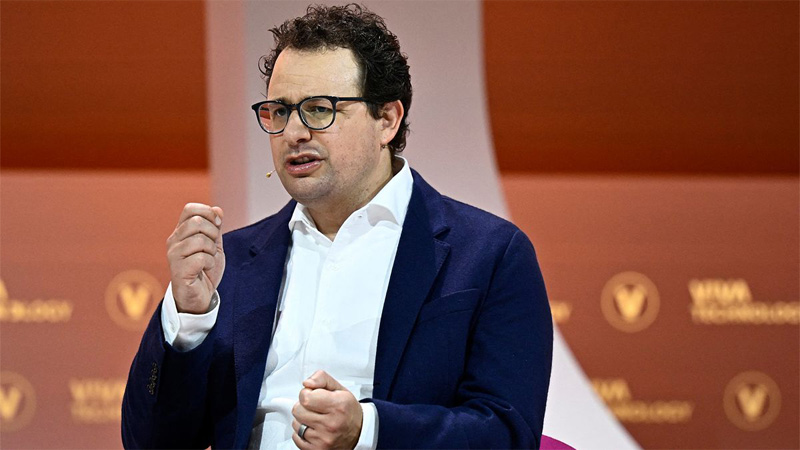
At the 2026 World Economic Forum in Davos, Amodei said that:
"I think this is crazy. It’s a bit like selling nuclear weapons to North Korea and [bragging that] Boeing made the casings.”"
The center of his concerns, is the Nvidia H200, which is roughly six times more powerful than the H20, the "compliance chip" designed to be just slow enough to stay under the U.S. export cap, that Chinese companies have been forced to use.
At this time, the H200 is no longer the absolute king of the hill.
That title now belongs to the Blackwell (B200) architecture, which is a generational leap, packing 208 billion transistors, or more than double the H200, and delivering up to 15 times the inference performance.
Because Blackwell is so vastly superior, the U.S. government viewed the "older" H200 as a safe compromise to sell to China.
To the U.S. Department of Commerce, the H200 is "lagging" technology; but to a country under a chip embargo, it is a massive upgrade over the H20, a "crippled" version of the H100 that Nvidia previously designed specifically to meet export limits.
Despite Nvidia being a backer and investor in Anthropic, Amodei did not hold back in his assessment of the security risks.
In this high-stakes environment, the semiconductor is no longer just a consumer good but a geopolitical weapon. This transition has set the stage for a new kind of conflict: one where the export of hardware is weighed against national security, and where AI leaders now find themselves at odds with the very chipmakers that powered their rise.