
In the fierce competition among large language models, it has always felt like a zero-sum game where one company's breakthrough could crown a definitive winner.
Yet victory has stayed just out of reach, as tech giants keep unleashing innovations that only heighten the intensity. Ever since OpenAI launched ChatGPT and fundamentally reshaped expectations for what AI could deliver, the pressure on rivals became unrelenting.
Few companies have felt that strain more acutely than Google.
Its initial response came in the form of Bard, a tentative debut that betrayed more caution than conviction. It was only when Bard evolved into Gemini that Google regained its footing, stepping back into the fray not as a cautious imitator but as a formidable contender ready to prove its enduring strength in AI.
With the original Gemini series, the company demonstrated genuine capability and signaled its determination to lead rather than follow. Subsequent releases built on that momentum: Gemini 2.0 pushed boundaries further, and Gemini 2.5 refined performance across reasoning, multimodality, and practical applications.
Google showed no intention of easing up, with Gemini 3 introduced mainly to mock rivals.
Then, the next major leap arrived.
With this new release, Gemini applies advanced reasoning to make sense of complex, changing information in real-time.
3.1 Pro can utilize advanced reasoning to bridge the gap between complex APIs and user-friendly design. For example, Gemini built a live aerospace dashboard,… pic.twitter.com/qQZ0BIXAIL— Google Gemini (@GeminiApp) February 19, 2026
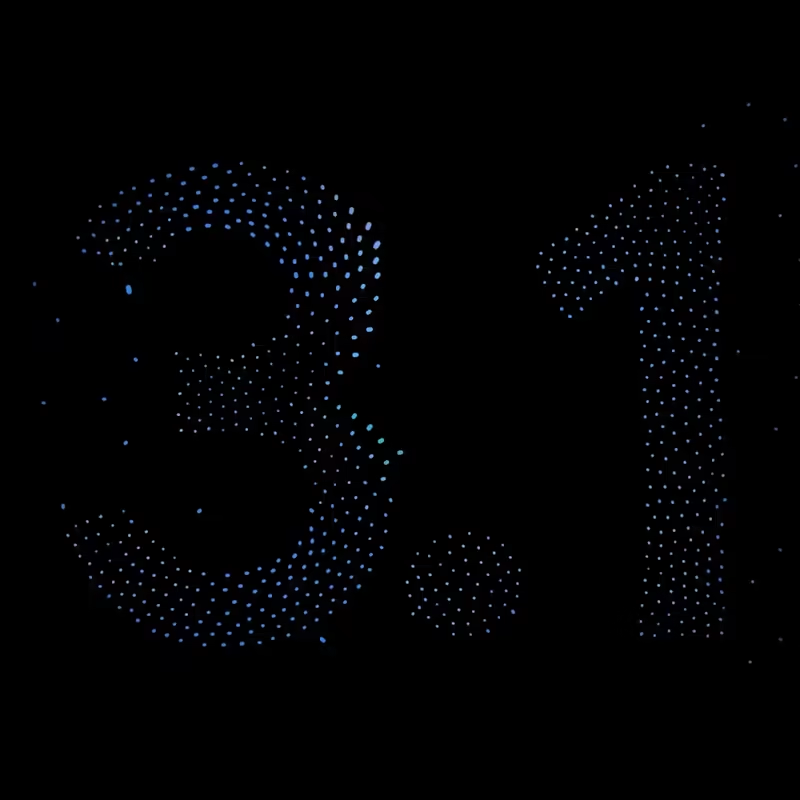
Google in a blog post announced 'Gemini 3.1 Pro,' a refined and significantly upgraded model positioned as its most advanced tool yet for tackling intricate, multi-step challenges where straightforward responses fall short.
While Google said that the 3.1 is a "major update," the first ".1" increment in the Gemini lineage is more of a shift towards more frequent, meaningful enhancements rather than waiting for full generational jumps.
Regardless, at its core, Gemini 3.1 Pro delivered a substantial boost in reasoning depth, enabling it to synthesize vast datasets, explain nuanced concepts, bridge complex APIs into user-friendly designs, and generate sophisticated outputs like animated SVGs from text descriptions or interactive 3D experiences with generative elements.
Benchmarks underscored the progress: it achieved a record 44.4% on Humanity’s Last Exam (surpassing Gemini 3's 37.5% and OpenAI’s GPT-5.2 at 34.5%), and a striking 77.1% on ARC-AGI-2 (more than doubling prior Gemini scores and outpacing many competitors in the 50-60% range).
Gemini 3.1 Pro is here. Hitting 77.1% on ARC-AGI-2, it’s a step forward in core reasoning (more than 2x 3 Pro).
With a more capable baseline, it’s great for super complex tasks like visualizing difficult concepts, synthesizing data into a single view, or bringing creative… pic.twitter.com/aEs0LiylQZ— Sundar Pichai (@sundarpichai) February 19, 2026
These gains highlighted particular strength in abstract logic, agentic workflows, and creative problem-solving.
A standout companion to this upgrade was the expanded Deep Think mode, an advanced reasoning system integrated with Gemini 3.1 Pro.
Deep Think allowed the model to iterate through generation, verification, and revision cycles for open-ended problems in mathematics, physics, and computer science.
3.1 Pro can even generate website-ready, animated SVGs from a simple text prompt.
Since these are built in pure code — not pixels — they stay crisp at any scale and keep file sizes tiny compared to traditional video.
Go ahead, try generating an animated SVG of a pelican riding… pic.twitter.com/2mXtCigOzp— Google (@Google) February 19, 2026
Guided by expert-level prompting and tool use, including web browsing and code execution, it functioned as a force multiplier for research.
It powered breakthroughs such as solving longstanding open problems in number theory, refuting conjectures in optimization, contributing to AI-generated mathematical papers, and assisting in physics derivations that had stalled human efforts for years.
In controlled evaluations, it reached near-Olympiad gold-medal levels on proof-based benchmarks and produced publishable-quality results in collaborative settings.
We used Gemini 3.1 Pro to build a realistic city planner app.
Watch how the model tackles complex terrain, maps out infrastructure, and simulates traffic to generate a high-quality visualization. pic.twitter.com/SKoVzwtBy8— Google DeepMind (@GoogleDeepMind) February 19, 2026
To demonstrate Gemini 3.1 Pro’s advanced reasoning, Google showcased how the model can coordinate multiple logic streams simultaneously. It can ingest live data from public APIs, synchronize that data with a responsive user interface, and apply real-world physics, such as accurately rendering day-night cycles,all within a single coherent system.
Beyond dashboards, Gemini 3.1 Pro can generate website-ready animated SVGs directly from text prompts. Because these visuals are created entirely in code rather than rendered pixels, they remain sharp at any scale while keeping file sizes extremely small.
Google also highlighted a more immersive example: an interactive 3D starling murmuration simulation. The model reasoned through flocking physics to build a system that responds to hand-tracking input and dynamically adjusts a generative soundscape as the birds move, illustrating its strength in modeling complex, sensory-rich environments.
Starting today, Gemini 3.1 Pro is rolling out globally to the Gemini app, with higher limits for users with the Google AI Pro and Ultra plans.
Learn more about these updates in our blog: https://t.co/TceeqpBxmh— Google Gemini (@GeminiApp) February 19, 2026
While some observers noted that real-world differences might feel incremental outside highly specialized tasks, and independent leaderboards like the Arena still showed close rivalry with models like Claude Opus variants, Gemini 3.1 Pro solidified Google's aggressive pace in the AI race.
It arrived not as a revolutionary overhaul but as a confident assertion that the company had closed key gaps in complex reasoning and was prepared to keep pushing forward relentlessly. In a field defined by constant escalation, Google had once again raised the bar.
The model rolled out in preview across Google's ecosystem: the Gemini app (with higher limits for Pro and Ultra subscribers), NotebookLM, Vertex AI, the Gemini API, and developer tools like Google AI Studio and even integrations such as GitHub Copilot.
Pricing held steady at previous levels, making the enhanced capabilities more accessible without added cost.