A software can be so huge and so widely used, that it requires a lot of vendors as partners to keep it functioning and running.
Because of this, certain software can have features and functions that are so integrated to its system, that an issue can cause it to fail entirely.
One example of this, is the CrowdStrike incident, which happened instantly following a faulty update to its security software.
When the American cybersecurity technology company that provides cloud workload protection and endpoint security, threat intelligence, and cyberattack response services, distributed a faulty update to its security software, the move caused a global catastrophe that rendered an estimated millions of computers and virtual machines running Microsoft Windows to crash.

The affected computers, which were mostly business and governmental machines, were caught in a a boot loop or in recovery mode.
The outage that happens worldwide, with so many systems unable to restart, effectively disrupted so many critical services, including airlines, airports, banks, hotels, hospitals, manufacturing, stock markets, broadcasting, and many other services.
A number of services, such as emergency services and websites, were also affected.
In all, the outage reported around the globe, CrowdStrike more or less, 'crowd strike' the world.
The incident has since been described as the largest in the history of information technology and "historic in scale."
All that, thanks to the ubiquitous presence of Microsoft Windows in those affected systems.

The faulty update CrowdStrike was pushing, resulted in a blue screen of death (BSOD) on virtual machines running Windows virtual machines on the Microsoft Azure cloud platform.
The problem primarily affected systems running Windows 10 and Windows 11, with lesser number of systems were running Windows 7 and 8.
A much lesser number of systems that use Google Compute Engine also reported the problem.
Computers running macOS and Linux were unaffected, as were most personal Windows PCs.
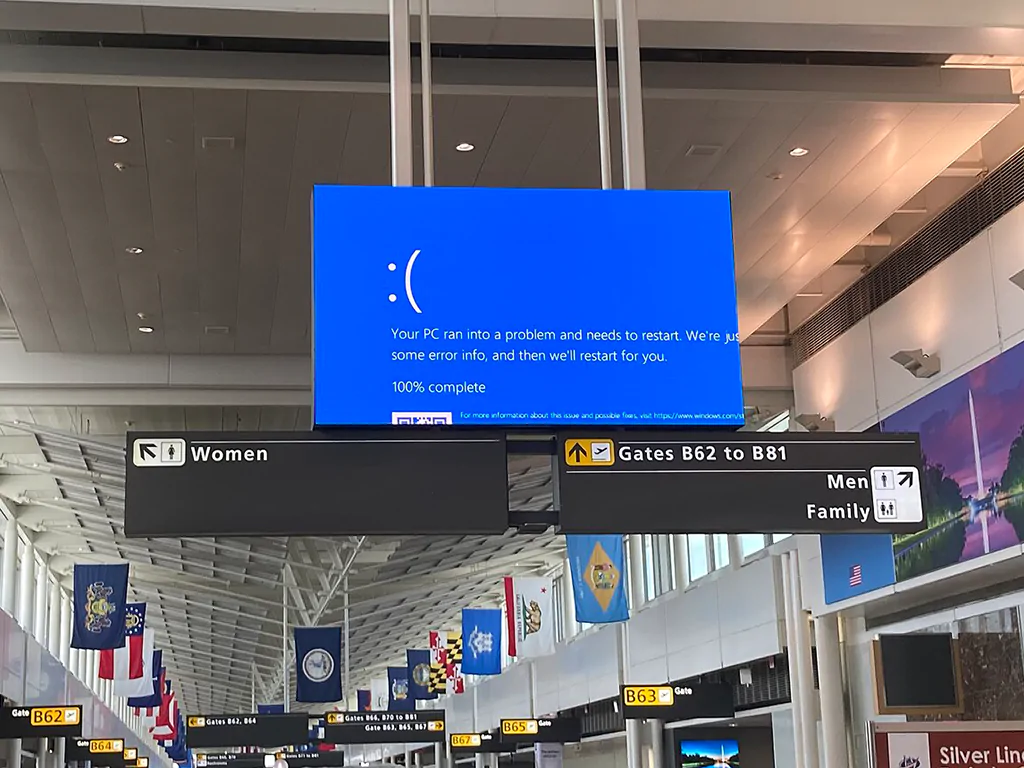
While the problem could be temporarily mitigated by restoring the affected system by booting into safe mode or the Windows Recovery Environment, and deleting certain files with certain a timestamp, the manual process was inefficient, and was "expected to take days."
But what made it worse is that, the problem was exacerbated on devices with Windows' BitLocker disk encryption enabled.
With that many computers couldn't turn on and function, CrowdStrike literally created the biggest ransomware attack, by mistake.
To what extent the issue goes, at the time of the incident, CrowdStrike said it had more than 24,000 customers, including nearly 60% of Fortune 500 companies and more than half of the Fortune 1,000.
Microsoft estimates that 8.5 million devices were affected by the update.
Yesterday, CrowdStrike released an update that began impacting IT systems globally. We are aware of this issue and are working closely with CrowdStrike and across the industry to provide customers technical guidance and support to safely bring their systems back online.
— Satya Nadella (@satyanadella) July 19, 2024
Read an update on what we’ve done to help Microsoft customers recover from the recent CrowdStrike outage. Learn about our actions from the start of the incident and our collaboration with customers, cloud providers and others in the tech community. https://t.co/7lS3zl32ww
— Microsoft News and Stories (@MSFTnews) July 20, 2024
CrowdStrike is a company that develops a suite of security software products for businesses, designed to protect computers from cyberattacks.
And here, it has what it calls the Falcon Sensor product, which is CrowdStrike's vulnerability scanner. This installs an endpoint sensor at the operating system kernel level on individual computers to detect and prevent threats.
Due to the nature of cybersecurity that is always evolving, CrowdStrike needs to continuously maintain this product. And because of that, the company routinely distributes patches and updates to clients, so their computers can address new threats.
But on July 19th, an update to this Falcon software crashed the many systems that has the software running.
Sooner after realizing the mishap, CrowdStrike reverted the update, and forced affected devices to reboot.
CrowdStrike CEO George Kurtz explained the the issue stemmed from CrowdStrike's faulty kernel configuration file update, and that a fix was deployed.
According to reports, the outage have costed the entire system more than $20 billion in its first day.
CrowdStrike is actively working with customers impacted by a defect found in a single content update for Windows hosts. Mac and Linux hosts are not impacted. This is not a security incident or cyberattack. The issue has been identified, isolated and a fix has been deployed. We…
— George Kurtz (@George_Kurtz) July 19, 2024
Today was not a security or cyber incident. Our customers remain fully protected.
We understand the gravity of the situation and are deeply sorry for the inconvenience and disruption. We are working with all impacted customers to ensure that systems are back up and they can…— George Kurtz (@George_Kurtz) July 19, 2024
All of CrowdStrike continues to work closely with impacted customers and partners to ensure that all systems are restored.
I’m sharing the letter I sent to CrowdStrike’s customers and partners. As this incident is resolved, you have my commitment to provide full transparency on…— George Kurtz (@George_Kurtz) July 19, 2024
As CrowdStrike continues to work with customers and partners to resolve this incident, our team has written a technical overview of today’s events. We will continue to update our findings as the investigation progresses. https://t.co/xIDlV7yKVh
— George Kurtz (@George_Kurtz) July 20, 2024
It's worth noting though, that some countries were less affected than others.
Those that rely less on Western products, like China that thrive through its own self-sufficient IT systems, as well as countries restricted by international sanctions, like Russia and Iran, were all experiencing far less disruptions.
Some of their services even reported no disruptions, whatsoever.
A day later, as the world is trying to heal itself from Crowdstike's crowd strike, and with the many people seemingly trying to find someone or something to blame, Vincent Flibustier claimed to be the the one responsible.
He said that he was a newly hired CrowdStrike employee responsible, and that his job was to just upload an update, and that's it.
"First day at Crowdstrike, pushed a little update and taking the afternoon off," he said in a post on X.
Quickly, the post gained traction, for the very obvious reason.
First day at Crowdstrike, pushed a little update and taking the afternoon off pic.twitter.com/bOs4qAKwu0
— Vincent Flibustier (@vinceflibustier) July 19, 2024
The truth is that, he is just parodying things, and only tried his luck piggybacking the trend that happens on the internet, to make a name for himself.
To do this, Flibustier created a manipulated photo of himself outside the CrowdStrike office, and to amplify his message, he made a follow-up post claiming he had been fired, and later, posted a video "confessing" to causing the global outage.
His X bio was even updated to read: "Former Crowdstrike employee, fired for an unfair reason, only changed 1 line of code to optimise. Looking for a job as Sysadmin."
Here's a short video to explain what happened..
I'm waiting for my letter of dismissal. #Crowdstrike pic.twitter.com/bl4vPxX1E8— Vincent Flibustier (@vinceflibustier) July 19, 2024
He even mentioned X owner Elon Musk, and asked for a job.
Hello @elonmusk do you have a job for me ? Please RT so M. Elon Musk can see it.
— Vincent Flibustier (@vinceflibustier) July 19, 2024
While intended as satire, thousands of users took Flibustier's posts and mock him for what he claimed he did.
Many users seemingly directed their fury and anger, and frustration towards him.
Some however, praised him for inadvertently creating a work-free Friday or
But the truth is that, Flibustier is just satirical writer who runs a Belgian parody news site.
In an interview, he shed light on why his joke resonated so strongly online.
"People are drawn to stories that confirm their preconceptions... No culprit named yet, I bring it on a platter, people like to have a culprit. The culprit seems completely stupid, he is proud of his stupidity, he takes his afternoon off on the first day of work. This falls right into a huge buzz in which people absolutely need to have new information, and a fake is by nature new, you won't read it anywhere else," he said.
He also noted that while some users shared his post knowing it was a joke, the amplification propelled it into a realm where many interpreted it literally.
How I broke the internet today and what lessons can we learn from it? #Crowdstrike
Several things that make it a good fake that worked:
1. No culprit named yet, I bring it on a platter, people like to have a culprit.
2- The culprit seems completely stupid, he is proud… pic.twitter.com/JFJ2MEYNMQ— Vincent Flibustier (@vinceflibustier) July 19, 2024






















































































































































































































































































