Whether people are browsing the web, gaming on their phone, or tackling work on a laptop, their device relies on a battery to keep running. From powerful desktops and sleek laptops to smartphones, smartwatches, and beyond, nearly every gadget depends on rechargeable power sources: most commonly lithium-ion batteries (Li-ion).
Yet as technology explodes in capability and demand, fueled by AI, faster networks, and more immersive experiences, most devices still draw from the same basic battery chemistry that's been around for decades.
The lithium-ion batteries powering the world are fundamentally similar to those commercialized in the 1990s. They've seen incremental tweaks in energy density, safety, and cost, but the core limitations persist: constrained capacity in compact sizes, slower charging relative to modern needs, finite lifespans, and safety risks from flammable components. These constraints increasingly bottleneck innovation, preventing devices from becoming thinner, lighter, longer-lasting, or more powerful without compromises.
Enter silocon-carbon batteries (Si-C).
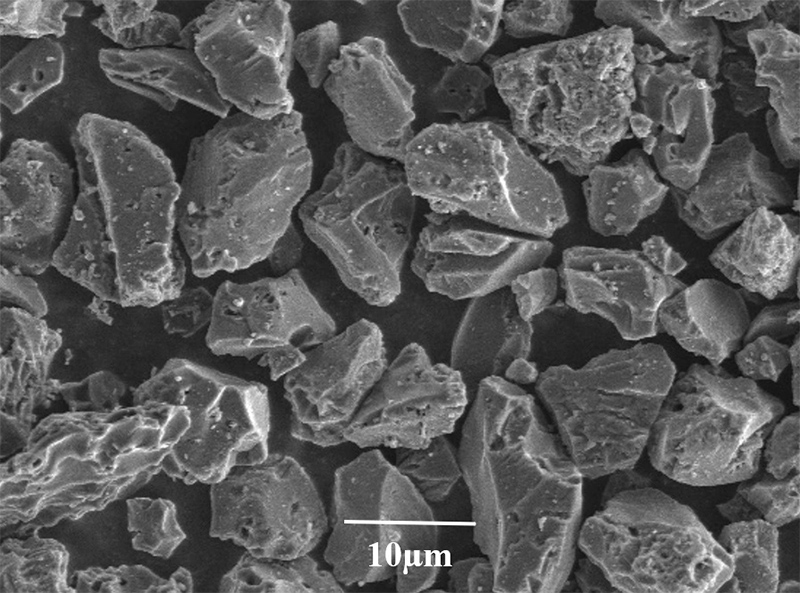
Or also known silicon-carbon composite anodes, the kind of battery is a promising upgrade over Li-on that's gaining traction in 2025 and 2026.
Silicon-carbon batteries, or also known as carbon-silicon batteries, represent a significant evolution in energy storage technology that's finally breaking through to consumer devices.
These aren't an entirely new battery type to be precise, since they're still lithium-ion at heart. However, they replace or blend the traditional graphite anode with a composite of silicon and carbon.
The idea is to use silicon, since it can theoretically store up to 10 times more lithium ions than graphite (around 4,200 mAh/g vs. 372 mAh/g for graphite). And in turn, this should unlock dramatically higher energy density.
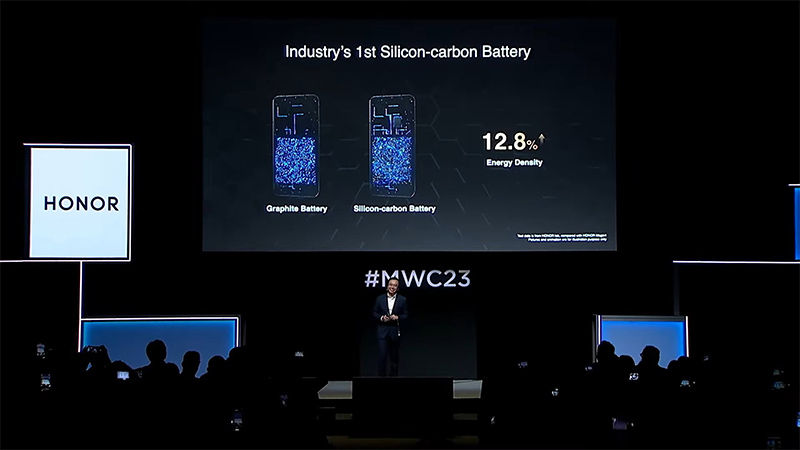
Notable companies that pioneered using silicon-carbon batteries on their phones include Honor (with 25% silicon batteries in devices like the Magic V series, offering ultra-slim 6,100 mAh packs), and OnePlus (in models like the OnePlus 15), Xiaomi. Others have also rolled out silicon-carbon tech in flagship phones.
Innovations from firms like Group14 Technologies (SCC55 material achieving 1,500+ cycles) push toward even higher stability and performance.
Read: How The Batteries We Know Are Limiting Technology Breakthrough: The Challenges
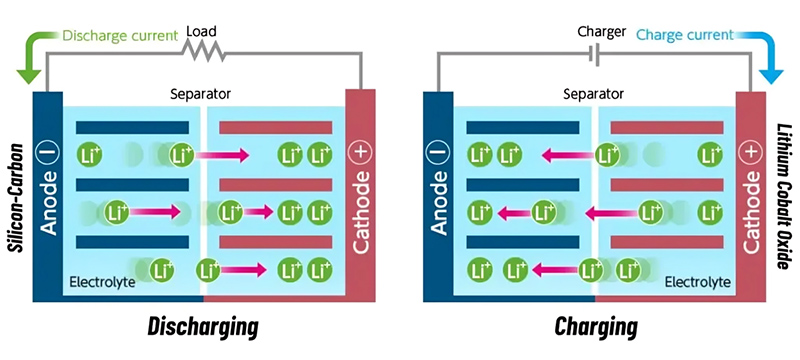
Key advantages of silicon-carbon batteries include:
- Higher Energy Density: By incorporating silicon (often 10-25% or more in composites), batteries achieve 20-50% more capacity in the same physical size. This translates to smartphones with 7,000-9,000 mAh batteries without becoming bulky, enabling all-day (or multi-day) usage even with demanding tasks.
- Faster Charging Potential: Improved lithium ion diffusion in silicon composites supports quicker charge times, sometimes under 10-15 minutes for significant boosts in emerging implementations.
- Better Performance in Compact Designs: Ideal for slim foldables, wearables, and thin laptops, where space is premium.
- Path to Broader Applications: Beyond phones, this tech is eyed for electric vehicles (EVs), energy storage, and AI devices needing sustained power.
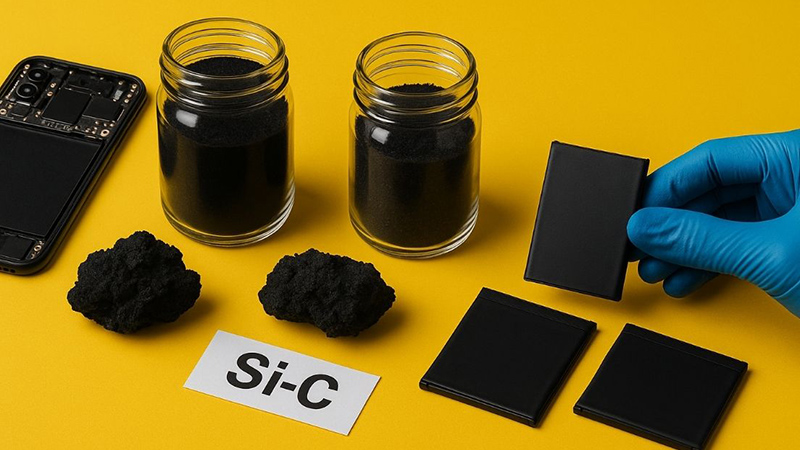
However, there are some downsides of using Si-C if compared to Li-on.
First of, pure silicon expands up to 300% when absorbing lithium. And this process can cause cracking, pulverization, and rapid capacity loss over cycles. The solution for this, us using carbon matrix (often nano-structured graphite or graphene) that acts as a buffer: it provides structural support, stabilizes the solid electrolyte interphase (SEI) layer, and limits expansion to 10-20%.
This makes silicon-carbon viable commercially, though with silicon content typically capped to balance gains and durability.
Then, it's the life cycle. While Si-C promises a higher cycle of life, early versions of Si-on shows faster degradation than pure graphite anodes in the first 2-3 years, though advancements (e.g., optimized composites) have minimized this.
After that, there is also issues about the cost and scaling, since manufacturing high-quality silicon-carbon materials remains complex and expensive. The good thing is that, production that is ramping up rapidly should help reduce cost.
Read: The '40-80 Rule' Battery Charging: Dealing With Lithium-Based Chemical Problems
It's worth noting that Si-C is not a replacement of Li-on.
It only acts as an evolutionary step toward future tech like solid-state or pure silicon anodes.
As of early 2026, silicon-carbon batteries mark the biggest smartphone battery leap in years, powering longer runtimes and sleeker designs.
They're not perfect, but they address the stagnation critiqued in battery tech: proving that meaningful progress is possible without abandoning lithium-ion foundations.
Further reading: Extending The Life Of Your Gadget's Battery, Prolonging Its Usage






















































































































































































































































































