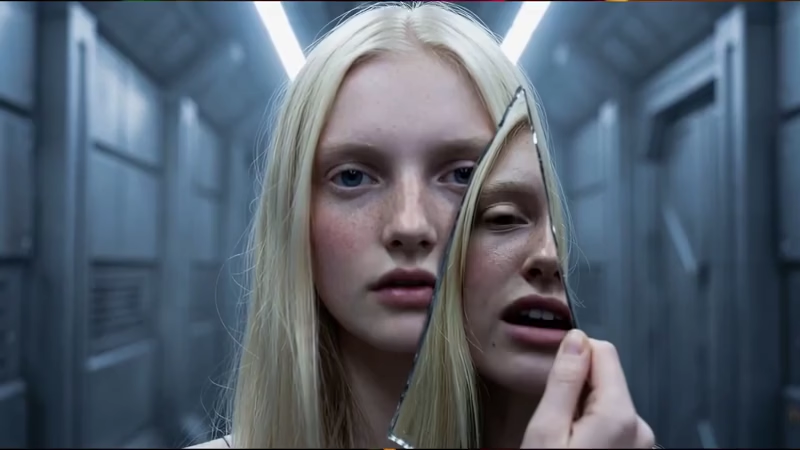
At this time around, AI-generated visuals often outshine reality: what began as text has spilled into other domains, reshaping how people imagine moving stories.
When ChatGPT burst into public awareness in late 2022 it didn’t just popularize large language models (LLMs); it kicked off an arms race in capabilities and ambition. Companies across the globe, from Silicon Valley giants to fast-moving Chinese platforms, raced to expand those models beyond text into richer, multimodal experiences.
And whoever is the winner at a given time, is the one that can make convincing, controllable, and audio-ready video the fastest.
Into that war steps Kling: Kuaishou’s family of video models that aim to turn anyone with an idea into a director.
Kling’s early releases were focused on making text-to-video workflows intuitive and fast, letting users type a scene and get a coherent short clip without stitching together tons of separate tools.
And Kling 'O1' builds on that foundation as the multimodal, “unified” engine: it accepts text, images, and short video references in a single input box and performs generation, editing, and understanding inside one system.
Kling Omni Launch Week Day 1: Introducing Kling O1 — Brand-New Creative Engine for Endless Possibilities!
Input anything. Understand everything. Generate any vision.
With true multimodal understanding, Kling O1 unifies your input across texts, images, and videos — making… pic.twitter.com/v7XZmvht6t— Kling AI (@Kling_ai) December 1, 2025
What this literally means, users can generate a clip, ask the same model to swap outfits or change camera angles, and keep subject identity and style consistent across shots.
This unified approach addresses the longstanding “consistency challenge” in AI video — reducing jitters, preserving characters and props across cuts, and enabling rapid iteration that feels interactive rather than batch-rendered.
Kling O1 can remove ANYTHING! Items, people, backgrounds? All removed within seconds. Video outpainting has never been easier! pic.twitter.com/6S4zCGGLkG
— Kling AI (@Kling_ai) December 2, 2025
Technically, O1 blends transformer-style sequence modeling with temporal latent representations so motion, lighting, and object relationships are modeled across time instead of frame-by-frame.
That gives much better stability and controllability: prompts can include camera directions, editing instructions, or multi-image references to anchor a character’s look, and the model can output edits that preserve the original motion while changing style or setting.
With Kling O1, you can wear ANYTHING you want! pic.twitter.com/mh9rJDyaSJ
— Kling AI (@Kling_ai) December 2, 2025
For creators, O1 became the ideal workhorse for concepting, fast prototyping, and video edits that used to require dozens of manual steps.
But O1 was only the foundation.
With Kling O1, you can be ANYWHERE you want! Whether it's a change in background, environment, or even a weather, simply have Kling O1 put you in your desired world seamlessly. pic.twitter.com/PwJgjW8iY7
— Kling AI (@Kling_ai) December 2, 2025
Kling 2.6 (or also called 'Video 2.6') stitches sound and picture into a single pass: instead of producing a silent clip and asking the creator to add voice, music, and SFX in another tool, 2.6 can output synchronized dialogue, lip-synced speech, ambient audio, and sound effects along with the visuals.
All that from the same prompt or reference input.
This successor of Kling 2.5 changes the workflow from "generating visuals to post-producing audio" into "describe a scene and get a finished, talking clip."
The result is enormous for solo creators and small teams: faster turnaround, fewer tool handoffs, and a much lower technical bar to produce polished, narrative clips.
The practical implications are wide.
For social platforms and e-commerce, creators can animate product shots with narration and ambient sound in one go; educators can turn lesson outlines into explainers with automatic voice and illustrative motion; marketers can A/B test short ads that differ in both visuals and voice without booking a studio. And because Kling supports multi-character dialogue and bilingual audio in its newer releases, the same prompt can produce a scene that looks cinematic while speaking in multiple languages or singing, all tightly synchronized to the lips and actions on screen.
Day 3: Meet VIDEO 2.6 — Kling AI's First Model with Native Audio
Generate an entire experience — more than a video clip! With coherent looking & sounding output, the 2.6 model opens up narrative possibilities, and makes you "See the Sound, Hear the Visual".
With the launch of… pic.twitter.com/H5WR7jL71S— Kling AI (@Kling_ai) December 3, 2025
All of this highlights a broader point: the video domain has moved from experimental to practical.
Where early AI video felt like a novelty, interesting frames but fragile continuity and no native sound, the newest generation is integrated, controllable, and production-oriented.
Kling O1 supplies the unified multimodal foundation for generation and editing; Kling 2.6 supplies the audio glue and cinematic polish that turns prototypes into finished pieces. For creators, that means imagination becomes the main limiter, not budget or technical skill.
As these tools become more powerful and easier to use, the real creative questions shift away from whether AI can produce convincing video and toward how humans direct, curate, and use that power responsibly: who gets credit, how do we avoid misuse, and what storytelling choices remain distinctly human?
For now, Kling's O1 that acts like the workhorse that unifies editing and generation, and the 2.6 that speaks as it shows, are legitimate signs that the gap between an idea and a finished, audio-ready video is vanishing fast.






















































































































































































































































































