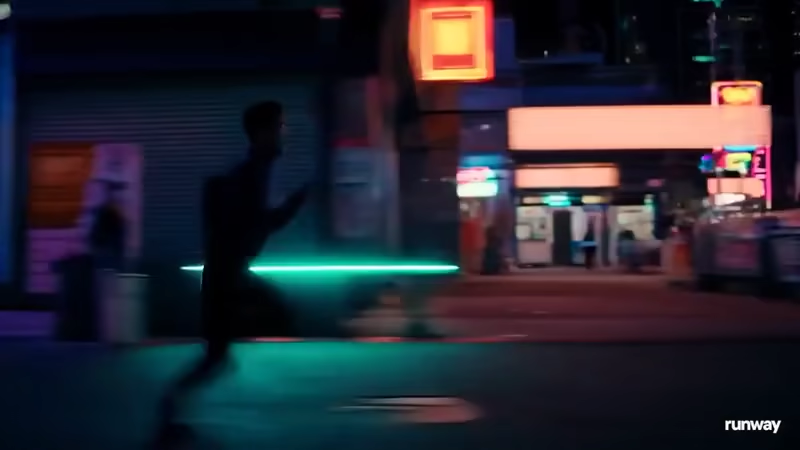
During the brutal months, the battleground has quietly shifted from text/image to video.
What began as the launch of ChatGPT by OpenAI, more than a handful of tech companies pour their energy towards developing better and more advanced large language models (LLMs). And in video generation, a small but nimble startup has just demonstrated that specialization: careful focus and deep technical craft that can beat the scale and hype.
While giants like Google and OpenAI still dominate headlines, Runway, a video-first startup has just delivered a striking blow.
Their newly released 'Gen-4.5' model doesn’t just inch ahead of competitors.
According to independent blind tests, it leads them decisively.
Gen-4.5 scored 1,247 Elo on the independent Artificial Analysis "Text-to-Video" leaderboard, outpacing long-touted models from larger players such as the formidable Google Veo 3 and the immensely viral OpenAI Sora 2.
Introducing our new frontier video model, Runway Gen-4.5. Previously known as Whisper Thunder (aka) David.
Gen-4.5 is state-of-the-art and sets a new standard for video generation motion quality, prompt adherence and visual fidelity.
Learn more below. pic.twitter.com/2J945S4bQt— Runway (@runwayml) December 1, 2025
What makes Gen-4.5 different is not just incremental improvement.
It refines the core ingredients of video synthesis: motion realism, physics-aware behavior, temporal coherence, and control flexibility.
According to Runway's announcement, this Gen-4.5 delivers "unprecedented physical accuracy and visual precision," where objects in motion behave with realistic weight, momentum, and force; liquids flow properly; surface details.
Even hair strands or fabric weave remain consistent across motion and time.
Runway said that Gen-4.5 was developed entirely on Nvidia's GPUs across initial R&D, pre-training, post-training and inference (Nvidia Hopper and Blackwell series GPUs).
"We collaborated extensively with NVIDIA to push the boundaries of what's possible in video diffusion model optimization, from training efficiency to inference speed," the company said.
In practice, that means video output that goes beyond dreamy, impressionistic clips.
Instead of floating disembodied shapes or "glitchy" animations, Gen-4.5 aims for the feel of real footage or convincingly rendered cinematic animation: physically plausible motion, believable collisions, natural fluid dynamics, and stable consistency.
Two years ago, we introduced Gen-1, the first publicly available video generation model. It enabled an entirely new form of creative expression and created a new product category.
Over the past two years, we've led the industry in making video models more powerful and… pic.twitter.com/eLJfFtvQUg— Runway (@runwayml) December 1, 2025
At the same time, Runway preserves creative flexibility.
Gen-4.5 supports multiple generation modes: text-to-video, image-to-video, and promises keyframe and video-to-video workflows as well.
That gives artists, filmmakers, content creators, and marketers a versatile toolkit: generate cinematic sequences from scratch, animate still images, or build from reference video, all using the same model.
Finally, and perhaps most importantly for real-world adoption, Gen-4.5 reportedly maintains the speed and efficiency of its predecessor.
That means high-fidelity results without impractical computational or temporal cost; ideal for rapid prototyping, iterative creative workflows, or early-stage production.
There’s a reason this launch is being described as a David-vs-Goliath moment.
Runway is a relatively modest-sized startup, and it isn't owned or operated by any of the big monolithic labs dominating headlines. Yet with Gen-4.5, they’ve proven that careful engineering and domain specialization can outperform broad-spectrum AI efforts. As one industry write-up puts it: "It proves that quality improvements don’t necessarily depend on enormous scale, but on focus."
For creators, like independent filmmakers, animators, content marketers, indie game developers, storytellers, the implications are huge.
Gen-4.5 potentially lowers the barrier to high-quality video: no need for expensive cameras, large crews, studio time, or significant post-production effort.
What once required a production pipeline might soon be feasible with just a text prompt (or an image), a subscription, and a bit of creativity. As local media in Jakarta noted: Gen-4.5 could "democratize cinematic video generation," making it accessible to both big organizations and small creators alike.
From an industry perspective, this signals a shift in how we think about "content creation."
Gen-4.5 achieves an unprecedented level of physical accuracy and visual precision. Objects move with realistic weight and momentum. Surfaces behave the way they would in the real world. Laws of physics can be both observed or ignored, depending on your vision.
Despite the big… pic.twitter.com/AsbLQ0ZSDH— Runway (@runwayml) December 1, 2025
AI-generated video is no longer a gimmick or proof-of-concept.
With tools as advanced as Gen-4.5, high-quality commercial content becomes increasingly feasible. From cinematography pre-viz and advertisement production to short films, concept art animation, and a wide range of other professional outputs.
Moreover, the success of Runway suggests the broader AI landscape may fragment: instead of a few giant labs trying to own every modality, the industry may soon see more specialized players, film-AI, music-AI, design-AI, with each pushing boundaries in their domain.
Despite the hype and the benchmark win, Gen-4.5 is not magic.
According to developers and early testers, there remain challenges with causal logic and object permanence: in some outputs, cause-and-effect can misalign, or objects may flicker, vanish, or reappear inconsistently across frames.
These issues are common in video generation AI, especially when models try to handle complex, dynamic scenes with multiple moving objects, fluid dynamics, and camera motion.
We are gradually rolling out access to Runway Gen-4.5. It will be available to everyone in the coming days.
Learn more: https://t.co/VMMZBF5mzz pic.twitter.com/yniAXdfj0e— Runway (@runwayml) December 1, 2025
For narrative or commercial work where continuity matters, such imperfections may constrain how much you can rely on the model without manual scrutiny or post-production corrections.
Additionally, it’s unclear how long Gen-4.5 can generate.
Many public statements suggest its sweet spot is in short clips (e.g., a few seconds to under 20 seconds). For longer form content, extended scenes, long takes, full-length videos, current limitations of video-AI (computational cost, memory constraints, temporal coherence) still apply.
Finally, while benchmark performance, especially in blind user tests, is a strong indicator, real-world success depends on prompt design, creative direction, and often manual touch-up.
AI video generation is unlikely (at least for now) to fully replace traditional production, but to augment and accelerate it.
Previously, Runway has released its own tools, like the Gen-3 Alpha, Act-One, Act-Two, Gen-4, and Aleph.






















































































































































































































































































