Billie Eilish has long been one of the most compelling figures in modern music, pairing hauntingly intimate lyrics with a sound that balances whispery vulnerability and bold experimentation.
Since emerging as a teenager, she has built a career defined not just by chart success, but by an unusually clear sense of authorship over her music, her image, and her boundaries.
Born in 2001 in Los Angeles, Billie rose to fame after releasing Ocean Eyes, a bedroom-produced track made with her brother Finneas that unexpectedly exploded online. What followed was a meteoric ascent: albums that openly grappled with mental health, identity, and fame; historic Grammy sweeps at an early age, including multiple Album of the Year wins; and even an Academy Award for her contribution to the Barbie soundtrack. All that before her mid-twenties.
Parallel to her musical evolution has been a carefully intentional approach to style. From the beginning, Billie rejected the industry’s default expectations of glamour and hyper-sexualization, instead embracing oversized, often androgynous silhouettes that prioritized comfort and autonomy. Over time, that visual language has evolved. Not into conformity, but into confidence.
And that evolution was on full display at the opening night of her Hit Me Hard and Soft world tour on September 29, 2024, at the Videotron Centre in Quebec City.
But to some in the audience, the moment became about more than what they paid for.
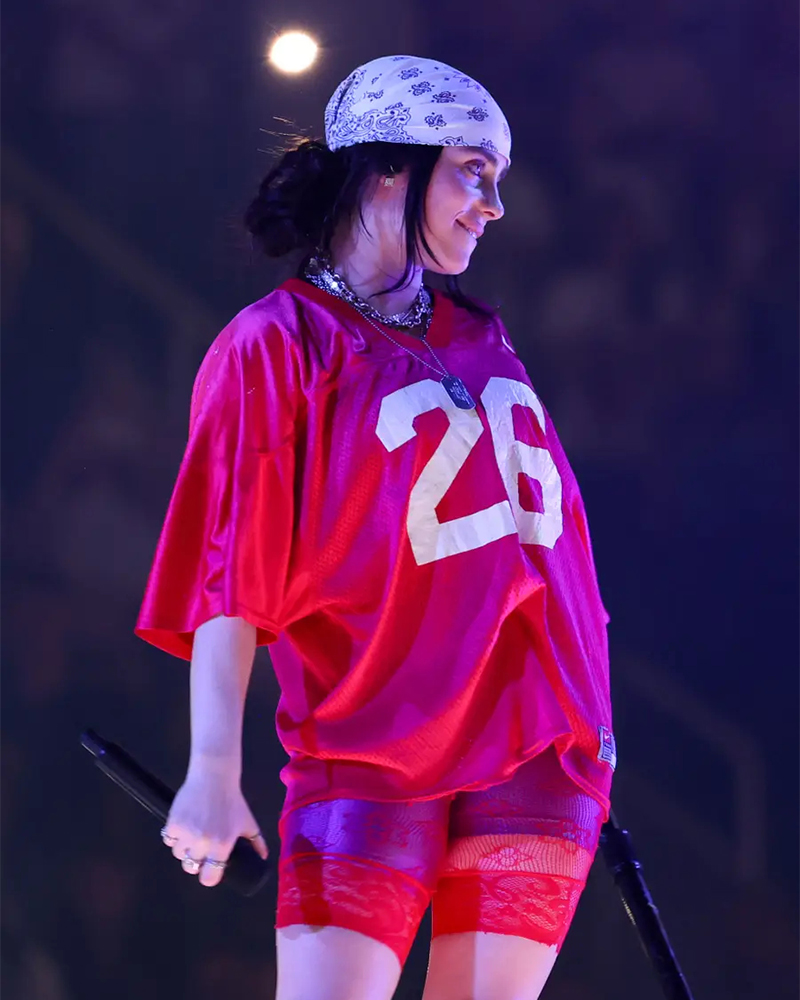
At the time, Billie stepped onstage in a striking, athletic-inspired outfit that immediately caught attention: an oversized red Nike football jersey emblazoned with a bold white "26," paired with sheer red lace shorts. Underneath, she layered blue bike shorts for coverage and practicality during a high-energy, sweat-drenched performance.
The rest of the look leaned fully into sporty edge with a nostalgic Y2K twist: black Nike knee pads, white socks, chunky olive-green sneakers, and a floral bandana tied around her head or neck, occasionally swapped for a black cap.
The contrast between the tough jersey and the delicate lace gave the outfit its tension, while stage lighting, often washing the arena in green and blue, cast dramatic shadows across the sheer fabric as she moved, played guitar, and commanded the crowd.
Almost immediately, images and clips from the show spread online.
Fashion outlets and fan accounts flooded Instagram, TikTok, and X, praising the look as a natural extension of Billie’s long-standing "anti-fashion fashion" ethos. Fans applauded how she made early-2000s lace and bike-short styling feel current again, noting how the outfit balanced boldness with comfort rather than catering to sex appeal. The jersey quickly became a recognizable motif of the tour’s early leg, inspiring recreations and unofficial merch.
But as is often the case with female performers, attention soon shifted away from the performance itself.
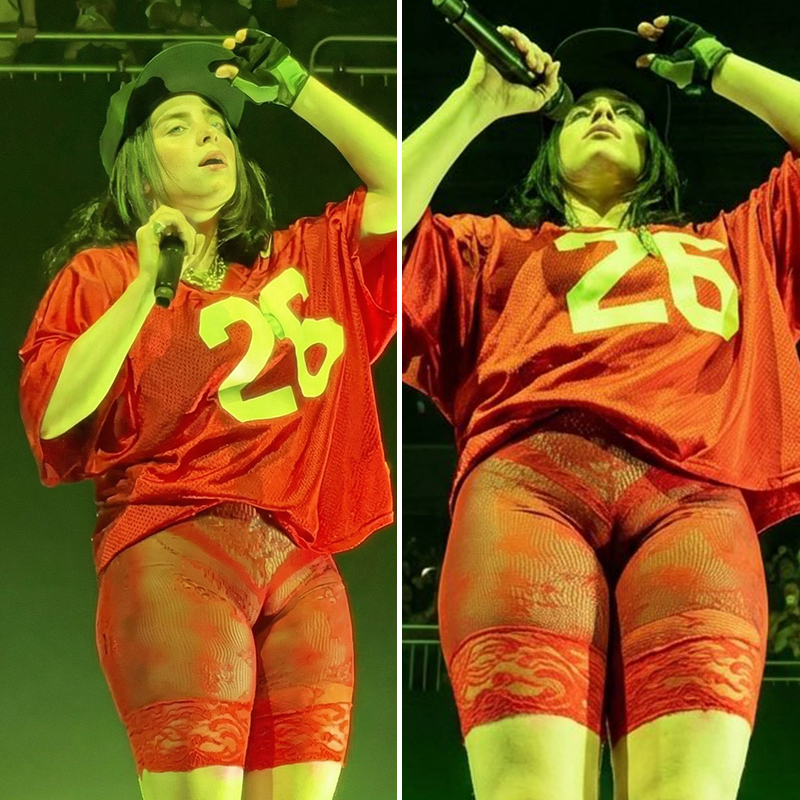
During the Quebec City show, the combination of bright stage lighting, constant movement, and layered athletic fabrics created moments where the clothing clung or shifted. In certain fan-captured angles, particularly close-ups and slowed clips, visible outlines became noticeable beneath the shorts.
While the blue layering was there for practicality and comfort, cropped zooms and low-quality edits circulating online exaggerated the appearance of her "cameltoe," turning it into a focal point separate from the performance itself.
What was, in practical terms, an ordinary consequence of athletic wear under intense lighting began to draw disproportionate focus.
At the time, the moment didn't dominate headlines. Instead, it lingered quietly across TikTok and X, circulating within smaller fan and meme communities. But by February 2026, long after the tour had wrapped and as a concert film was reportedly nearing release, those same clips resurfaced aggressively. Threads amassed millions of views, often featuring zoomed-in frames, slowed footage, or heavily edited images designed to exaggerate what was visible.
Some posts went further, digitally altering images to remove the clearly present blue bike shorts layer altogether, manufacturing a false sense of exposure for engagement.
Others paired the footage with crude captions or objectifying commentary, turning a fleeting visual artifact into click-driven spectacle.
The internet reaction split along familiar lines.
Supporters dismissed the fixation as absurd, pointing out that lighting, sweat, and motion routinely create such effects in performance wear. Many referenced Billie's long history of speaking out against body scrutiny, including her Not My Responsibility short film, and praised her for remaining unbothered, continuing to perform with confidence rather than adjusting herself to avoid speculation.
Others actively pushed back against misinformation, sharing unedited footage and stills that clearly showed the layered shorts, countering manipulated images designed for virality. Meanwhile, meme accounts and thirst pages leaned into sensationalism, reducing a full arena performance to a single zoomed detail, prompting backlash from those calling the discourse invasive and reductive.
Ultimately, the episode reignited broader conversations about how female artists' bodies are dissected online, often long after the moment itself has passed, and frequently stripped of context. That the clips resurfaced years later speaks less to the incident itself and more to the internet's appetite for recycling scrutiny under new algorithms.
Through it all, Billie Eilish remained largely silent. And in doing so, she managed to retain control of the narrative.
What lingered instead was a familiar reminder: even for an artist known for rejecting objectification, the body remains a battleground online, but not one she allows to define her.
Further reading: Billie Eilish And Internet Pornography That 'Is A Disgrace' That 'Destroyed My Brain'






















































































































































































































































































