The AI landscape has erupted into what many call the "LLM war," but the real battleground has shifted beyond text to video generation.
This is where companies race to create models that don’t just spit out clips but build coherent, cinematic worlds from mere prompts or images. Giants like OpenAI with Sora 2, Google with Veo 3, and others like the more recent ByteDance's Seedance 2.0 and Kuaishou's Kling 3.0 dominate headlines, Runway stands apart.
But not by chasing raw spectacle alone, but by prioritizing consistency and creative control, turning AI video from a novelty into a practical tool for storytellers.
Now Runway is stepping further in that effort with the launch of a feature it calls “Story Panels.”
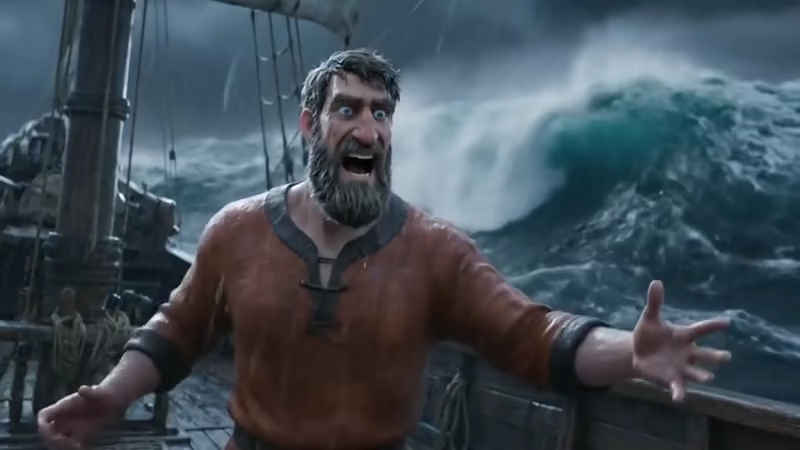
This workflow allows users to start with a single image and expand it into an entire film, ad, or content piece. By building a catalog of shots with persistent characters, locations, and styles in simple steps, creators can maintain narrative flow without constant manual fixes.
Go from a single image to an entire film, ad or piece of content using our new Story Panels Featured Workflow.
This Workflow allows you to build a catalogue of shots with consistent characters, locations and style all in a few simple steps.
Comment "Mammoth" for the in-depth… pic.twitter.com/gfuXjnzk19— Runway (@runwayml) February 12, 2026
Story Panels represents one of Runway's most practical innovations in the push toward coherent AI-driven storytelling. Emerging as a dedicated Featured Workflow within its platform, it transforms a single starting image into a structured narrative sequence.
The feature uses Runway’s Gen-4 model series (and its iterations like Gen-4.5), launched in early 2025.
The model excels at world consistency, capable of keeping the same face, clothing, lighting, and environment intact across perspectives, angles, and scenes. With it, creators can expand one reference photo (of a character, product, or scene) into a catalog of connected shots that maintain visual continuity across characters, environments, lighting, and overall style.
The process begins simply: upload or generate an initial image, then use the Story Panels interface to build a sequence of panels.
Typically starting with a basic three-panel stack for quick storytelling, the system leverages Gen-4's reference capabilities to regenerate elements from new angles or contexts without losing fidelity.
But wets Runway apart is its focus on professionals and narrative-driven work.
While competitors often deliver flashy one-off clips, Runway enables the building of sequences. It integrates image-to-video, upscaling, editing, and even real-world inspiration (snap a photo, describe the story, generate).
For instance, a single portrait can spawn variations where the subject appears in different locations, under varied lighting, or performing actions (all while preserving facial features, clothing, and aesthetic tone).
From there, users can apply Panel Upscaler to enhance resolution and detail on individual frames, followed by its Gen-4.5-powered image-to-video generation to animate those static panels into short clips.
Turn a single image into a full story with consistent characters and world design with Story Panels, Panel Upscaler and Gen-4.5 Image to Video. pic.twitter.com/hobUqMkMFo
— Runway (@runwayml) February 9, 2026
This creates a seamless pipeline: one image → expanded static story panels → upscaled assets → animated sequences ready for editing or refinement.
In other words, creators only need to build a catalog of shots in a few steps, while the underlying model handles much of the consistency automatically.
This approach democratizes high-end VFX and filmmaking, allowing indie creators or brands to prototype ideas rapidly without large production teams.
Despite these strengths, Story Panels inherits some limitations from Runway’s broader ecosystem.
Outputs can still suffer from subtle inconsistencies during extreme angle changes or dynamic motion, where fine details like hand positions or background elements drift.
Temporal consistency remains a challenge: flickering, random quirks, or objects vanishing and reappearing can plague generations, especially in complex motion.
Generated clips remain relatively short (often 5-10 seconds per panel animation) requiring manual stitching in external editors for longer narratives. Complex prompts may demand iteration to avoid artifacts or unintended stylistic shifts.
Introducing the Story Panels app. A simple way to turn a single character or product image into a three panel stack that tells a story.
Try it today. pic.twitter.com/MSjPuiLrIx— Runway (@runwayml) January 13, 2026
While the tool excels at controlled, reference-heavy work, it can feel less "magical" for purely text-driven wild ideas compared to more freeform competitors. Processing times and credit usage can also add friction for heavy experimentation.
Casual users may find the workflow interface requires a learning curve to master prompt precision and reference management effectively.
Regardless, in a field where models leapfrog each other monthly, Runway carves its niche by making AI feel less like a magic trick and more like an extension of the artist’s toolkit.
With Story Panels, Runway embodies the philosophy of making AI a collaborative partner in creation rather than a one-shot generator. By focusing on expandable, consistent building blocks from a single starting point, it lowers the barrier between imagination and producible content.