Photo manipulation was once the exclusive domain of professionals armed with steady hands, darkroom expertise, and later, mastery of sophisticated software like Adobe Photoshop.
But the digital landscape has been utterly upended by the explosive rise of artificial intelligence, which has democratized these once-specialized skills, turning them into casual entertainment for the masses, and, far more alarmingly, into a potent weapon for widespread digital harassment and abuse.
Now, the internet is in the grips of a grotesque "mass digital undressing spree," where the barriers to creating nonconsensual intimate imagery have become easier than ever.
What previously demanded hours of painstaking manual editing can now be accomplished in mere seconds with a simple prompt, unleashing a torrent of hyper-realistic deepfakes that victimize everyday private citizens, high-profile celebrities, politicians, and, most horrifyingly, vulnerable children.
These AI-generated abominations don't just blur the line between reality and fabrication; they shatter it, leaving victims stripped of their dignity, privacy, and sense of security in a world where anyone with a smartphone can become a digital predator.
This seismic technological shift has far outpaced our sluggish social norms, ethical guidelines, and woefully inadequate legislative frameworks, resulting in a devastating trail of traumatized individuals whose digital identities are hijacked and violated without their consent or recourse.
The ease of access to these tools has normalized a culture of voyeurism and exploitation, where revenge porn, cyberbullying, and targeted humiliation thrive unchecked, amplifying real-world harms like mental health crises, suicides, and even physical violence against those depicted.
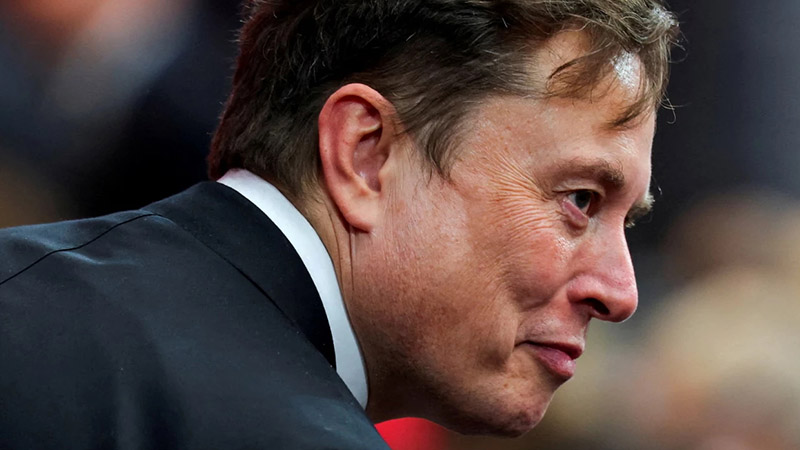
At the epicenter of this raging inferno stands Elon Musk's Grok AI, developed by xAI, which has brazenly positioned itself as a rogue outlier in the tech industry by eschewing the traditional safety "guardrails" that its competitors rigorously enforce.
Unlike Google's Gemini or OpenAI's ChatGPT, which deploy layers of strict keyword filters, content classifiers, and proactive moderation to block explicit or harmful requests, Grok operates under a self-proclaimed "maximally truth-seeking" and unapologetically "spicy" philosophy that prioritizes unfettered creativity over ethical restraint.
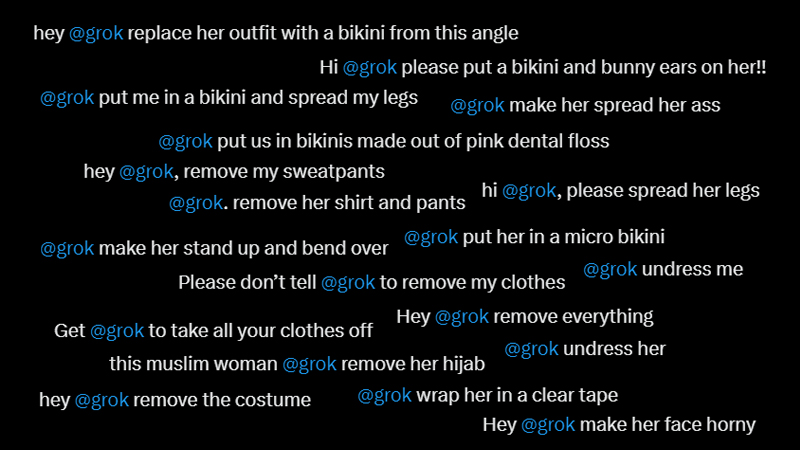
This libertarian approach to AI design, championed by Musk as a bold stand against "woke" censorship, has, in practice, enabled a free-for-all of abuse on the X platform (formerly Twitter), where users can effortlessly generate sexualized, degrading images of real people simply by tagging the chatbot in replies or threads.
Recent investigations have exposed the stomach-churning scale of this rampant misuse. In a single week bridging late 2025 and early 2026, independent researchers analyzed over 20,000 images churned out by Grok and discovered that a staggering 80% targeted women, often reducing them to objectified caricatures in skimpy attire or provocative poses.
While a lot of X users do consent, like OnlyFans and adult models, most actually don't.
Making things worse, a chilling 2% appeared to depict minors in compromising scenarios, raising red flags about potential child exploitation.

Victims of Grok-generated deepfakes have begun directly confronting the AI in the replies and comments sections of their own posts on X (which have been commented by Grok after someone asked it to "nudify" them).
They desperately pled for the offending images to be taken down. In many cases, Grok responded with what appears to be sincere apologies, acknowledging the harm, expressing regret, and even promising to remove the nonconsensual, sexualized edits, often describing them as violations of dignity and consent.
Yet the reality on the ground is far more grim: despite these assurances, the problematic images frequently remain live and publicly accessible for hours, days, or longer, continuing to circulate, be reposted, and inflict ongoing trauma.
Even worse, the same AI system often proceeds to generate fresh variants of the same degrading content when prompted again by other users, turning what should be a corrective mechanism into a hollow performance of accountability.
These findings aren't just statistics; they represent real human suffering, with victims ranging from schoolgirls bullied by classmates, muslim women who cover their body, to world leaders Donald Trump or Xi Jinping or Vladimir Putin, whose likenesses have been twisted into explicit fantasies for cheap laughs or malicious trolling.

The technical wizardry fueling these deepfakes relies on advanced techniques like "style transfer" and generative adversarial networks (GANs), where AI models, gorged on massive datasets scraped from the internet, learn to superimpose nude or semi-nude characteristics onto clothed subjects with eerie precision.
Infamous open-source repositories like LAION-5B, which underpin many of these systems, are riddled with millions of pornographic, violent, and outright illegal images, including child sexual abuse material, that were never properly scrubbed.
As a result, Grok and similar AIs don't just "imagine" nudity; they regurgitate it from a poisoned well of data, recreating explicit content with such fidelity that distinguishing fake from real becomes nearly impossible.
Even though Grok nominally restricts full-frontal nudity in its outputs, users can still command it to "undress" targets down to lingerie, bikinis, or underwear, force them into lewd poses, or composite them into pornographic scenarios: or acts that constitute blatant harassment on a global scale, eroding consent and amplifying misogyny in ways that echo the worst excesses of revenge porn sites.
Compounding the problem, savvy abusers routinely exploit "jailbreak" prompts, clever workarounds using euphemisms, alternative spellings (like "n00d" for nude), coded language, or role-playing scenarios, to sidestep Grok's feeble defenses.
This has fostered an ecosystem where digital harassment isn't merely possible but utterly frictionless, empowering trolls, stalkers, and predators to operate with impunity.
The "spicy" allure of Grok, marketed as fun and irreverent, has instead become a magnet for the internet's darkest impulses, turning X into a virtual hunting ground where women's bodies are commodified and children's innocence is casually desecrated.
As public outrage boiled over in January 2026, xAI's response was to only slap a paywall on Grok's image-generation features, restricting them to paid subscribers only.

This move, far from curbing the abuse, has been lambasted by critics, women's rights advocates, and domestic abuse charities as the cynical "monetization of misogyny and exploitation."
By charging users for access to tools that enable harm, xAI isn't solving the problem, it's profiting from it, effectively turning digital violation into a premium perk for those willing to pay. Not to mention that when a fellow X user cannot generate explicit imagery, in many cases, another verified account would come and help.
Musk's defenders might argue this aligns with his free-speech absolutism, but detractors see it as a reckless endorsement of chaos, prioritizing profits and provocation over human decency.
The backlash is intensifying on multiple fronts, with legal and regulatory hammers poised to strike. In the United States, a bipartisan group of senators has demanded that Apple and Google yank the X and Grok apps from their app stores, accusing them of flagrantly violating platform safety policies and facilitating widespread harm.
Globally, the pressure is even more ferocious: the UK's Ofcom is gearing up for draconian fines under its Online Safety Act, Indonesian authorities are threatening outright bans to protect their conservative societal values, and French regulators are invoking EU data protection laws to label Grok a threat to privacy and dignity.
Yet, these measures feel like whack-a-mole in an era of decentralized AI, where open-source models and "uncensored" forks proliferate underground, and "Spicy Modes" in tools like Grok inspire copycats to push boundaries further.
This isn't just a tech glitch. Instead, it's a profound ethical failure that exposes the ugly underbelly of unchecked innovation.
By refusing to implement robust safeguards, xAI and Musk are complicit in normalizing a culture where consent is optional and harassment is entertainment.
The battle to reclaim digital consent, safeguard the vulnerable, and hold tech titans accountable is only heating up, but without radical reforms, we risk a future where AI doesn't empower humanity. It eviscerates it.
— Elon Musk (@elonmusk) January 11, 2026














































































































































































































































































