
The relationship between Israel and Palestinian's Hamas is always complex and volatile, and in October 2023, things get a lot worse.
The Hamas' surprise attack on Israel angered Israeli's Prime Minister so much, that he refuses to cease fire.
Benjamin Netanyahu stated that Israel would continue attacking Gaza, even when civilians and children are dead from the attacks.
Until all hostages taken by Hamas are released, Netanyahu is determined.
While war can benefit some people, it translates to hell on Earth to others. But regardless of which side these people are on, information is crucial.
And during conflicts, one of the few that has proven itself useful in terms of spreading information, is Telegram.
Since the start of the war on October 7, the official channels of the Qassam Brigades and Hamas added nearly half a million and 100,000 subscribers, respectively.
Gaza Now, which is described as "Hamas-aligned" by the Atlantic Council, managed to increase its subscribers count from 343,000 to about 1.9 million in that same time frame.
Since both Apple and Google have store policies, which require apps that feature user-generated content to moderate "egregious content, including content that promotes terrorist acts, incites violence, or celebrates terrorist attacks," Telegram has no other way but to comply, or not risk its app being banned from the stores.
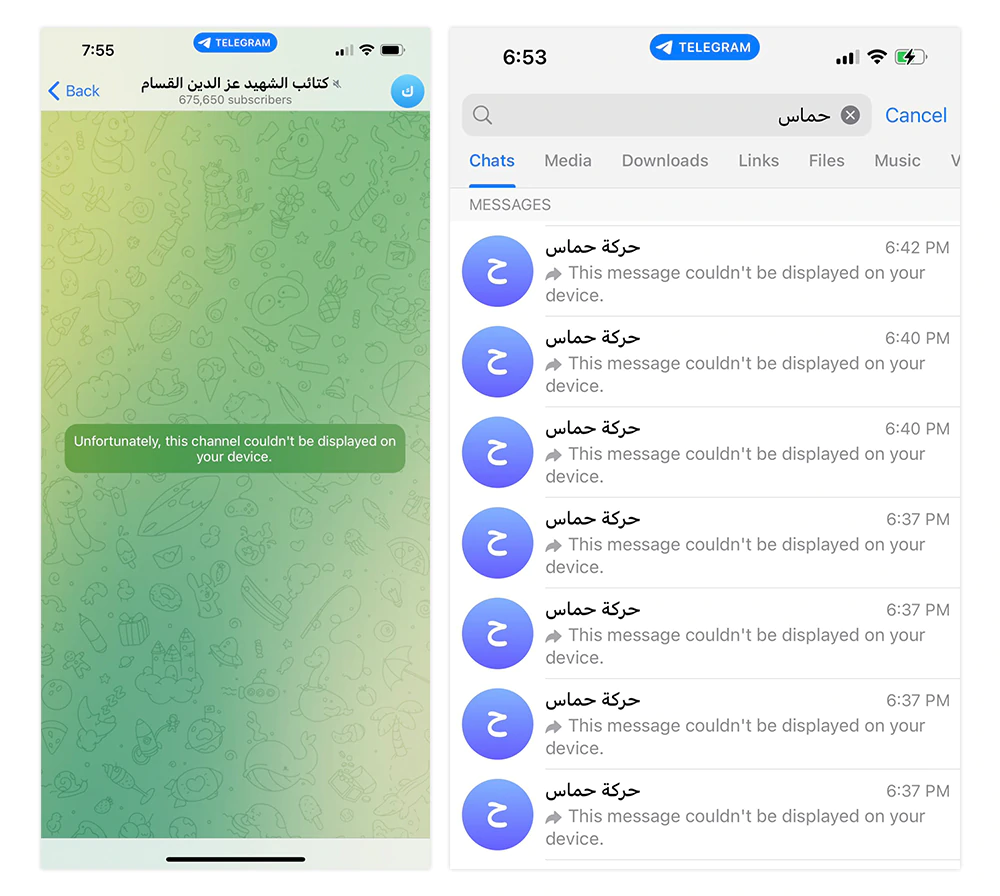
As a result of this, and unlike before this, Telegram has quietly restricted access to several channels affiliated with the Palestinian armed group Hamas.
A Telegram spokesman said it had closed “several dozen channels that contained direct calls to violence,” adding that such videos “violate Apple and Google guidelines”.
But what's worth noting here is that, the accounts are no longer accessible from Telegram app that is downloaded from Apple's App Store or Google Play Store.
The accounts are still accessible from the online version of Telegram, and also from the version of the app downloaded directly from Telegram’s website.
Telegram has not publicly commented on this.

Telegram app is known for gaining popularity during wars and conflicts.
Before Hamas’s terror attack, for example, Telegram had already served as a source of information, including videos of the most brutal combat from Russia’s invasion of Ukraine.
It also helped Russia's Wagner Group deliver its plea for ammo.
Telegram's popularity can be attributed to several key factors. The most notable, is due to its high-level of security and encryption, which makes it a preferred platform for individuals and groups seeking to communicate securely and privately, especially in situations where privacy and confidentiality are of utmost importance, such as during war and conflicts.
Then, the app also provides a number of other features, including the ability to create large group chats, which makes it particularly useful for organizing and coordinating and sharing activities among various parties.
Moreover, its cloud-based nature allows for the storage and retrieval of large amounts of data, enabling users to share and disseminate crucial information quickly and efficiently.
And because it's less restricted, and also because of the app's ability to function even in areas with limited internet connectivity, Telegram has proven itself a useful during times of war and conflict.
During the Israel-Palestinian's Hamas war, the Hamas in particular, have been sharing how they press forward in the battlefield, shooting their way through a checkpoint, killing Israeli's soldiers and bombing tanks along the way.
Through body cameras and drone footage, Hamas recorded their assault for the world to see.
And as counterattacks to Israel's mass media coverage, Hamas, which receives much less coverage from international news, has increasingly used its social media channels to highlight videos of civilian casualties from Israeli strikes.
To them, Telegram is their gateway to the world.
Information about Hamas is shared first-hand to Telegram, before spreading elsewhere.
Because of this, a lot of people began to consider Hamas as using Telegram for propaganda, using the popular messaging app as their weapon in the war.
Telegram CEO Pavel Durov has defended the platform’s loose moderation policies, saying that it has provided valuable information about the Israel-Hamas war, and that its presence is less likely to spread harmful content than competitors as users must opt in to channels.
Initially, Durov defended his decision to not block Hamas channels, even claiming it could help protect civilians.
"Hamas used Telegram to warn civilians in Ashkelon to leave the area ahead of their missile strikes," Durov said on October 13. "Would shutting down their channel help save lives – or would it endanger more lives?"
"As such, it’s unlikely that Telegram channels can be used to significantly amplify propaganda," Durov said, adding that its moderators have removed millions of pieces of harmful content every day.
"Instead, they serve as a unique source of first-hand information for researchers, journalists and fact-checkers. While it would be easy for us to destroy this source of information, doing so risks exacerbating an already dire situation."
He also claimed Telegram did not "algorithmically promote shocking content" on its app.
Telegram users will only receive messages from channels after they specifically follow the channels.
Durov claimed that the approach makes Telegram a "unique source of first-hand information."
Hamas, which governs the Gaza Strip, is considered a terrorist organization by the United States, the European Union, the United Kingdom, and a number of other countries.
Durov, sometimes known as “Russia’s Mark Zuckerberg”, launched Telegram in 2013 with an emphasis on privacy and resisting censorship.
Durov left Russia in 2014 after Moscow cracked down on his previous internet company, VKontakte.
Read: The End Of "VKontakte Era"
And this crackdown, which hampers the speed at which Hamas videos spread, the group is now looking for alternatives.
And also because channels that are restricted on Telegram’s iPhone and Android apps are still accessible on its web-only version and sharing dozens of posts about the war each day, people are creating copycat channels to forward the messages, in order to continue spreading Hamas posts on smartphones.