Ever since prehistoric times, humanity has built tools to solve problems. From creating crude weapons to hunt, to then discover how to make fire.
Fast forward, after the invention of electricity, the world started to glow brighter, with many things that weren't previously possible, made possible.
Among the many things humanity has created thanks to electricity, is computers, and internet.
As mechanics engineering also advanced, computers not only reside on top of desks, as they can also run on wheels.
Tesla, Inc. is an American multinational company headquartered in Texas. While Tesla designs and manufactures products for clean energy, which include batteries, what it's best known for, is creating automotive products. In fact, Tesla is regarded as one of the world's most valuable automaker, in terms of market capitalization.
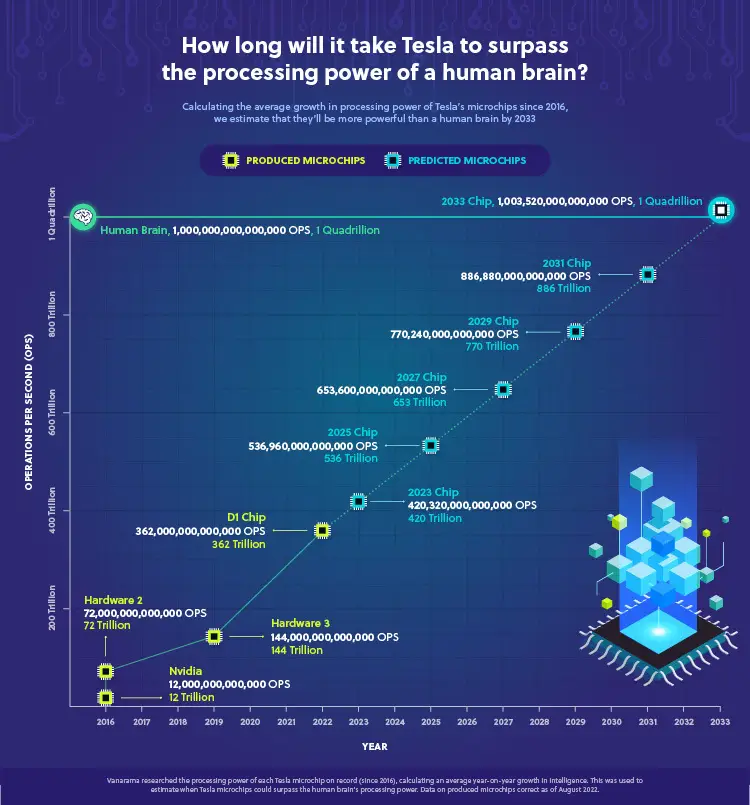
And it's predicted that the company's computer could be smarter than humans by 2033.
One of the very computers was able to solve a few thousand problems per second.
According to Moore's law, which observes that the number of transistors in a dense integrated circuit doubles about every two years, computing power has significantly multiplied since the start of the 21st century. From 100 million transistors in the early 2000s, the number has grown to more than 50 billion transistors in 2020.
And according to a study by car and van leasing company, Vanarama, the microchips inside Tesla vehicles, could soon be "more intelligent" than humans.
To come into its conclusion, the company said that the electric cars' microchips are already having 36% of the capacity of a human brain.
This translates to around 362 trillion operations per second.
The previous chip, known as Hardware 3, performed 144 trillion operations per second in 2019. Prior to that, the Hardware 2 could handle 72 trillion operations.
In comparison, according to previous studies, a human brain triples its size during the person's first year, before reaching full maturity by the age of 25. And by that time, the brain contains about 100 billion neurons.
The brain's enormous computing power stems from its connections. Research suggested that a matured human brain has roughly 1 quadrillion connections.
The thing is, Vanama that analyzed Tesla microchips to find their capabilities, realize that the company is increasing its microchips' capability by a rate of 486% per year.
Doing the calculations, it may take the company just over a decade before its computers become smarter than humans.
The microchip in question, is based on what Tesla has introduced in 2021.
At that time, Tesla announced the D1 chip, which is part of its Dojo supercomputer, ExaPOD. This microchip is manufactured in 7nm process, has a total of 50,000 million transistors, and only uses an area of 645 mm square.
The microchip is purposefully designed to run AI that is capable of delivering a power of 362 TFLOPs in BF16 / CFP8.
The Tesla D1 has a total of 354 training nodes that form a network of functional units, which are interconnected to create a massive chip. Each Tesla D1 comes with a quad-core processing unit that uses a 64-bit ISA CPU, specifically designed for transpositions, compilations, broadcasts, and link traversal.
It also comes with a 1.25 MB SRAM and 512 GB/sec bandwidth.
The CPUs are joined in a multichip configuration of 25 D1 units, which Tesla calls "Dojo Interface Processors" (DIPs).
According to Tesla at the time, the Dojo chip is enabling the company to bring its self-driving system to full autonomy.
The same technology is also meant to power Tesla Bot, a humanoid device that is designed to perform mundane tasks like grocery shopping or assembly-line work.
Looking back to humanity's history, humans are known to copy what they see in their surroundings.
For example, airplane's wings were initially designed to mimic birds' wings. Back then, watching birds glide inspired inventors to build gliders with stationary wings that have a curved shape to create lift; Velcro was inspired by burdock burrs that the investor saw clinging to his clothes and his dog; grippers for International Space Station repairs were inspired by geckos.
And among many many others, the more recent would be the painless syringe researchers created after taking inspiration from mosquitos.
And this advancement of computation and AI on wheels have been predicted, and have been long anticipated.
After all, not only that the hardware being used by computers have become significantly smaller, in which it allows to put even more transistors in a smaller amount of space, but because researchers have been developing AIs to work the way brain synapses do.

Humans are able to understand their surroundings by relying on their senses. And based on that, the brain can make decisions. Humans essentially act based on what their senses sense.
Similarly, in order for an AI to be able to mimic human intelligence, they need sensors that act as their senses.
And in order for an AI to mimic human intelligence, it too needs to have a brain that works similarly to humans.
"It wouldn’t be crazy to believe that tech will become significantly smarter than humans in our lifetime," concluded Vanarama. "Microchips are currently capable of working the way brain synapses do, with researchers developing chips that are inspired by the way the brain operates."
It's worth noting that as of June 2022, the most powerful supercomputer is the Hewlett Packard Enterprise Frontier.
Or also called the OLCF-5, it's the world's first exascale supercomputer using AMD CPUs and GPUs. Frontier achieved an Rmax of 1.102 exaFLOPS, which is an equivalent of 1.102 quintillion operations per second.
The supercomputer is hosted at the Oak Ridge Leadership Computing Facility (OLCF) in Tennessee, United States.






















































































































































































































































































