TikTok, the wildly popular short-form video platform, has become a cultural force unlike anything before it.
Built on quick clips, powerful discovery algorithms, and a constant stream of personalized content, the app has evolved from a place for dance trends and memes into a central hub for entertainment, discussion, and more. But who would have known that TikTok has also become the "trusted" source for news?
At least for younger people, a lot of them are using TikTok to get information about things around them, including politics.
TikTok's appeal is based on how it seamlessly blends information and personality. Despite its short-form video format, users don't just watch content. Instead, they connect with the people sharing it.
This unique mix has made TikTok especially popular among young users, who increasingly trust creators and influencers to break down current events in a way that feels real, accessible, and human.
And in 2025, that influence has officially tipped into mainstream news consumption.
According to new survey data from the Pew Research Center, TikTok is now the number one social media platform for news among Americans aged 18 to 29.
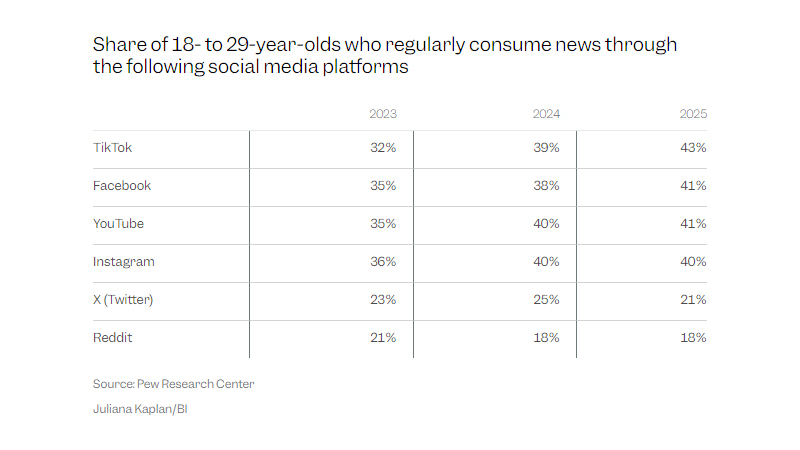
A striking 43% of young adults say they regularly get news from TikTok. What this means, the number surpasses platforms like YouTube and Facebook, which sit at 41%, and Instagram at 40%. X (formerly Twitter) and Reddit lag much farther behind, at 21% and 18%.
This marks a rapid shift over the past few years; in 2023, just 32% of young adults reported using TikTok for news.
The growth reflects more than just new habits: it reveals a transformation in where and how younger generations prefer to understand the world around them.
Part of TikTok’s rise comes from the changing nature of news itself.
Watching news on the app doesn't necessarily mean tuning into traditional outlets and big publishers. Instead, young viewers increasingly rely on independent creators, commentary channels, and on-the-ground videos captured by regular people at protests, demonstrations, or even in active conflict zones.
News influencers have built large followings by reporting in formats that feel conversational and authentic, rather than scripted or corporate.
Even major outlets have adapted, with organizations like NPR’s Planet Money centering content around individual creators to build trust through personality rather than brand alone.
This shift goes hand in hand with a broader change in trust.
Pew's survey found that half of young adults say they have at least some trust in news shared on social media, which is roughly the same level they have in national news organizations.
And social media now beats every other medium as a news source for this age group.
76% of them say they often or sometimes get news from social platforms, compared to 60% from traditional news websites and only 28% from email newsletters. Politicians and government agencies have noticed this shift too. In 2025, creators and podcasters have played a larger role in political communication, attending major party conventions and even applying for access to White House press briefings.
TikTok itself is leaning into this identity.
The platform has rolled out tools specifically for news consumption, including the ability for publishers to link full articles in videos and a fact-checking feature called Footnotes, similar to community-notes systems on other platforms. It also partners with independent fact-checking organizations in more than 130 markets to help verify claims and address misinformation.
These updates suggest TikTok isn't just passively becoming a news destination. It's is also actively positioning itself as one.
In just a few years, TikTok has reshaped the media landscape.
For young Americans, the news is no longer just something watched on TV or read on a website; it’s something discovered in a feed, discussed in comments, and delivered by people who feel more like friends than anchors. Whether this shift is ultimately good or bad for the future of information is still being debated.
But one thing is clear: TikTok has changed the way a generation consumes the news, and there's no going back.






















































































































































































































































































