
In the fast-evolving landscape of AI, where billions of dollars are poured into research and development every year, disagreements among the industry's most powerful figures are inevitable.
From scientists and researchers to founders and engineers, opinions about AI vary widely. Some expect a utopia, others fear a dystopia. Yet few exchanges have captured attention quite like the sharp critique from Nvidia CEO Jensen Huang, directed at fellow leaders issuing stark warnings about AI's impact on jobs.
Huang, whose company has become synonymous with the explosive growth of AI hardware powering many of today's AI tools, has pushed back forcefully against what he sees as overly dramatic and potentially harmful predictions of widespread job loss.
At the center of the debate are comments from Anthropic CEO Dario Amodei, who has suggested that artificial intelligence could eliminate around 50% of entry-level white-collar jobs in the coming years.
Huang delivered his response during an interview with the Special Competitive Studies Project, framing such narratives as not only inaccurate but actively damaging to the broader technology ecosystem.
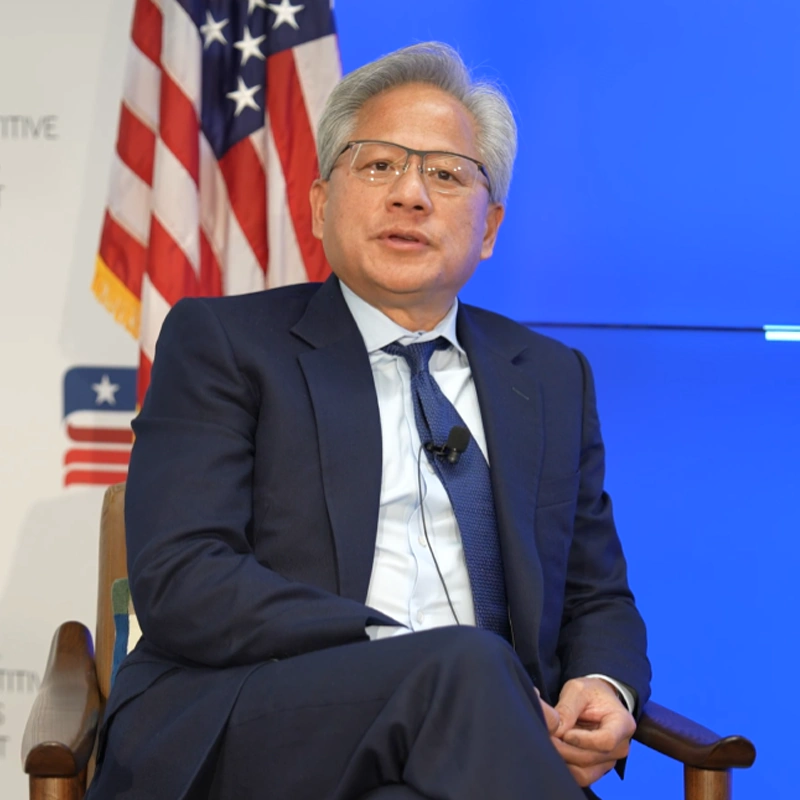
This is not just a casual disagreement between executives.
Huang argues that claims like these risk deterring bright young talent from entering technical fields at exactly the moment when the world needs more engineers, coders, and innovators.
He emphasizes that predictions of massive job loss often come from a place of inflated certainty rather than grounded analysis. In contrast, he points out that AI has already contributed to the creation of hundreds of thousands of new jobs, driving growth in areas such as chip design, healthcare, manufacturing, and scientific research.
Central to Huang's argument is his observation about the mindset that can develop at the top of successful companies.
Leaders of major AI firms operate with immense capital and influence. Reaching that level can foster a kind of "god complex," where confidence in one's own foresight turns into sweeping claims about the future.
There is some irony in this critique, given that Huang himself leads a company whose valuation has surged into the trillions during the AI boom. Still, he uses that position to call for greater humility and nuance in how the future of AI is discussed.
Huang's optimism about AI’s economic impact draws on established economic principles such as Jevons paradox, the idea that increased efficiency can lead to higher overall consumption rather than less.
Just as more efficient steam engines during the Industrial Revolution led to greater coal consumption, Huang argues that AI will make professional services cheaper, faster, and more accessible, ultimately increasing demand. Lawyers, accountants, consultants, and software developers are unlikely to disappear. Instead, their capabilities may expand, unlocking new markets and projects that were previously too expensive or time-consuming.
He has also pointed to the massive unmet needs across industries, including what he describes as the need for "a trillion lines of code" to tackle challenges in drug discovery, climate modeling, and personalized education.
As productivity increases, companies tend to grow, invest, and hire, creating a cycle of expansion rather than simple job displacement.
"The facts are this: the facts are AI has created more than half a million jobs in the last couple years. The facts are AI is our greatest best opportunity to re-industrialize United States to bring manufacturing jobs back to United States. The facts are that's going to generates hundreds of thousands of jobs, trillions of dollars of new economy back into United States. The fact of the matter is companies that use AI have demonstrated the ability to grow faster. When they grow faster, they hire more people. Apparently, AI creates jobs."
" [...] And so if you just said this to yourself: suppose we infused AI into this country and as a result of that we are doing things faster than ever before. Our ambition is greater than ever before. Our expectations are greater than ever before. How is that a bad condition for our country?"
" [...] We are so, if you will, cinematic. So incredibly science fiction in the way we describe AI that we're causing so much consternation and so much fear around the United States. Meanwhile, the rest of Asia are embracing adopting AI with great enthusiasm. And so this is something we have to be very quite concerned about. This is how we get generally left behind."

This clash highlights a deeper divide within the AI community.
On one side are optimists like Huang, who see AI primarily as a productivity tool that can elevate human potential and drive economic growth. On the other are more cautious voices, including leaders at companies like Anthropic, who stress the need to prepare for disruption, manage risks, and build safeguards.
Amodei and others argue that ignoring potential downsides would be irresponsible given the pace of AI development. Huang does not dismiss these concerns entirely, but he maintains that exaggerated claims can become counterproductive when they discourage people from building the skills needed for the future.
Beyond the question of jobs, Huang's comments also reflect the broader responsibility of leading influential technology companies.
In a world where a single executive's words can shape markets and policy, narratives matter. Pessimistic forecasts may attract attention, but they can also create unnecessary fear, slow hiring, and encourage regulation that may hinder innovation.
Huang warns that if too many graduates are discouraged from entering fields like software engineering, the global economy could face real talent shortages in the future.
In the end, whether one leans toward caution or optimism, the shared challenge remains the same: how to harness AI responsibly while expanding opportunity and prosperity.