
Not many men have endured what Pavel Durov has. As a figure whose career has been marked by challenges that few people ever experience, he has faced political pressure, legal scrutiny, public controversy, and the immense responsibility of leading one of the world's largest messaging platforms.
Whether viewed as a champion of digital privacy or a controversial technology executive, his journey has unfolded under an extraordinary level of attention and criticism.
From founding VKontakte, giving his middle finger as his "official response" when a company wanted greater control of his company, to then founding, and also leading Telegram, Durov has decades of experience witnessing firsthand which methods governments use to suppress people's freedoms and to take away their basic rights.
"I've became an expert at this."
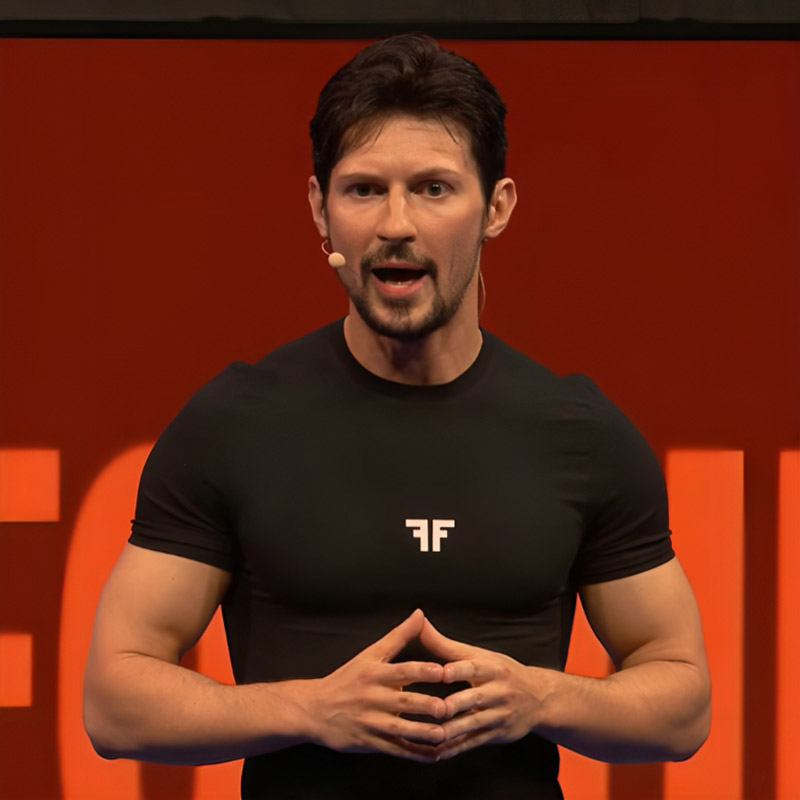
At the 2026 Oslo Freedom Forum, Durov discusses protecting free speech, Telegram’s origins, government suppression, and the “ship of Western freedoms” metaphor. And according to him, what the world is seeing now, is equivalent to the Titanic.
"People thought the Titanic was unsinkable. Lifeboats left half empty. Only in the last half an hour, people started to panic. But by that time, it was already too late."
"Not enough lifeboats, nowhere to hide, nowhere to run."
"Now, I came here today to tell you that we find ourselves in a similar predicament, in a similar situation."
"Our ship has already hit the iceberg. We have already started to sink without even realizing it. And I'm talking about the ship of our personal freedoms. Personal freedoms are being eroded everywhere in the world almost without exception."
Drawing from his years of experience running massive social media platforms, Durov argues that the manipulative tricks once reserved for authoritarian regimes are now being actively employed by Western governments to suppress public discourse and take away basic rights.
The tactics often begin with the selective enforcement of laws and the introduction of contradictory regulations that make full compliance impossible for any tech company.
This creates a system where the government can choose whom to prosecute based on political loyalty. Durov points to the recent claims by Elon Musk, who stated the European Commission offered a secret deal to drop fines in exchange for censoring specific political narratives.
In his own experience, Durov recalls being offered a similar deal by French intelligence to silence political voices while under investigation in 2024. He suggests that when governments claim they are just enforcing the law, they are often using it as a tool to capture platforms with significant influence over public discourse.
One of the most effective tools for this expansion of power is the use of noble pretexts to bypass critical thinking.
Durov explains that once somebody says child protection, it triggers very ancient, very deep parts of our brain. This emotional shield is used to justify measures like the UK Online Safety Act or the European Commission's push for mandatory ID verification to access the internet.
Because everybody is scared for the future of their offspring, the call to protect children completely bypasses logic, debate, and rationality.
However, these measures frequently fail in practice. When Russia banned Telegram to enforce surveillance, ninety five percent of teenagers simply bypassed the block using VPNs.
This shift actually put those children in greater danger by granting them easy access to unregulated and illegal content that was previously blocked on the main platform.
The drive for mass surveillance is often framed as a necessity for safety, yet this trade is historically a deceptive one.
Durov invokes the words of Benjamin Franklin, stating that those who are willing to give up their essential liberty for some temporary safety deserve neither liberty nor safety. Surveillance does not stop determined criminals who can simply build their own encrypted tools or use AI to hide their tracks. Instead, it strips privacy from law abiding citizens and creates massive databases that are prone to corruption.
In France, a tax official was recently caught selling the personal data of citizens to criminals, leading to a surge in kidnappings and torture. The government demanded too much data and then failed to protect it, proving that the loss of privacy frequently results in less safety, not more.

The future of this trend is particularly dark because of the rise of computers everywhere, and also AI.
"After all, there was a human limit to surveillance. There were only so many KGB officers, only so many hours in the workday, only so many letters they could open."
"Now, we don't have this luxury."
In the world where computers run in pretty much everybody's hands and homes, humming in data centers, and as AI becomes increasingly used, every single message can be monitored. Every thought will be scored, and every relationship will be mapped.
During his recent detention in Paris, a translator who had fled the USSR decades ago told Durov that she felt like the Soviet Union was catching up with her.
There is no second West or backup civilization to flee to if the current trajectory continues. If the ship of Western freedom sinks, the rest of the world will follow, meaning we must act immediately to fix the ship before it is too late.