
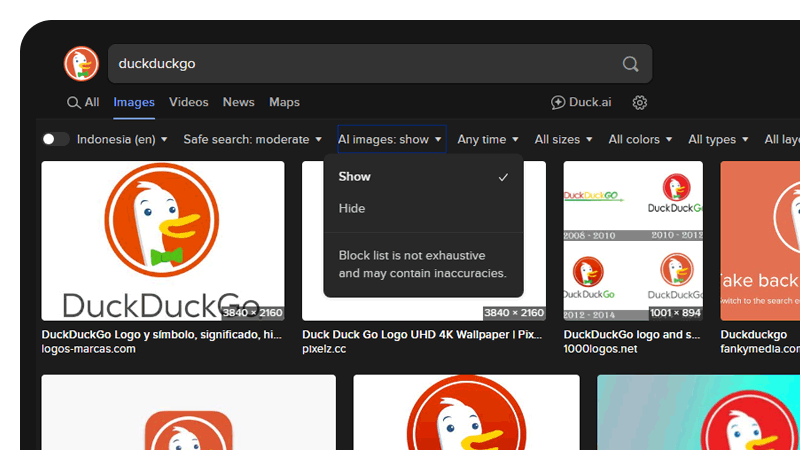
How much is too much? Some love AI images, some others hate them. DuckDuckGo wants to cater to the latter.
DuckDuckGo has introduced a new feature that lets users filter out AI-generated images from their search results. This feature responds directly to user frustration over seeing synthetic content—often misleading or low-quality—mixed in with authentic photographs.
It appears as a simple dropdown labeled “AI images” within the Images tab, where users can choose to either show or hide AI-generated visuals.
An equivalent setting can also be activated permanently via search preferences or by visiting a special URL, noai.duckduckgo.com, which enables the filter alongside disabling AI summaries and chat icons.
The filter works by comparing image results against community-maintained open-source blocklists, such as the "nuclear" list from uBlockOrigin and the Huge AI Blocklist from uBlacklist. DuckDuckGo makes clear that while the system is not perfect and may not catch every synthetic image, it significantly reduces the presence of AI-generated content in search results.
To that end, we’ve added a new setting to hide AI-generated images in your results when you’re searching for images on DuckDuckGo.
Try it by making a search on DuckDuckGo and heading to the Images tab. You’ll see a new drop-down option: AI images: show or AI images: hide. (2/4)— DuckDuckGo (@DuckDuckGo) July 14, 2025
The company has emphasized its guiding philosophy: AI features should be private, useful, and optional, and it's up to users to determine how much AI they want in their browsing experience.
This release comes at a time when AI-generated visuals have become harder to distinguish from real photos, and users frequently look for authentic content—especially in cases like the infamous “baby peacock” fiasco, where Google’s image results were dominated by AI-generated pictures of peacock chicks instead of real images.
DuckDuckGo’s launch positions the engine as distinct from major competitors—such as Google and Bing—which have not yet offered similar user-controlled AI filtering in image search.
The launch has been well received by users, where some praised the feature for granting users control and protecting the visibility of human-created content. One thoughtful post noted that the filter “creates strict data separation … seamless switching between accounts,” a metaphorical nod to user agency even though the context differs.
Blended into DuckDuckGo’s longer-term vision, this image filter reinforces the company’s commitment to transparency and privacy, aligning with earlier initiatives like the launch of the anonymous AI chat service duck.ai in 2024 and expanded Scam Blocker protections in mid-2025.
You can also turn on the filter in your search settings and choosing Hide AI-Generated Images > Off
Or bookmark https://t.co/kbHO7rqji5, where the image filter is auto enabled, AI-assisted summaries are switched off, and https://t.co/gZKADER7S8 chat icons are hidden. (4/4)— DuckDuckGo (@DuckDuckGo) July 14, 2025
While DuckDuckGo did not release usage metrics or error rates for the filter, industry analysts note that its opt-in, open-source framework stands out as a user-first alternative amid broader debate over AI labeling and trust in search results.
The company has promised further filters in the future, though no specifics have yet been shared.
This update reflects a broader trend: as generative AI becomes ubiquitous and increasingly indistinguishable from human-made content, users are demanding more control—and DuckDuckGo is offering it.
Whether this approach influences competitors remains to be seen, but it underscores a clear differentiator: users can simply choose how much AI they want in in the search engine results they see.