The landscape of large language models (LLMs) has intensified into a fierce competition.
Often dubbed the "LLM war," it's where OpenAI, Anthropic, xAI, Google and more continually push boundaries with ever-more capable systems. Each release escalates performance on reasoning, multimodality, and real-world utility, but Google's Gemini series has carved out a distinctive niche by prioritizing deep, specialized reasoning over broad conversational flair.
With a major upgrade to Gemini 3 Deep Think, Google positions this mode as a powerhouse for tackling the thorniest challenges in science, research, and engineering in areas where data is messy, solutions are ambiguous, and breakthroughs demand rigorous, creative thought.
Unlike standard modes in competing models that excel at quick responses or pattern matching, Gemini 3 Deep Think leverages advanced parallel reasoning to explore multiple hypotheses simultaneously, mimicking deliberate "System 2" thinking.
Today, we’re releasing a significant upgrade to our specialized reasoning mode, Gemini 3 Deep Think.
Deep Think is built to drive practical applications, enabling researchers to interpret complex data and engineers to model physical systems through code.
With the updated Deep… pic.twitter.com/jupp49pvmw— Google Gemini (@GeminiApp) February 12, 2026
The Deep Think mode was first introduced as part of Google's Gemini 2.5 series in mid-2025, specifically previewed at Google I/O in May 2025 and made publicly available to Google AI Ultra subscribers starting August 1, 2025.
At the time, Deep Think was a dedicated enhanced reasoning mode, emphasizing parallel thinking, where the model explores multiple hypotheses or solution paths simultaneously to handle particularly complex problems in areas like advanced mathematics, coding, science, and logic.
An advanced variant of Gemini 2.5 Deep Think famously achieved a gold-medal-equivalent performance at the 2025 International Mathematical Olympiad (IMO) in July 2025, though the public version available in the app was described as a slightly tuned variant achieving strong but not identical results.
This time, Google is upgrading Deep Think, building it on top pf Gemini 3's foundation from late 2025.
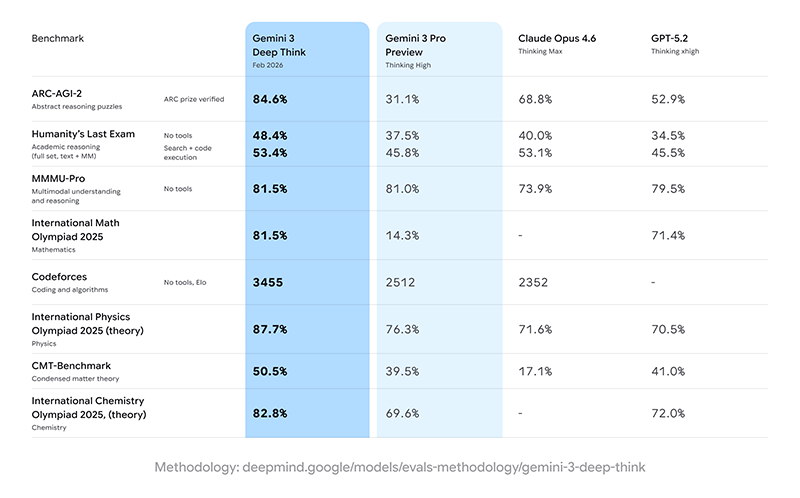
The refined version now delivers unprecedented results on frontier benchmarks: an astonishing 84.6% on ARC-AGI-2 (a test of genuine abstract reasoning and adaptation to novel tasks, verified by the ARC Prize Foundation), 48.4% on Humanity’s Last Exam without external tools (a benchmark pushing the limits of expert-level knowledge and logic), and a staggering 3455 Elo on Codeforces for competitive programming. It also reaches gold-medal levels on written sections of the 2025 International Physics and Chemistry Olympiads, underscoring its prowess in scientific domains.
What sets Gemini 3 Deep Think apart is its focus on practical, high-impact applications rather than abstract demos.
Collaborations with researchers have shown it spotting subtle logical flaws in complex mathematics papers that evaded human peer review, as demonstrated at Rutgers University. At Duke University's Wang Lab, it optimized crystal growth recipes for thin films exceeding 100 μm, hitting precise targets that eluded prior methods.
Engineers benefit from accelerated physical design, where the mode bridges theory and fabrication.
Read: Google 'Gemini 2.5 Deep Think' Has Parallel Thinking Techniques For Stronger Reasoning
A standout new feature allows users to upload a simple sketch, perhaps a napkin drawing of a mechanical part, and have Deep Think analyze it, model the complex geometry, ensure structural integrity, and output a ready-to-use 3D-printable file like an STL for immediate prototyping.
This sketch-to-print pipeline represents a leap toward democratizing hardware innovation, turning rough ideas into tangible objects without traditional CAD expertise.
This feature is released to Google AI Ultra subscribers through the Gemini app (with a dedicated "Deep Think" option in the tools menu), this upgrade also opens early access via the Gemini API for select researchers, engineers, and enterprises eager to integrate it into workflows.
While premium pricing reflects the compute intensity required for such depth, prompting some discussions around query limits and costs. The investment targets users who need a reliable partner for discovery, not casual queries.
As the LLM arms race continues, Gemini 3 Deep Think stands out by shifting AI from a general assistant to a specialized collaborator capable of accelerating scientific progress and engineering breakthroughs in ways that feel increasingly indispensable.

















































































































































































































































































