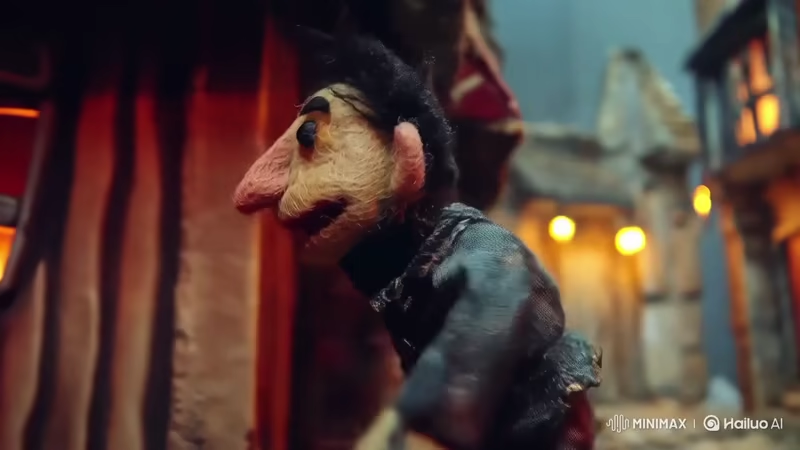
The generative-AI industry had been trending at an unprecedented pace.
Fueled by the rise of large language models and intensified by a global tech rivalry. After OpenAI popularized the concept with its breakthrough model, the ChatGPT, what had once been a two-player game quickly expanded to three, four, five and beyond, each firm racing to launch its own suite of generative solutions.
While the bulk of innovation came from the West, Eastern players refused to fall behind.
China, recognizing the value of the wave, saw one of its leading tech houses launch a new text-to-video model designed to go head-to-head against those that came before it. This was when the industry welcomed yet another entrant. MiniMax.
And its product that goes by the name 'Hailuo,' could generate short high-fidelity video clips from text or imagery.
This time, 'Hailuo 2.3' is introduced.
The company described this tool as a leap forward in motion generation, subject consistency and creative control.
In all, this model enters the race to compete against rivals like Google's Veo 3.1 and OpenAI's Sora 2.
Introducing Hailuo 2.3 — Realism Reimagined. Breakthroughs in movement, expression & physical realism.
Choose your mode:
Hailuo 2.3 — Cinematic realism & professional-grade visual fidelity
Hailuo 2.3 Fast — Quicker, lighter, more affordable
4 free videos daily →… pic.twitter.com/DtS3sMK7Lw— Hailuo AI (MiniMax) (@Hailuo_AI) October 28, 2025
China’s MiniMax with Hailuo 2.3 marks yet another evolution of text-to-video AI.
Building on the trends that have been set by others, Hailuo 2.3 positions itself as a true cinematic engine—where choreography, motion, and physics meet storytelling.
With Hailuo 2.3, the company aimed for more than just realism.
Its model learned to blend complex body motion with natural scene physics—shadows that fall correctly, fabrics that react to wind, and dancers whose movements flow with human rhythm. Each frame looks less like a generated guess and more like something choreographed and captured on set.
MiniMax said the 2.3 upgrade enhances temporal stability and frame-to-frame consistency, issues that have long challenged text-to-video systems.
Early demonstrations showcased scenes with fluid camera pans and believable emotional nuance, suggesting that Hailuo’s understanding of “time” has grown as much as its grasp of texture and tone.
Unlike older models that could only infer motion, Hailuo 2.3 calculates how physical objects interact in space, making the results appear grounded in reality, even when they’re entirely synthetic.
The platform interprets text prompts with cinematic awareness, applying depth, lighting continuity, and camera movement that feel intentionally directed.
The update came as competition in the AI-video arena intensified worldwide.
After OpenAI dazzled the industry with Google Veo and Sora, and Luma AI with Dream Machine, which was then followed by Kuaishou’s Kling AI and Tencent’s DynamiCrafter, MiniMax, based in Shanghai and already known for its conversational AI systems, is extending that ambition into moving images than ever before.
The release also signals a larger shift in China’s generative-AI strategy.
Rather than just chasing Western benchmarks, local companies are focusing on tools that connect creative industries, from advertising and entertainment to education and e-commerce.
Text-to-video platforms like Hailuo are poised to become everyday companions for storytellers, not just engineers. This is a hint that AI creativity may soon transcend language, region, and even medium.
Read: MiniMax Heats Up The Text-To-Video AI War By Competing Against The Western Giants
Hailuo 2.3 isn’t merely another entry in the text-to-video race.
It’s a reminder that the generative-AI story isn’t written by one company or one continent. While the West defines the narrative of intelligence, the East is quietly choreographing its own frame by frame, with precision and grace.
Unlike the first wave of video models that dazzled with spectacle but stumbled in coherence, Hailuo 2.3’s power lies in restraint.
Movements follow natural laws, fabrics ripple with weight, and environments breathe with subtle realism.
It’s the kind of progress that doesn’t shout; it shows.




















































































































































































































































































