Bringing complex graphics to web browsers has always required substantial engineering effort, and for more than a decade, most of that work has been handled by WebGL.
Short for "Web Graphics Library," WebGL is a JavaScript API introduced in 2011 to deliver hardware-accelerated 3D graphics inside the browser. Before its arrival, browsers had no native access to the GPU, forcing developers to rely on plugins like Flash or Unity Web Player. These external tools were slow, inconsistent across platforms, and often raised significant security concerns.
WebGL solved this problem by giving browsers direct GPU access through a standardized API. Built on OpenGL ES 2.0, the dominant mobile graphics API at the time. It enabled real-time 3D rendering, shaders, and interactive visualizations without any plugins.
This breakthrough paved the way for browser-based games, simulations, mapping tools, and countless other interactive experiences.
The mission was straightforward: bring native-like 3D rendering to the web, safely and consistently.
But as GPU technology evolved, WebGL began to show its age.
This happens because its design depends on OpenGL ES, which is now considered legacy on many platforms. Also, it exposes only the graphics pipeline, leaving no room for compute operations. It hides many details of modern GPU architectures, forcing developers to rely on hacks or heavy abstractions for advanced rendering techniques.
And because it was built on an older API model, performance can be unpredictable.
By the mid-2010s, native applications had already moved toward low-level, explicit, compute-capable GPU APIs such as Vulkan, Metal, and Direct3D 12. Meanwhile, the web was still tied to an outdated abstraction.
This gap set the stage for WebGPU.
WebGPU, the successor to WebGL, is built directly on modern native APIs like Direct3D 12, Metal, and Vulkan, rather than the aging OpenGL ES stack. It offers developers a low-level model for buffers, textures, pipelines, and command buffers, along with its own shading language, WGSL.
This design yields far more predictable performance and opens access to contemporary GPU capabilities that WebGL never could.
Crucially, WebGPU is not limited to graphics.
It includes compute shaders, allowing JavaScript and WebAssembly code to perform parallel workloads such as physics, simulations, and machine learning, directly on the GPU.
Libraries like ONNX Runtime Web and transformers.js already use this to run AI inference on the client side, reducing latency while keeping data local.
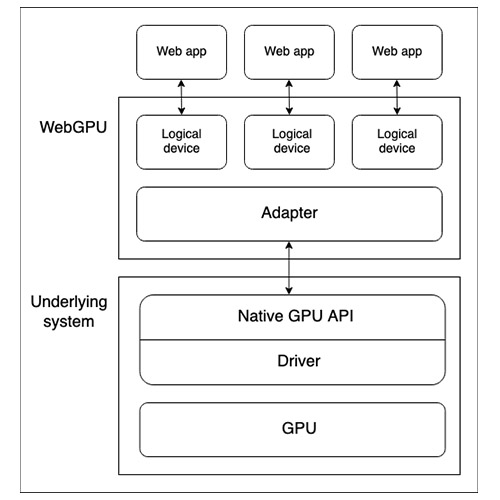
In practical terms, users can now run high-fidelity games or even AI models directly inside the browser, powered entirely by their local GPU.
"This massively improves performance for tasks like machine learning inference and training (running workloads like large language models), video processing, physics simulations, essentially bringing desktop-class performance to computationally intensive applications on the web," the announcement says.
And now, WebGPU has cleared its final major barrier: it is officially supported across all major browsers.
It is enabled in stable releases of Chrome and Edge on Windows, macOS, ChromeOS, and Android; Firefox on Windows and macOS; and Safari on macOS, iOS, iPadOS, and visionOS. This gives developers, for the first time, a single GPU API that runs reliably across every major browser engine.
Looking ahead, this unlocks the possibility of professional-grade creative tools, AAA-quality games, and advanced 3D applications running entirely within a browser tab. While the exact timeline remains speculative, such progress typically spans several years as developers build full-scale products atop a new low-level GPU foundation.
— WebGPU (@WebGPU) December 3, 2025
WebBPU Browser Support and Availability
Chrome, Edge, and other Chromium-based browsers:
- WebGPU is available on Windows (with Direct3D 12), macOS, and ChromeOS starting with Chrome and Edge version 113.
- Support for Android was added in Chrome version 121 for devices running at least Android 12, and with Qualcomm/ARM GPUs.
- Support for Linux and expanded support for existing platforms is in progress.
Firefox:
- WebGPU is available on Windows as of Firefox 141.
- WebGPU is available in macOS Tahoe 26 on ARM64 machines, as of Firefox 145.
- Support for Linux, Android, and Intel-based Macs is in progress.
Safari:
- WebGPU is available in macOS Tahoe 26, iOS 26, iPadOS 26, and visionOS 26.
Initially, WebGPU shall sit mainly in the hands of engine authors and tool developers who already target multiple platforms.
With Chrome, Edge, Firefox and Safari all on board, they can treat WebGPU and its native implementations like Dawn and wgpu as a single cross platform layer for graphics and compute. The next phase is less about spec work and more about engines, editors and games that show ordinary users what that GPU access in the browser is good for.




















































































































































































































































































