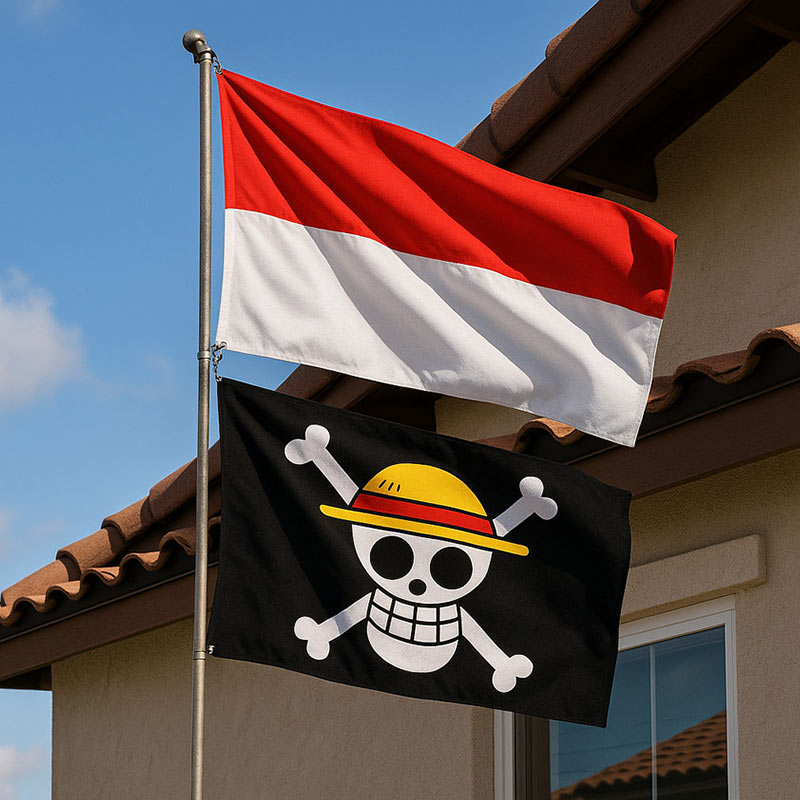
In the weeks leading up to Indonesia’s 80th Independence Day on August 17, a surprising symbol began appearing alongside the national Merah Putih flag: the Straw Hat Pirates’ Jolly Roger from the popular anime One Piece.
But rather than a fan tribute, the black pirate flag—featuring a skull topped with a straw hat—has become a potent form of protest.
Across cities like Jakarta and Surabaya, citizens have mounted the flag on poles, vehicles, and homes to express discontent with perceived government corruption, hollow nationalism, and democratic erosion.
Behind the flag’s rise is a grassroots social media movement. TikTok, X, and Instagram were flooded with visual evidence—videos and snapshots of the pirate banner flying next to the national flag. It started in places like Surabaya, where one viral photo reportedly sparked a cascade of imitators, including youth, activists, drivers, and meme accounts.
The movement offered an ironic mirror: when authorities urged citizens to fly the Merah Putih to show patriotism, protesters responded with the One Piece flag to critique performative nationalism and reclaim symbolic power.
Government response was swift and forceful.
Deputy House Speaker Sufmi Dasco Ahmad, a Gerindra Party official, condemned the practice as a “systematic movement” aimed at fragmenting national unity, invoking Law No. 24 of 2009 which prohibits raising any other flag above the Red-and-White flag.
Coordinating Minister Budi Gunawan echoed the concern, calling the trend “provocative” and cautioning it could compromise the nation’s dignity during a pivotal moment of commemoration.
Not all officials condemned it, however.
Deputy Home Affairs Minister Bima Arya Sugiarto clarified that citizens are allowed to fly the One Piece flag as long as it doesn’t contradict constitutional law, while emphasizing the supremacy of the national flag in public displays. Human Rights Minister Natalius Pigai even stated that the government reserves the right to ban the pirate flag for the sake of preserving national symbols, citing international legal justification and dismissing concerns over restricting expression.
Social media sentiment was overwhelmingly sympathetic to the protest.
Influential anime and youth-focused accounts described the One Piece flag as a form of resistance, stating the Merah Putih had become too sanctified under a government many once admired but now perceive as morally compromised.
One Reddit post said that "It all started as a joke" — but it transformed into a deliberate and symbolic act of rebellion adopted across Indonesia.
Underneath the imagery lies substantive discontent.
Since early 2025, Indonesia has witnessed escalating protest movements—collectively tagged #IndonesiaGelap (“Dark Indonesia”)—centered around reforms allowing active-duty military officials to take civilian government roles, reminiscent of the Soeharto-era dwifungsi system. Mass demonstrations erupted in response to these changes as well as a sweeping austerity program that slashed Rp306 trillion from public spending, affecting education, social services, and civic participation.
In that context, the One Piece flag became more than cartoon hijinks—it evolved into a subtle but powerful manifesto.
In the fictional world, Monkey D. Luffy’s crew hoists their Jolly Roger to signify resistance against an oppressive world government.
For many Indonesians, the analogy hit home: they were reclaiming symbols to confront what they see as performative patriotism under a government prioritizing power over public welfare.
Much of the discourse framing this as a "threat" has come from ruling party figures who heard this symbolic rallying as subversive. Yet opposition lawmakers, including members of PDI-P, defended the movement as valid democratic dissent—an alternative to street protests that could escalate into violence.
Online commentators reinforced that this was symbolic resistance, not chaos.
Despite escalating tensions, no formal ban has been implemented. Instead, authorities have issued warnings and urged people to prioritize national symbols without silencing the trend altogether. It’s a precarious moment—a pop culture icon repurposed as protest, and politics wrapped in symbolism on flagpoles across the archipelago.
Ultimately, the juxtaposition between the Merah Putih and the Straw Hat Jolly Roger captures a generational divide.
It’s a visual manifesto: patriotism must be earned, not performed.
Dissent must evolve when traditional channels are blocked. And sometimes, a fictional pirate flag can say more about the state of a democracy than any op-ed or headline ever could.
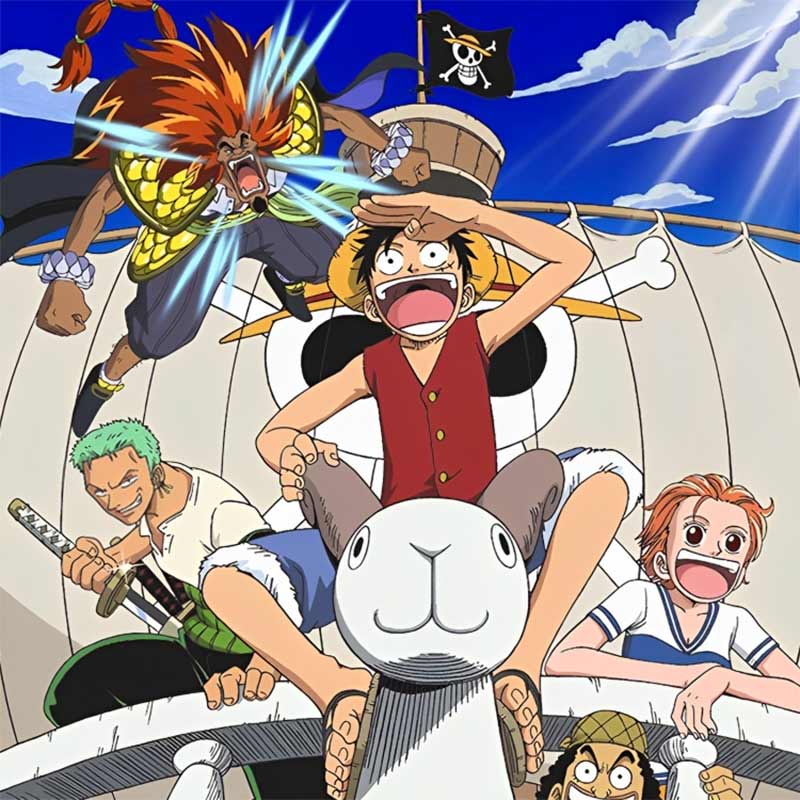
One Piece is a globally popular Japanese manga and anime series created by Eiichiro Oda.
First published in 1997 in Weekly Shōnen Jump, the story follows Monkey D. Luffy, a young pirate with a rubber-like body after eating a supernatural Devil Fruit. Luffy sets out to find the legendary treasure known as the "One Piece" and become the King of the Pirates. Along the way, he gathers a diverse crew called the Straw Hat Pirates, each with unique dreams and backstories—ranging from a swordsman and navigator to a reindeer doctor and a cyborg shipwright.
Set in a vast oceanic world with its own government, navy, and pirate factions, One Piece blends action, humor, emotional storytelling, and strong themes of friendship, freedom, justice, and rebellion.
The series is known for its deep world-building and critiques of authoritarianism, often depicting corrupt world leaders, social inequality, and powerful institutions that oppress the weak. This rebellious undertone has helped it resonate beyond entertainment, becoming a cultural symbol in many parts of the world.
As of 2025, One Piece is one of the best-selling manga series of all time, with over 500 million copies sold. It has inspired a long-running anime adaptation, multiple films, games, and merchandise, as well as a live-action adaptation by Netflix. Its iconic Jolly Roger—Luffy’s smiling skull wearing a straw hat—has become a symbol of defiance and freedom, far beyond the pages of manga.

















































































































































































































































































