"That's one small step for a man, one giant leap for mankind," declared Neil Armstrong, when he placed his put his left foot on the lunar surface, representing humanity's first successful landing on the Moon.
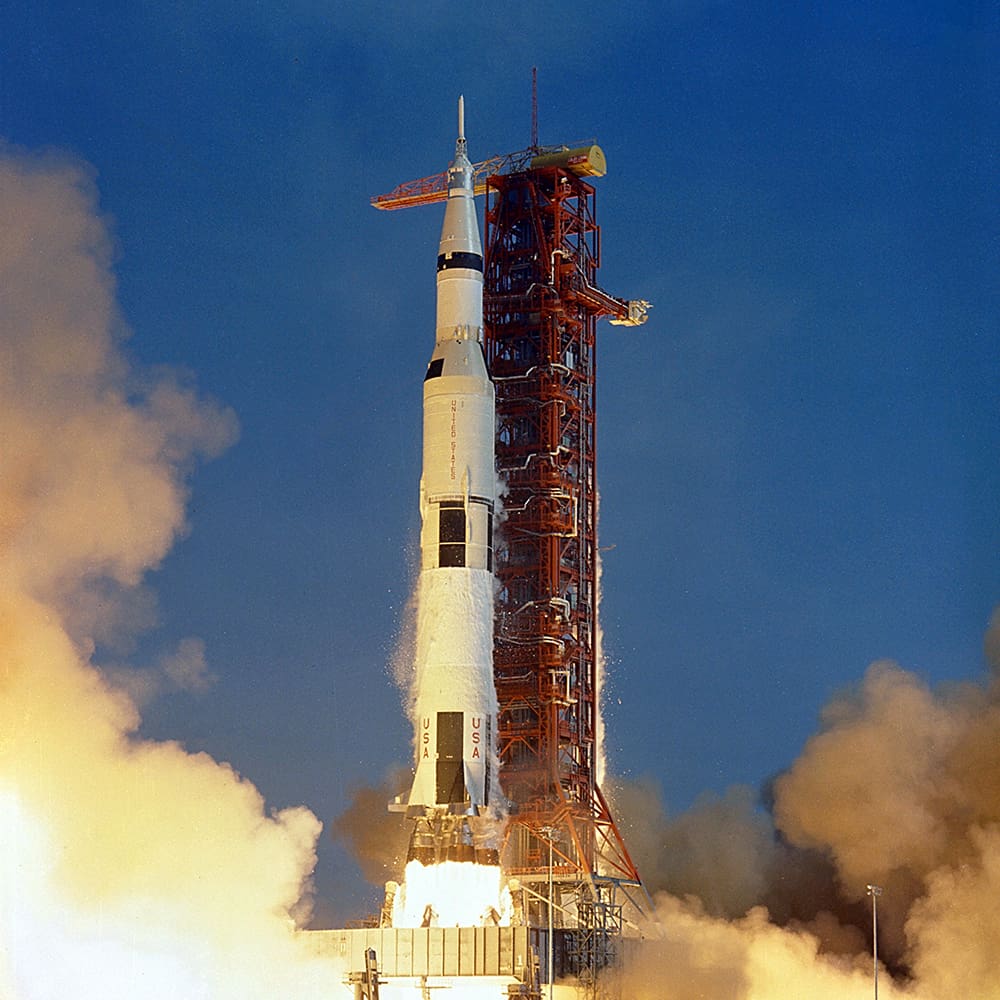
To travel 384,400 kilometers into space and land on Earth's only natural satellite that travels at a staggering 3,683 kilometers per hour was extremely difficult. But that was possible with the help of a computer onboard the Apollo 11 that is said to be less powerful than even a calculator.
At that time, the computer embedded inside the Apollo 11 was called the Apollo Guidance Computer. It only had 2,048 words of memory that could be used to store "temporary results." Because each word comprised 16 binary digits (bits), with a bit being a zero or a one, this means that the Apollo computer had 32,768 bits of RAM memory.
That, in addition to 72KB of read only memory (ROM), which is equivalent to 589,824 bits.
As for its processor, it ran at 0.043 MHz.
This time, many smartphones have RAM that is around 4GB. In comparison, that is 34,359,738,368 bits, which is one million times more memory than the Apollo computer had as its RAM.
Phones that have 512GB of ROM for storage, means that the phones have around 4,398,046,511,104 bits, which is more seven million times more than that of the Apollo.
Phones at this time can run at about 2490 MHz, which means that the phones can run 100,000 times the processing power of the computer that landed man on the Moon.
While Apollo 11's computer is certainly a relic in the modern age of computers and internet, it was a state-of-the-art in its time.
If a computer with that capacity can help humans land on the moon, NASA is looking forward to computers that are 100 times faster than they currently are.
And this time, NASA announced that it has awarded a $50 million contract to Microchip Technology, the microcontroller giant, to develop next-generation processors.
With this huge amount of processing power, NASA aims to fulfill its goal of exploring deeper into the solar system.
In order to make that happen, NASA needs all the necessary computing power capable of carrying out complex navigation calculations and communication tasks for all sorts of hardware - from spacecraft to robotic rovers.
The processor's design has to be general enough to support a wide range of applications, which include and not limited to: AI, edge computing, and ethernet data transmission. It should also be flexible enough to be used for all types of missions that include: Earth monitoring, Mars exploration, or possibly support astronauts to (and on) the Moon.
According to Niki Werkheiser, director of technology maturation within the Space Technology Mission Directorate:
"This effort will amplify existing spacecraft capabilities and enable new ones, and could ultimately be used by virtually every future space mission, all benefiting from more capable flight computing."

The granted $50 million fund is to help Microchip in designing and manufacturing the so-called High-Performance Spaceflight Computing (HPSC) processor in the span of three years.
Besides requiring chips that are 100 times more powerful, the U.S. space agency wants the computer to be able to survive harsh environments with extreme temperatures and high cosmic radiation.
In other words, NASA also requires the chips to be reliable and capable of operating under high fault tolerance.
This is about time NASA updates its computers because according to Wesley Powell, NASA's principal technologist for advanced avionics, the agency's spaceflight computers "were developed almost 30 years ago."
According to Babak Samimi, corporate vice president for Microchip's Communications business unit:
"We will foster an industry-wide ecosystem of single board computer partners anchored on the HPSC processor and Microchip's complementary space-qualified total system solutions to benefit a new generation of mission-critical edge compute designs optimized for size, weight, and power."

















































































































































































































































































