
Microsoft, the tech company that started the PC revolution, is trying to remain relevant, in the large language models (LLMs) war that decimated in 2022.
When OpenAI introduced ChatGPT, the world was in wowed and awed. The moment quickly created an arms race, where tech companies of all sizes race towards AI supremacy. And Microsoft is one of the many, and it's product is called Copilot.
Microsoft's CEO, Satya Nadella has stepped back from the day-to-day grind of running one of the world’s largest commercial organizations. And because of that, Nadella has turned his attention to something far less conventional for a Fortune 500 executive in 2026: launching a personal blog called Sn Scratchpad to share his evolving thoughts on artificial intelligence.
In his inaugural post, Nadella delivers a blunt message to the entire AI industry. He urges everyone to move past the endless debate over "slop vs sophistication," the tired argument about whether current AI outputs are garbage or genuine breakthroughs.
Instead, he argues for a deeper shift in perspective.

In his post, Nadella wrote that:
"We have moved past the initial phase of discovery and are entering a phase of widespread diffusion. We are beginning to distinguish between 'spectacle' and 'substance'. We now have a clearer sense of where the tech is headed, but also the harder and more important question of how to shape its impact on the world."
"We are still in the opening miles of a marathon. Much remains unpredictable. Amidst this 'model overhang,' where capability is outpacing our current ability to use it to have real world impact, this is some of what we still need to get right."
He argues that:
- AI should be a concept that evolves "bicycles for the mind." People should "always think of AI as a scaffolding for human potential vs a substitute."
- AI deployment is shifting from standalone models to integrated systems. While model capabilities continue to grow rapidly, their limitations require robust engineering.
- AI is moving from standalone models to full systems. To achieve real-world impact, we must pair rapidly improving model capabilities with robust engineering that handles their limitations.

This is why he urges people to stop talking about AI slops.
His opinion is more than philosophical musing: it signals a clear strategic pivot at Microsoft.
The company is quietly moving away from the race to build the single most powerful frontier model. This is because behind the scenes, Nadella has grown increasingly candid about the current limitations of Microsoft's own AI products. According to internal communications reported in late December 2025, he has bluntly told teams that many Copilot integrations, particularly those connecting to Gmail and Outlook, "don’t really work" for the most part and are "not smart."
Not to mention that behind Copilot, there is OpenAI that powers it.
This internal frustration stands in stark contrast to Microsoft’s public messaging. For years the company has aggressively embedded Copilot across Windows, Office 365, Teams, and even consumer hardware, often without giving users meaningful ways to opt out.
"Microslop" is painfully visible, and Nadella knows this.
Read: Microsoft Was 'Below Them, Above Them, Around Them,' In Reference To OpenAI
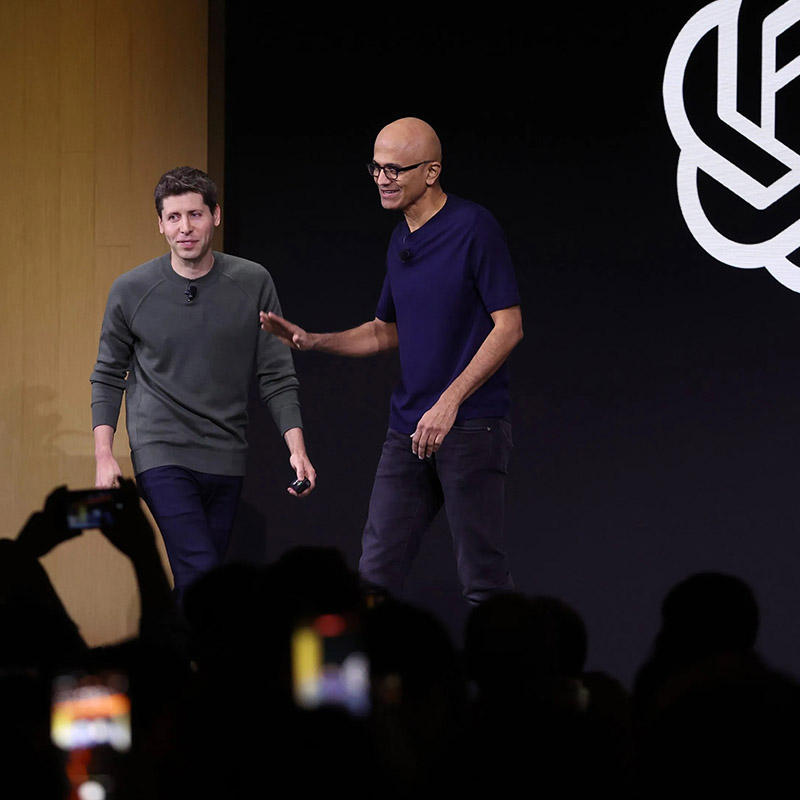
Nadella seems to recognize at least part of this concerns.
This is why his blog post is an attempt to reframe the conversation: away from flashy demos and model-size bragging contests, toward questions of deployment, societal permission, and genuine human benefit. He emphasizes that naming is not the problem: execution is.
"The real problem is that the adoption has been forced, not earned," he implies between the lines.
As Microsoft continues to hold a leading position in enterprise AI adoption, the gap between installation numbers and meaningful daily usage is growing hard to ignore.
Nadella's bet is that the future belongs not to whoever builds the biggest model, but to whoever can make AI disappear into the background, and making an AI that becomes something taken for granted: becoming as unremarkable and useful as the operating system and productivity suite that made Microsoft dominant in the first place.