
When speaking about web browsers, what immediately comes to mind for most people is Google Chrome, and that is because of a good reason.
Chrome continues to dominate the global browser market, and this time, it is able to capture more than 70% of worldwide usage, far ahead of every other competitor. That overwhelming share means billions of people trust it as their window to the internet, even if some aspects of that trust are increasingly being questioned.
But popularity and dominance don't necessarily equate to privacy or security.
A recent privacy risk study by Digitain evaluated mainstream and emerging browsers not for speed or features, but for how well they protect users from tracking, fingerprinting, and insecure connections.
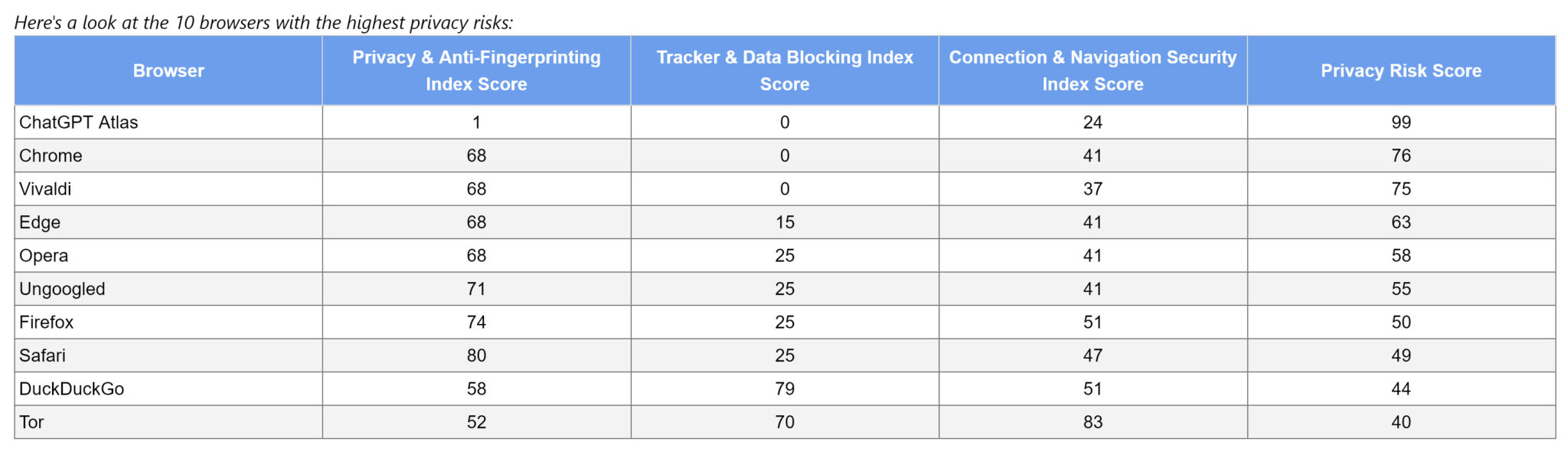
The results were eye-opening: Chrome scored 76 out of 100 on the privacy risk scale, making it one of the least private browsers among major options, beaten only by a new AI entrant ChatGPT Atlas, which scored a staggering 99 out of 100, which means it offers almost no effective privacy protections at all.
ChatGPT Atlas, launched by OpenAI in October 2025 with deeply integrated AI features, failed all state partitioning tests, meaning it does not block websites from tracking users across sessions, and scored virtually zero for blocking trackers. That’s bad — and surprisingly bad for a brand-new, hyped browser that promises intelligent browsing based on AI.
Chrome's own privacy shortcomings aren't minor.
While it performs somewhat better than Atlas at preventing browser identification (scoring around 68 in that category), it scores zero for blocking trackers, meaning companies can freely follow users' activity across the web using cookies and other tracking signals. This isn't just a theoretical issue; independent analysis have found that traditional browsers, especially Chrome, often leak metadata and can expose internal IPs or tracking identifiers unless carefully configured.
By contrast, browsers that prioritize privacy by design, like Brave, offers fewer ads while surfing the web, shorter load times, with far less RAM and CPU usage. It far outperforms Chrome using its own default ad and tracker blocking system, and built-in protections to minimize data collection.
Privacy-centric tools like Tor also ranked better, though they are often slower or less convenient for everyday use.
Mullvad Browser is also touted as the browser with a great focus on user privacy. Although Brave is more popular, Mullvad is a result of a collaboration between Mullvad VPN and The Tor Project, and is marketed as an open-source privacy-focused browser that minimizes tracking.
Kagi's Orion browser is another alternative for the privacy-concerned individuals. This browser also prioritizes privacy, efficiency, and speed, though it's only available on macOS and iOS as of December 2025, with versions for Linux and Windows still in development.
Here is the list of the top 10 worst browsers when it comes to user security, along with their risk scores (the lower the score, the better in terms of privacy):
- ChatGPT Atlas (99)
- Google Chrome (76)
- Vivaldi (75)
- Microsoft Edge (63)
- Opera (58)
- Ungoogled (55)
- Mozilla Firefox (50)
- Apple Safari (49)
- DuckDuckGo (44)
- Tor (40)
Paruyr Harutyunyan, Group head of Digital Marketing at Digitain, further said that:
Knowing the bad raport its biggest rival receive, both Apple and Microsoft mutually agree.
The iPhone-maker is increasing pressure on iPhone users to stick with Safari, which Apple claims "truly helps protect your privacy" by limiting device fingerprinting and cross-site tracking more aggressively than Chrome does. As for the Windows-maker, it has been pushing Edge as a more secure alternative to Chrome, touting features like private browsing enhancements and threat protection. It is even launching pop-ups within its own browser to urge people to reconsider downloading Chrome.
Yet for all the marketing around privacy and security, the browser landscape remains a trade-off: Chrome’s ubiquity and performance make it the default choice for most users, but that convenience comes with compromises in tracking and data exposure.
Meanwhile, alternatives that genuinely focus on privacy often appeal to smaller audiences who are willing to sacrifice some mainstream compatibility or convenience for stronger protections.
In the end, choosing the "best" browser in 2025 depends on what users value most.
If it's seamless integration, speed, and feature sets like AI assistance, or deeper protections against tracking and data collection.
But what is certain is that, popularity doesn't equal to privacy, and as concerns about data harvesting and AI integration grow, more users are paying attention to how their browsers handle the sensitive information that shapes their online lives.






















































































































































































































































































