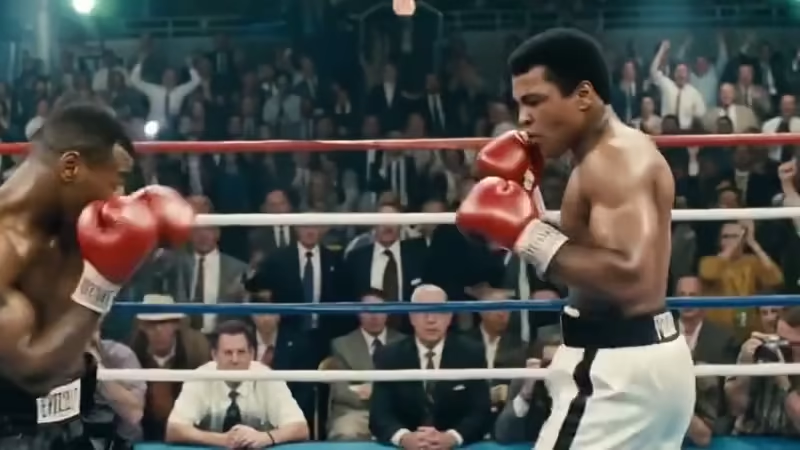
Large language models continue to surprise the world, and the pace they're advancing is astonishing.
Since the arrival of OpenAI's ChatGPT, the event ignited a fierce global race among tech giants to dominate AI. What began as a breakthrough in conversational text generation quickly evolved into something far broader. Within months, companies raced to add multimodal capabilities: first images, then full video synthesis.
Tools such as OpenAI's Sora 2 stunned the world with coherent, high-fidelity clips from simple text prompts, proving that AI could not only describe scenes but animate them with startling realism. Google wasn't far behind with Veo 3.
The pace of innovation has been relentless, shifting from static visuals to dynamic, narrative-driven videos that blur the line between human creativity and machine output.
And in this arena, China has never lagged far behind. If anything, its companies have often surged ahead in practical deployment and scale.
Kuaishou's Kling AI stands as a prime example of that momentum.
Introducing the Kling 3.0 Model: Everyone a Director. It’s Time.
An all-in-one creative engine that enables truly native multimodal creation.
- Superb Consistency: Your characters and elements, always locked in.
- Flexible Video Production: Create 15s clips with precise… pic.twitter.com/CJBILOdMZs— Kling AI (@Kling_ai) February 4, 2026
Back in the earlier days of AI-powered video generators, models could barely create Will Smith eating a plate of spaghetti. Models were also having a hard time creating five fingers for a hand, and make gymnasts move defy physics and normal human joints.
Now, things have advanced so far, that AI models are so capable they can even allow people to create Hollywood-like cinematics.
Just like others, Kling has evolved rapidly through iterative releases.
Having first captured attention in mid-2024 with its impressive text-to-video capabilities, now the platform has unveiled 'Kling 3.0,' a major leap that redefines what's possible in AI-driven filmmaking. This isn't merely an incremental update; it's a comprehensive shift toward what Kuaishou calls the "AI Director" era, where everyday creators gain professional-grade tools to orchestrate complete visual stories.
At the heart of Kling 3.0 lies its unified Multi-modal Visual Language (MVL) framework, which integrates text, images, audio, and video inputs and outputs into a single, seamless architecture.
Previous versions, like the powerful Kling 2.6, handled these elements separately, but 3.0 brings them together natively.
What this means, users can start with a detailed text prompt, incorporate reference images for character or scene consistency, add audio cues, and even edit within the video itself.
All that without switching tools or losing coherence.
And the result feels less like generating isolated clips and more like directing a short film with an intelligent assistant that understands narrative flow.
Check out how @PJaccetturo brings cinematic content to the next level with Kling 3.0! Details in the thread https://t.co/Bi2FPgLq3Q
— Kling AI (@Kling_ai) February 4, 2026
One of the most exciting advancements is the extension of video length to up to 15 seconds, a noticeable jump from earlier limits.
Within that window, Kling 3.0 supports multi-shot storyboarding, allowing up to six distinct cuts or scenes in a single generation. The model intelligently interprets prompts to apply automatic camera movements, shot-reverse-shot sequences, dynamic angles, and compositions that enhance storytelling. This turns simple descriptions into cinematic sequences.
Users can create a character walking through a bustling market, cutting to a close-up reaction, then panning to reveal a dramatic reveal, without having to manual stitching or post-production tweaks.
Visual quality has seen dramatic improvements too.
Check out this masterpiece by @Diesol made with Kling 3.0! More details about the process in the thread https://t.co/zdv2lEsPm5
— Kling AI (@Kling_ai) February 4, 2026
Kling 3.0 delivers native 4K resolution in many modes, with enhanced photorealism that tackles persistent challenges like human movement realism, facial expressions, and complex physics.
Characters move more naturally, lip-sync aligns precisely with generated or custom audio, and environmental interactions feel grounded.
Element consistency is another standout: upload reference videos or multiple images, and the model maintains coherent appearances for people, objects, clothing, and settings across frames and shots. Early user feedback and benchmarks suggest it often outperforms competitors in prompt adherence and lifelike motion, making outputs suitable for everything from social media shorts to professional pre-visualizations.
Audio integration pushes boundaries further.
Native generation supports multiple languages, dialects, and accents, with spatial sound, multi-character dialogue, and expressive voice modulation. This closes the gap between silent AI clips and fully realized scenes, letting creators produce videos that feel complete right out of the tool.
Combined with stronger narrative precision, it empowers users to experiment with dialogue-driven stories, musical sequences, or atmospheric soundscapes that sync perfectly with the visuals..
Still, Kling 3.0 is not without its constraints.
The extended 15-second limit marks progress, but longer narratives still require stitching multiple generations together. This is a process that can introduce continuity drift in lighting, character details, or scene composition. Prompt sensitivity also remains a factor, as small wording changes can significantly alter camera behavior or performance, meaning creators must still learn how to "speak" the model’s language to get consistent results.
Even with improved realism, edge cases persist.
Complex physical interactions, crowded action, and fine object handling can still expose motion artifacts, while maintaining perfect consistency across separately generated scenes remains challenging. And as with all high-end generative video systems, questions around compute cost, access barriers, and ethical use.
And also, even with advanced and precise control over the narrative, there is no way to make things exactly the way users want. There is still some degree of trusting an AI to do its job, than having the ability to be a real movie director.
Yet these limitations do not diminish the significance of the leap. Kling 3.0 demonstrates just how far AI video has progressed. It underscores an enduring truth: technology can amplify storytelling, but human judgment, taste, and intention remain at the core of great filmmaking.






















































































































































































































































































