
The large language models (LLMs) war is far from over.
Since the launch of ChatGPT in late 2022, a new LLM war has unfolded: starting with text generation and quickly expanding into images, audio, and now high-quality video. Early language models that could write essays and code sparked an arms race for multimodal AI capable of understanding and creating across media.
When titans like Google with Veo 3.1, OpenAI with Sora 2, Runway with Gen-4.5, and a few others dominate headlines with tools that turn text and still images into cinematic video sequences, 'Kling 2.6' stakes its claim with a bold differentiator.
Instead of being a model leveraging massive models, complex diffusion systems, and deep semantic understanding to push video generation toward mainstream creative workflows, Kling 2.6 wishes to be the true native audio-visual co-generation.
Unlike most video AI that outputs silent footage requiring separate text-to-speech, sound design, Foley, and sync work, Kling 2.6 produces fully synchronized visuals and audio, complete with dialogue, ambient soundscapes, sound effects, and even singing voices, in a single pass from one prompt.
This shift eliminates the traditional "video first, audio later" workflow and compresses what used to be hours of production into minutes, making high-impact storytelling faster, easier, and far more accessible.
And now, Kling 2.6 gets a bunch of updates.
Kling 2.6 with Voice Control — Voice Consistency Now Resolved
Unlock Next-Level Voice Control! Your Signature Voice, Perfectly Crafted for Your Characters.
Own Any Voice Like a Queen — Master Your Voice with Kling. pic.twitter.com/9KzSOjJZEM— Kling AI (@Kling_ai) December 17, 2025
Since its rollout in late 2025, Kling 2.6 has been expanding beyond basic audio-visual co-generation with a pair of powerful features that push it toward much more directional control in AI video creation: Voice Control and Motion Control.
These upgrades mark a clear shift from "generate a clip" toward giving creators meaningful influence over how characters speak and move inside the scene.
The Voice Control feature in Kling 2.6 builds on the model's native audio generation by letting users more precisely define how speech and sound are expressed, not just that they exist. Rather than relying on default synthesized voices, creators can specify accents, emotional tones, pacing, and even upload custom voice samples to train or anchor a character's unique sound.
This means the AI can produce dialogue, narration, singing, rapping, and ambient audio that match the scene’s intent, and do so in ways that feel consistent across multiple video clips.
Characters can thus speak with distinct, recognizable voices rather than generic ones, and the system keeps lip movements and mouth shapes closely aligned with generated speech, reducing that "AI-dubbed" feel that often undermines immersion.
Voice control also broadens the kinds of stories creators can tell.
From product demos narrated in a specific tone, to lifestyle vlogs with a signature host voice, to multi-speaker dialogue scenes with natural emotional shifts, this feature helps ensure that audio doesn't feel like an afterthought but a core part of the narrative. Especially for talking-head videos, interviews, or scripted shorts, the stability and emotional coherence of the generated audio makes Kling 2.6's output more professional and character-driven.
Motion Control, Leveled Up
Newly upgraded Motion Control is now live in Kling VIDEO 2.6!
Experience precise, full control over every action & expression
Full-Body Motions — Body movements captured in stunning detail
Fast & Complex Actions — From martial arts to… pic.twitter.com/TJyVVdAqAV— Kling AI (@Kling_ai) December 17, 2025
Alongside voice control, motion control upgrades in Kling 2.6 drastically improve how human movement and camera dynamics are synthesized.
Early iterations of AI video generators often struggled with complex body motion, producing stiff limbs or unnatural transitions. With this update, Kling can capture full-body gestures in striking detail. Whether that's a dance choreography, martial arts moves, or fast physical actions, Kling 2.6 can preserve natural facial expressions, hand precision, and accurate lip synchronization even during dynamic sequences.
Creators can upload 3-30 second motion reference clips to guide the AI’s motion generation, layering realistic movement styles directly into the output rather than hoping the model interprets a vague text description correctly.
Kling 2.6 Motion Control Feature Is Now Live!
To celebrate the launch of Kling 2.6 Motion Control Feature, we’re kicking off a new contest - and the prizes are one post away from you!
Show us your creative power with Kling 2.6 Motion Control Feature - The Kling 2.6 Motion… pic.twitter.com/tGOlRmYktG— Kling AI (@Kling_ai) December 19, 2025
This motion control isn't just about character movement. It also encompasses camera dynamics and scene mechanics, enabling smoother pans, dollies, zooms, and more intentional action paths that mimic real-world cinematography.
Where earlier models often produced jittery or inconsistent motion, Kling’s upgraded system generates fluid, controlled sequences that feel purposeful and cinematic, with improved handling of velocity changes, natural acceleration, and expressive gestures.
Together, voice and motion control turn Kling 2.6 into a far more directive creative tool.
Rather than simply producing audio-visual clips that approximate prompt, these features let users shape the performance and personality of a scene in ways that were once the domain of human directors and actors.
Characters sound like users want them to, and they move the way they imagined, giving creators more confidence that the AI output will be both immersive and expressive.
In a landscape where AI video tools are rapidly evolving toward realism and professional quality, Kling's focus on expressive control helps it stand out, and brings generative storytelling closer to a true digital film-making experience.
How to Create a Trending Reze Dance Video Using Kling 2.6 Motion Control? Follow These Steps! pic.twitter.com/aFew3R8IXZ
— Kling AI (@Kling_ai) December 22, 2025
However, there are real drawbacks.
On the downside, control still isn't absolute. Voice control improves consistency, but creators can't yet fine-tune voices the way they would in a professional DAW or full voice-cloning pipeline. Emotional delivery can drift across generations, especially in longer clips or multi-scene sequences, and subtle traits like micro-pauses, or breath control, don't always land exactly as intended.
Motion control, while impressive, also has limits. Reference-based motion can sometimes overfit to the source clip, producing movements that feel copied rather than interpreted. Fast or highly complex actions may introduce artifacts, minor limb distortion, unnatural transitions, or physics that feel slightly "floaty."
Another drawback is compute cost and accessibility.
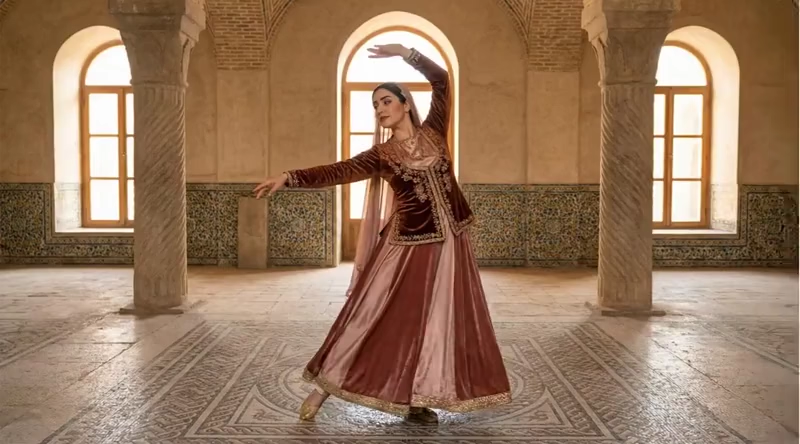
Enabling native audio, voice consistency, and motion control significantly increases generation time and credit usage. For casual creators, this can be a barrier compared to simpler text-to-video tools that generate silent clips quickly.
There's also the issue of creative predictability. As more creators use the same motion references, dance trends, and voice styles, outputs can start to feel familiar.
This is a common problem once a tool becomes popular.
What initially feels groundbreaking can quickly become visually recognizable as “AI-made” unless creators push beyond default styles.
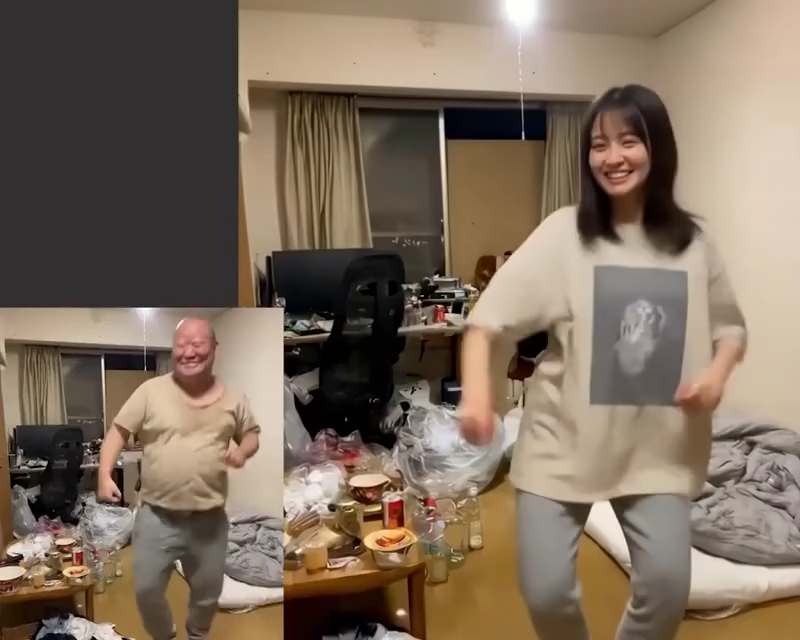
As for virality: yes, Kling 2.6 is absolutely going viral, especially on X, TikTok, and short-form video platforms.
Motion-controlled dance videos, anime recreations, and cinematic monologues are spreading fast because they look dramatically better than earlier AI video generations. The barrier to producing eye-catching clips is low, and the results are instantly shareable, which fuels trend cycles and challenge formats.
However, this virality is currently trend-driven rather than adoption-driven.
Many creators are experimenting, sharing one or two clips, then moving on. The long-term question is whether Kling 2.6 becomes a daily production tool or remains a viral showcase engine. Its success will depend on whether future updates improve consistency, lower costs, and give creators even finer creative control.
In short, Kling 2.6 is viral because it looks impressive and enables fast wins. But its drawbacks mean it's not yet a full replacement for professional pipelines. Right now, it sits in a powerful middle ground: too advanced to ignore, but not yet flawless enough to dominate without iteration.
Chainsaw Man Reze Himeno Power IRIS OUT Challenge
Tool: Kling 2.6 Motion Control
——Kling AI Creative Partner AI MART pic.twitter.com/v12FmmVxZl— Kling AI (@Kling_ai) December 22, 2025






















































































































































































































































































