
The battle between tech companies developing AI technologies has escalated into something far broader than model sizes and benchmark scores.
What began with OpenAI’s release of ChatGPT quickly exploded into what is now known as the "LLM war," as major players and emerging challengers pour billions into scaling models, fine-tuning capabilities, and embedding generative AI directly into everyday tools.
OpenAI’s conversation-first interfaces, Google’s aggressive push, Perplexity’s conversational search, Meta’s attempts to weave generative tools into social feeds, and Bing’s AI integrations have all accelerated this shift. Traditional fields are being transformed into hybrid experiences that blend human-curated web links with AI-synthesized summaries and responses.
This frenzy has sparked intense debate around accuracy, bias, environmental costs, and most critically, privacy. Many of these systems rely on vast data collection to train models and personalize outputs, raising concerns about consent and long-term autonomy.
While some users eagerly embrace the convenience of instant answers, follow-up dialogue, and creative assistance, others remain wary or openly resistant. Their concerns range from factual reliability and information homogenization to environmental impact and, most persistently, the erosion of privacy as AI systems learn from user behavior without clear consent.
Amid this divide, DuckDuckGo has carved out a distinctive position: neither fully embracing nor outright rejecting the AI tide. The company articulated a philosophy distilled into a simple but firm stance: AI should be useful, private, optional, and never obligatory. This wasn’t mere rhetoric; it translated into concrete product decisions that give users genuine agency in a landscape where opt-outs are often buried or ignored.
The most visible expression of this approach came with the launch of dedicated entry points that made the choice explicit: turning AI from an assumption into a deliberate yes-or-no decision.
The first, is creating two DuckDuckGo websites in two separate subdomains.
Users can visit yesai.duckduckgo.com, and have themselves greeted by an experience tuned for AI enthusiasts: Search Assist (the AI-powered summary feature) defaults to "often," Duck.ai, which is DuckDuckGO's private chat interface, sits prominently on the homepage for quick access to models like GPT variants, Claude, Llama, and Mistral, and any filters to hide AI-generated images are turned off.
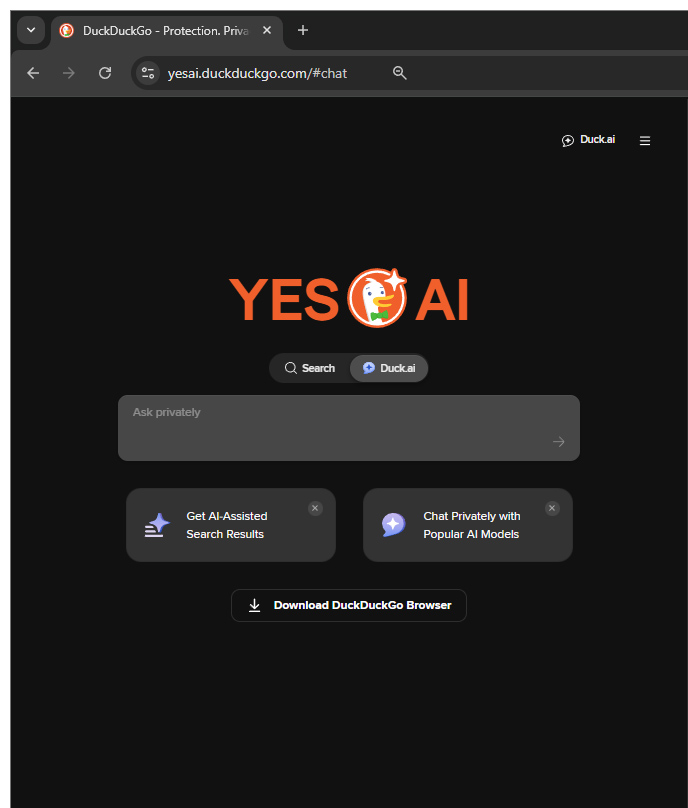
It's a welcoming space for those who want generative help front and center, where follow-up questions flow naturally into deeper, anonymized conversations without tracking or data retention for training.
And the flip side, DuckDuckGo also launches noai.duckduckgo.com, which transforms the website into the opposite: Search Assist is disabled by default, buttons linking to Duck.ai vanish, and the hide-AI-images filter activates automatically, pushing back against the flood of synthetic visuals that have overtaken many search results.
This version caters directly to those who prefer unadulterated web results:the classic DuckDuckGo promise of direct links, bangs, and instant answers without AI mediation.
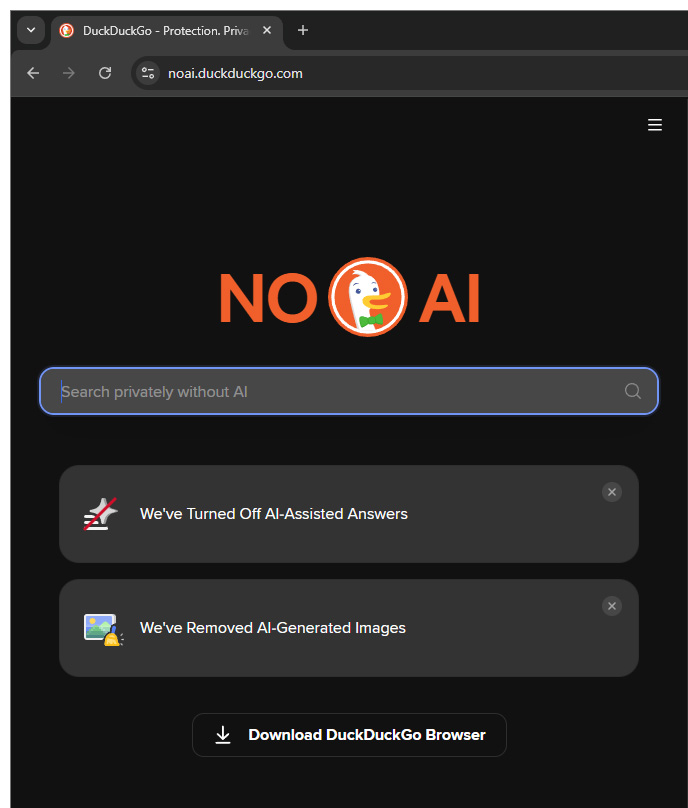
For the many users somewhere in the middle, granular controls remain available at duckduckgo.com/settings, letting people toggle Search Assist to "sometimes," "on-demand," or "never," adjust response styles, or fine-tune how aggressively AI appears.
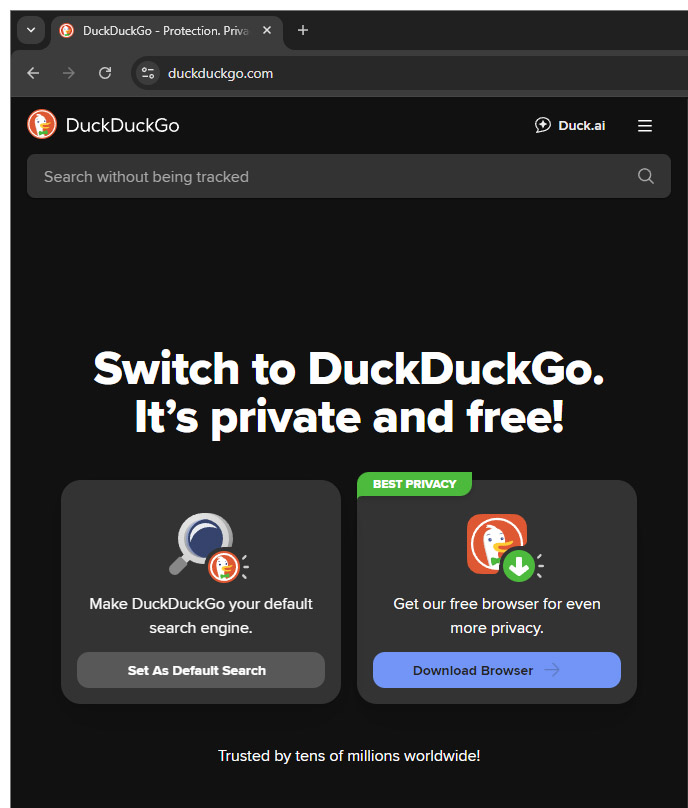
And to deepen engagement with this divide and gather real sentiment, DuckDuckGo introduced VoteYesOrNoAi.com (also accessible via voteyesornoai.com).
This website is a straightforward, anonymous public poll asking visitors to declare themselves "Yes AI" or "No AI." Votes tally live, broken down by country and U.S. state, creating a transparent snapshot of global preferences without collecting personal data.
The move was both pragmatic and provocative: it acknowledged that Big Tech rarely asks users what they actually want regarding AI saturation, instead rolling out changes unilaterally. By surfacing the question openly, DuckDuckGo invited participation and highlighted how many feel unheard in the rush to AI-ify everything.
Yes AI. No AI. Which do you choose? Let us know at https://t.co/Wdh6i109Xy. pic.twitter.com/9tM4CtTmuU
— DuckDuckGo (@DuckDuckGo) January 19, 2026
CEO of DuckDuckGo Gabriel Weinberg captured the essence in his own post:
He emphasized that DuckDuckGo's path isn't anti-AI, and is far from it. Instead, it's more of a ro-choice. Features like private, no-logs chat at Duck.ai and optional Search Assist demonstrate that powerful AI can coexist with privacy when designed thoughtfully. The company even integrated these tools into its browsers, making toggles seamless across devices. Traffic data shared around the same time showed steady growth in core search and even faster rises in Duck.ai usage, suggesting the balanced approach resonates rather than alienates.
This yes/no framework has sparked wider discussion.
On forums, social platforms, and comment threads, reactions range from appreciation for the rare respect shown to user agency to debates about whether true neutrality is possible in an AI-driven world.
Privacy advocates praise it as a bulwark against forced surveillance capitalism, while AI enthusiasts see it as unnecessary hedging. Yet the core innovation remains: by creating explicit "yes" and "no" experiences alongside customizable defaults, DuckDuckGo turned a polarizing question into an opportunity for empowerment. In an era where search increasingly feels like a battle over control versus convenience, this stance quietly asserts that users and not corporations, should decide how much AI enters their lives.






















































































































































































































































































