AI never has senses to begin with. And because it has no emotions and no determination beyond what it's tasked with, AI may have no imagination.
But with generative AIs, and thanks to the ever-growing capacity of hardware and better software, and also more data being used to train, AIs have become significantly smarter that they can indeed emulate human's imagination.
In fact, it can ever create an award-winning piece of art.
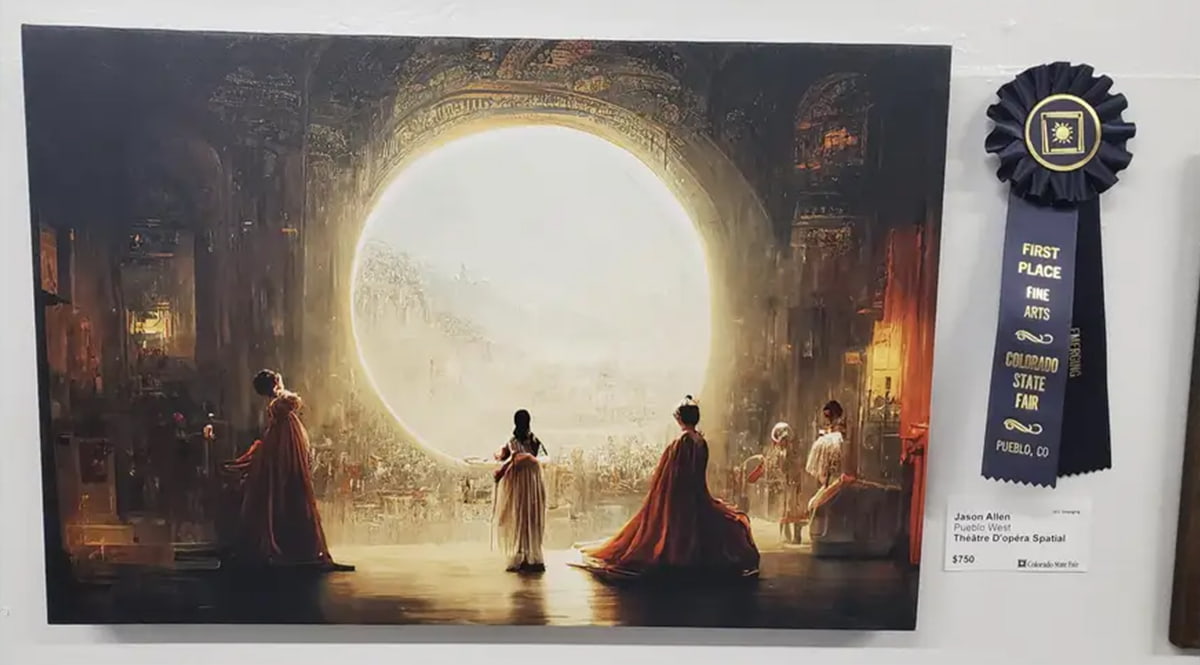
Called the "Théâtre D'opéra Spatial," the magnificent image was created by an AI, who was commanded by Jason M. Allen.
It came first in 2022's Colorado State Fair.
And here is where it becomes an issue.

This is because Allen, the artist behind the piece, can never be considered its "author."
Allen made headlines around the world when he Colorado State Fair awarded his AI-generated artwork. But later, he also gained notoriety after his application for protection is rejected by the U.S. Copyright Office.
Théâtre D'opéra Spatial won first place in the digital art/digitally manipulated photography category of the "Fine Art" competition, but since the piece is not made by a human being, it cannot be copyrighted.
Allen is not giving up.
"I’m not stopping now," he said.
According to the copyright ruling, Allen said that he inputted “at least 624″ prompts before the AI image generator Midjourney produced the images that he wanted.
Things didn't end there, because Allen said that he then further enhanced the image through his text prompting, by altering the scene, the tone, and the focus of the images.
Allen also said that he then used Adobe Photoshop to "remove flaws and create new visual content," before using another photo editing software program, Gigapixel AI, to increase the resolution and size of the image.
"I had a literal vision of women in Victorian dresses wearing space helmets. I was in a hypnagogic state halfway between awake and dreaming, and I was like, ‘Oh, wow. This is something I’ve never thought of or seen. Oh, I could put this into Midjourney," Allen said.

When Allen won first place in Colorado, he was clearly annoying genuine creators, and many called his piece "the death of artistry."
While Théâtre D'opéra Spatial is indeed a masterpiece, and that it has the ability to make human authors think about the competition AIs can create, "I’m not going to apologize for it," Allen said.
"I won, and I didn’t break any rules."
While deep down, Allen had indeed expected the U.S. Copyright Office to reject his copyright application, he said that for "certain we will win in the end."
Since then, the Théâtre D'opéra Spatial has been embroiled in a precedent-affirming copyright dispute.
"If this stands, it is going to create more problems than it solves," Allen said. "This is going to create new and creative problems for the Copyright Office in ways we can’t even speculate yet."
Allen plans to file a lawsuit against the U.S. federal government.
"I’m going to fight this like hell," he said.

He argued that the U.S. Copyright Office had ignored "the essential element of human creativity" needed to use Midjourney.
Allen attempted to use the fair use doctrine to argue that his work should be registered, because it amounts to a transformative use of copyrighted material.
For its argument, the U.S. Copyright Office has made it crystal clear that AI-generated pictures are not suitable for copyright protection.
This is because for all this time, copyright protections are not extended to artificial intelligence.
A federal judge agreed with the Office and contrasted AI images to photography, which also uses a processor to capture images, but it is the human that decides on the elements of the picture, unlike AI imagery where the computer decides on the picture elements.
"The work cannot be registered," the U.S. Copyright Office wrote in its final ruling on September 5.
Computers here are regarded the same as animal.
Back in 2018, a photo taken by a macaque was declared public domain because monkeys can’t hold copyright. Under the law, monkeys and machines have about the same claim on copyright protections.
However, generative AI and copyright remains opaque and the Copyright Office has just opened a public consultation seeking opinions on how copyright should work with AI-generated material.
It's worth noting though, that the U.S. Copyright Office initially agreed that the parts of the image that Allen had altered with Adobe constituted original work. However, the other parts that were generated by AI could not be copyrighted. In other words: Allen could copyright parts of the painting, but not the whole thing.






















































































































































































































































































