In the vast digital landscape of the internet, pornography has carved out a unique niche, drawing billions of views annually while remaining one of the most private corners of online activity.
For many viewers, their porn preferences feel more guarded than the contents of their email inbox or general browsing history. After all, the adult content they see on the web aren't just casual clicks. Instead, they're intimate glimpses into desires, fantasies, and curiosities that could spark judgment, embarrassment, or worse if exposed.
People flock to sites like Pornhub not just for the explicit content, from amateur videos to niche fetishes involving everything from BDSM to role-playing scenarios, but for the illusion of anonymity that lets them explore without consequence.
Yet, as recent events show, that veil of secrecy can tear apart in an instant, leaving users vulnerable in ways they never imagined.
The latest blow to this fragile privacy came in December 2025, when hackers breached data tied to Pornhub's premium users, exposing a treasure trove of sensitive viewing habits and search histories.
The group responsible, known as ShinyHunters, didn't hack Pornhub directly but targeted Mixpanel, a third-party analytics firm that the adult site had used until 2021.
This supply-chain attack allowed them to siphon off over 201 million records, including email addresses, geolocation data down to city or region levels, timestamps of activities, video URLs and titles, associated keywords, and whether videos were watched or downloaded. Imagine logs detailing searches for "milf creampie" or "lesbian bondage," paired with exact times and places.
This kind of data paints a vivid, unflinching portrait of someone's erotic inclinations, all from before 2021 but potentially still damning today.
The breach unfolded when ShinyHunters exploited vulnerabilities in Mixpanel's environment, though the analytics company insists it wasn't tied to their own recent security incidents and that the data hadn't been accessed illegitimately since 2023 by Pornhub's parent company, Aylo.
The hackers then turned to extortion, demanding bitcoin payments from Pornhub to delete the data and keep it from leaking online, a tactic they've used before with other victims.
Pornhub responded unexpectedly (but predictable) in a post on its website.
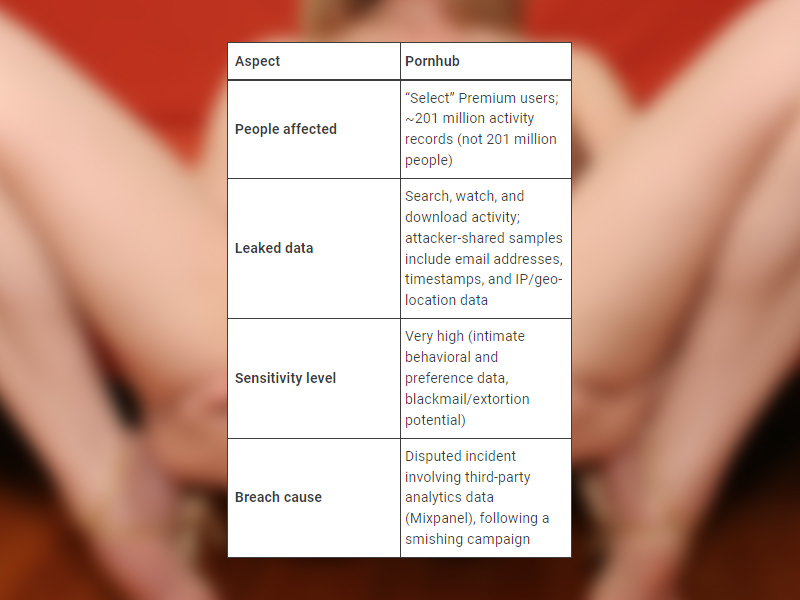
Instead of doubling down on PR or apologies, it downplayed the severity. Pornhub said in a statement on its website that premium users had been affected by an attack on Mixpanel, a company that had provided data analytics to the publisher. Pornhub added that an "unauthorized party" had been able to extract a "limited set of analytics events for some users."
Pornhub said a “select” number of users had been affected and that it had stopped working with Mixpanel in 2021, indicating the data is not recent.
It also emphasized that core account details like passwords, credit card numbers, and bank information remained secure, and that the incident affected only a select subset of premium subscribers, and not the site's free users or broader database.
"It is important to note this was not a breach of Pornhub Premium’s systems. Passwords, payment details and financial information remain secure and were not exposed," said the pornography service.
As for Mixpanel, the company said that it was "aware" of the alleged data theft but explained that it had found no indication that it was related to a cyberattack on the business it experienced a short time before this incident.
For its part, according to its post, the company has secured affected accounts, revoked all active sessions and sign-ins, blocked malicious IP addresses, engaged with third-party forensic providers, and more.
Still, the sheer volume of 94GB of stolen data underscores how even outdated analytics can become a liability, especially in an industry where user behavior is meticulously tracked to refine recommendations for everything from anal play to group sex scenes.
For those impacted, the fallout could be profound, echoing the 2015 Ashley Madison hack that led to doxxing, blackmail, and ruined lives.
With email addresses linked to explicit search queries and viewing patterns (think "ebony gangbang" at 2 a.m. from a specific city). The data opens doors to targeted phishing scams, where fraudsters might send emails referencing real video titles to coerce payments or spread malware.
Beyond that, there's the risk of harassment or de-anonymization, where personal routines and relationships are inferred from timestamps and locations, turning private indulgences into public scandals. In a world where age-verification laws in some U.S. states already force sites to collect more personal info like IDs or selfies, this breach amplifies fears that adult content platforms are becoming honeypots for cybercriminals.
Pornhub and Aylo have responded by launching internal investigations to scope the exposure and validate the leaked dataset, while promising to audit their analytics pipelines, shorten data retention periods, and anonymize or hash identifiable info moving forward.
They've urged users to stay vigilant: monitor accounts for odd activity, verify email origins to dodge phishing, and report suspicious messages as extortion attempts without engaging. Practical steps include changing passwords (especially if reused elsewhere), enabling two-factor authentication, and using dedicated email aliases for sensitive sites to separate your main identity from your porn habits.
For those in restricted regions, a VPN can help access content safely, but the bigger lesson here is skepticism, users must treat any claim of having their viewing history as a bluff until proven otherwise.






















































































































































































































































































