The explosive rise of large language models (LLMs) war jas sparked a fierce competition among tech giants and startups to dominate artificial intelligence.
OpenAI's breakthrough through the release of ChatGPT created a frenzy: Google rushed to enhance Bard (later Gemini), Meta pushed Llama models, Anthropic launched Claude, and countless others entered the fray with promises of smarter, faster, more capable language processing. This arms race quickly expanded beyond text, spilling into multimodal AI that could generate images, music, and eventually full-motion video.
By 2025 and into 2026, the battlefield had shifted dramatically to video generation, where tools like OpenAI's Sora, Kling, Pika Labs, and Google's Veo vied for supremacy in creating hyper-realistic clips from simple prompts.
Yet amid this crowded arena of photorealism chases and benchmark battles, one company has carved out a distinctly different path: Runway ML.
Unlike many competitors laser-focused on raw output quality or sheer speed, Runway has always prioritized the creative workflow itself. Founded in 2018 by artists and technologists, the platform emerged from a deep understanding of filmmaking and post-production pain points.
While others raced to produce longer, more cinematic single clips, Runway built an ecosystem designed for professionals, like filmmakers, studios, brands, and visual effects artists, who need consistency, control, and repeatability across entire projects.
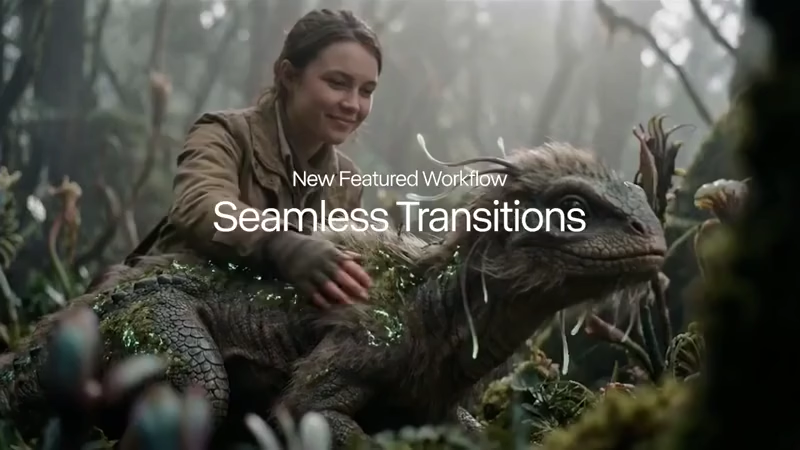
New to Featured Workflows: Seamless Transitions.
Now you can create multiple generations with a single consistent subject interacting with different objects across various scenes and environments. All in a single, easy to use Workflow without the need for complex prompting.… pic.twitter.com/kDgTMaJk3b— Runway (@runwayml) January 7, 2026
Using its latest Gen-4.5, for example, users can deliver stunning visual fidelity, realistic physics, and precise motion, but the real innovation lies in how these capabilities are packaged.
Runway empowers users to maintain coherent characters, objects, and worlds across multiple scenes without endless trial-and-error prompting.
This philosophy reaches a new pinnacle with the latest addition to their Featured Workflows: 'Seamless Transitions.'
Now available in the app, this workflow revolutionizes how creators handle narrative continuity in AI-generated content. Instead of wrestling with complex prompts to force consistency or stitching disparate generations manually, users can now produce multiple video generations featuring a single consistent subject interacting with different objects, placed in varied scenes and environments, all within one intuitive, node-based workflow.
The process runs with a single click, chaining prompting, generation, and refinement steps together effortlessly. No coding required, no intricate prompt engineering to maintain character appearance across lighting changes, locations, or actions.
It builds directly on Runway's strengths in reference-based generation and world understanding, making it ideal for storytelling, product visualizations, long-form narratives, or rapid iteration in advertising and film pre-production.
What sets this apart in the ongoing AI video arms race is its focus on empowerment rather than spectacle alone.
While tools like Sora excel at isolated, breathtaking moments and Kling prioritizes quick, high-volume social content, Runway's Seamless Transitions addresses a core frustration for serious creators: building cohesive sequences without losing the thread of identity or style. It transforms what was once a fragmented, labor-intensive process into a streamlined pipeline, allowing artists to experiment freely and scale ideas into full productions.
Partnerships with industry leaders like Lionsgate, Adobe, and NVIDIA further underscore Runway's position as the tool bridging accessible AI with Hollywood-grade demands.
As the LLM war evolves into a broader multimodal intelligence contest, Runway reminds us that the true winner isn't the flashiest single output, but the platform that best amplifies human creativity.
This feature is game-changing addition to users arsenal because after all, video creation isn't just about what AI can generate. But it's about how seamlessly it lets people tell their story.

















































































































































































































































































