The π, or pi, is a ratio and is obtained from a circle. If the diameter and the circumference of a circle are known, the value of pi will be as π = Circumference / Diameter.
For most people, pi is 22 / 7, or 3.14.
But for researchers and mathematicians, pi is an irrational number, meaning that it cannot be expressed exactly as a ratio of two integers. What this means, pi's decimal representation never ends, nor enters a permanently repeating pattern. In other words, pi is a transcendental number.
For thousands of years, mathematicians have attempted to extend their understanding of pi, in order to increase pi's accuracy.
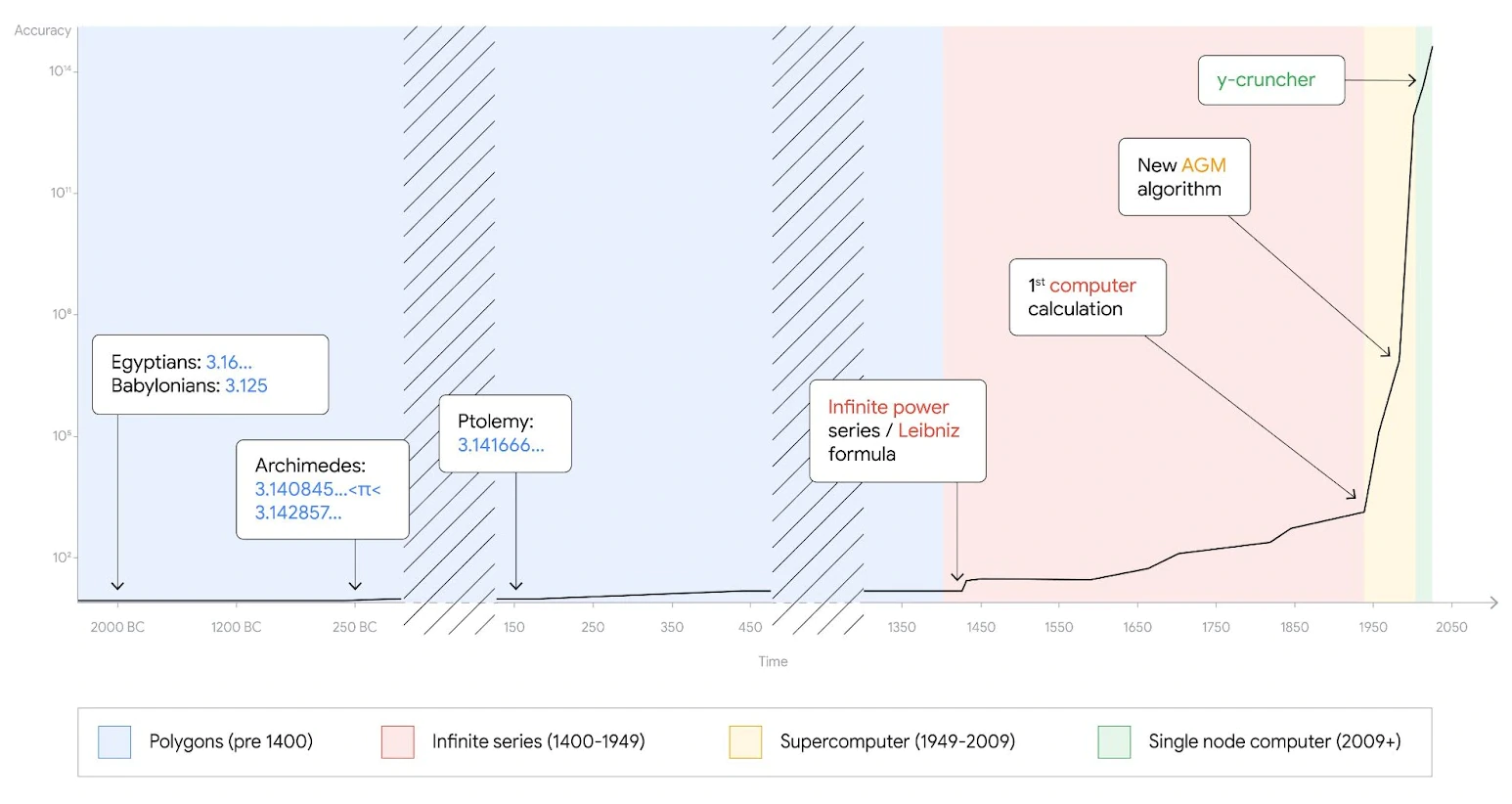
What can be traced back to ancient civilizations, including the Egyptians and Babylonians, the people at that time used approximation numbers for pi. Then, around 5 AD, mathematicians have approximated pi to seven digits. In mid-20th century, mathematicians managed to reach pi's first thousand digits.
And later, after the first ever computational formula for pi was only discovered after computers were invented, feeding computers with calculus, mathematicians were able to calculate far beyond thousands of digits, to millions, billions, and even trillions.
The computations are motivated by the development of efficient algorithms to calculate numeric series, as well as the human quest to break records, as well as to test computers that have evolved, in order to judge the incremental abilities supercomputers are benefiting as they advance.
Since then, and when the race began, the digits of pi have increased exponentially.
Advances in computing are causing records to regularly tumble.
This time, Google is having another go.
円周率100兆桁を @googlecloud を使って計算して、世界記録を更新しました!詳しい技術的な内容はこちらの公式ブログ(英語)をご覧ください。日本語版はもうちょっとしたら出る予定です。 https://t.co/UKcFchGisl
— Emma Haruka Iwao (@Yuryu) June 8, 2022
And when it did, developers working for the company have set a world record, after calculating pi to its first 100 trillion digits.
This massively obliterated previous record, which was at 31.4 trillion.
The team led by Google Cloud’s Emma Haruka Iwao, managed to broke the milestone by threefold.
It's worth noting that before this, in 2019, a milestone was also set by Iwao
That milestone was then overturned in 2020, before Iwao reclaimed her crown in March 2022.
To accomplish the feat, Iwao’s team used the y-cruncher program and Chudnovsky algorithm.
The team's calculation ran continuously for 157 days before finding the 100-trillionth decimal place, which is a 0.
They then verified the final numbers with the Bailey–Borwein–Plouffe formula.
In total, the process used 515 TB of storage and 82 PB of I/O.

While this is certainly an accomplishment, Google in doing this doesn't necessarily mean that it needs it.
While pi serves many practical purposes, and used in countless formulas for real-world applications, only an approximation is needed.
In most cases pi to the 10th decimal place is enough. Even NASA uses no more than 15 digits of pi.
Google goes to great length to calculate pi to the 100 trillionth digit because it simply wanted to showcase how fast and powerful computers have become.
"As a developer advocate at Google Cloud, part of my job is to create demos and run experiments that show the cool things developers can do with our platform; one of those things, you guessed it, is using a program to calculate digits of pi" Iawo said.
CEO of Google Cloud, Thomas Kurian, congratulated Iawo in a tweet:
Congratulations, @Yuryu, on your record-breaking calculations of pi to 100 trillion digits. It’s a true testament to how Google Cloud’s infrastructure can help push the boundaries of scientific experimentation. https://t.co/6IGViMjg3v
— Thomas Kurian (@ThomasOrTK) June 8, 2022






















































































































































































































































































