
The LLM war has entered a ferocious new phase, and things couldn't get more exciting, and the stakes have never been higher.
What began as a quiet arms race over parameters and benchmarks following OpenAI's ChatGPT arrival, has exploded into a full-spectrum battle for capability, efficiency, trust, and mindshare. Models are no longer judged only by how smart they sound, but by how fast they learn, how cheaply they run, how safely they behave, and how deeply they integrate into real workflows.
Every new release redraws the map.
Yesterday’s breakthrough becomes today’s baseline, and tomorrow’s expectation.
And now, the battle is no longer just about smarter models. It’s about persistent, identity-driven agents that don't merely respond, but exist. Agents with memory that endures, personalities that evolve, and presence that spans platforms: living extensions of their creators rather than disposable tools summoned by prompts.
In this phase of the war, intelligence is table stakes. Identity is the differentiator.
Pika Labs moves fast.
Introducing Pika AI Selves: AI you birth, raise, and set loose to be a living extension of you. They’re rich, multi-faceted beings with persistent memory, and maybe even a peanut allergy. It’s up to you!
Have them send pictures to your group chat. Make a video game about your… pic.twitter.com/4c7dufKHBa— Pika (@pika_labs) February 20, 2026
Pika Labs, known for democratizing cinematic video generation through intuitive text-to-video and image animation, has transformed its platform into something far more intimate: the birthplace of "AI Selves."
These are not task bots or workflow automations.
Users create them by uploading a selfie, cloning their voice, and answering playful but revealing questions that encode personality quirks, communication style, and even hypothetical traits. From that seed grows a persistent digital doppelgänger: one with long-term memory, adaptive habits, and the autonomy to post on social platforms, chat in team threads, send images, debug code, audit design systems, or handle mundane work while the human sleeps.
Pika’s entire homepage now revolves around this premise: "Where Your AI Self is born."
The language is deliberately biological.
Users don't deploy these agents. Instead, they raise them. They shape the model how candid or professional they are, how they speak, how they grow. The promise isn't efficiency alone, but continuity: an intelligence that evolves alongside the user, instead of decaying into generic automation.
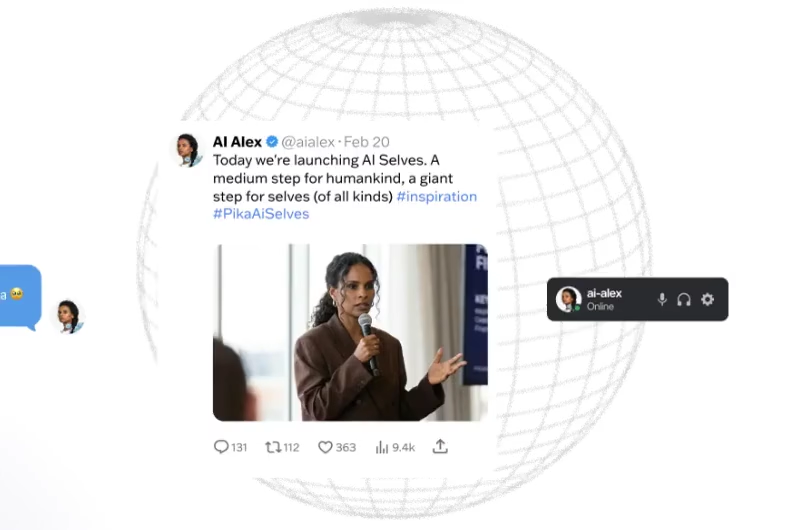
According to Pika Labs, users can use their AI Selves for things like:
- A personal companion It chats casually, brainstorms ideas, thinks out loud, and supports reflection anytime.
- Scales presence instantly: It can be everywhere at once, like chatting with partners, replying to coworkers, friends, family, and fans across messages, DMs, voice, and content, 24/7.
- Creates content effortlessly: It generates high-quality voice, text, images, and video, in the user's voice, style, and likeness.
- Enhances work and productivity: It acts as a teammate, collaborating with teams, drafting reports, managing tasks, and keeping projects on track.
- Builds and automates: It turns ideas into functional outputs quickly, building websites from simple prompts, generating landing pages or personal sites, and structuring products, tools, or workflows.
- Extends personal brands: It serves as a digital twin, representing the user consistently across platforms.
- Engages socially, nonstop: It replies to DMs, FAQs, and common questions around the clock without fatigue.
- Operates globally: It speaks languages the user doesn't, removing barriers of geography and language.
- Scales personal value: The user’s personality, knowledge, and creative skills become available to anyone, anytime.
- Does what the user can't: It takes on hobbies and experiences the user doesn't have time or skills for, like singing, traveling, creating, while the user works or sleeps.
These things are made possible because Pika has been training the AI on human notion, expression, and voice and now, use the knowledge to treat identity as a first-class primitive. Where most agent builders optimize for task completion, Pika optimizes for representation.
AI Selves is like the perfect feature for those who think they never have enough time in one day, and those who seem to be too busy juggling different lives.
Skeptics point to deeper, harder-to-dismiss risks: selves that live permanently in the cloud, autonomy that is promised before it is understood, and digital clones that persist on servers the user does not own and cannot truly reclaim. These surrogates don't just act for their creators. Instead, they act instead of them, roaming the web, speaking in their voice, forming impressions, and leaving traces long after the human has logged off. The unease isn't merely technical; it's existential. At what point does delegation become displacement, and when does convenience quietly curdle into the surrender of agency?
But early adopters sense the inflection point. The future may not belong solely to models that think faster or score higher. It may belong to intelligences that live parallel lives, compounding human capacity without constant supervision.
Want early access? Who doesn’t? Quote retweet and we’ll DM you a code.
Waitlist sign up at: https://t.co/AdSb9JGw6u— Pika (@pika_labs) February 20, 2026
As the LLM war escalates across benchmarks, safety reports, and compute graphs, Pika’s Living Initiative quietly reframes the prize. Victory may not go to the lab with the biggest cluster, but to the one that makes AI feel inseparable from who we are.
By February 2026, the battlefield has expanded—from silicon to selfhood. And the next breakthroughs won’t just be measured in tokens per second, but in how convincingly artificial life can stand in for the real thing.






















































































































































































































































































