
Deepfakes are synthetic media in which a person's likeness, voice, or actions are manipulated or entirely generated using AI.
The term which combines the world "deep learning" and "fake," reflects how the technology uses advanced neural networks to create realistic but false representations. What started on Reddit, it was fun at first, until it lasts.
As more people realize that they can use the technology to face swap, the more tools to enable this are created.
As a result, more people are able to create misinformation.
This raises risks and ethical concerns.
Among the many, include reputational damage, as well as legal concerns.
From deepfakes of Israeli actress Gal Gadot to many other celebrities who have had their faces swapped onto porn stars' bodies, AI-powered deepfakes become more worrisome, after generative AI came into play.
And one of the worst things that happened, was when AI-generated images of Taylor Swift began populating the internet and became viral.
Google, as the so-called 'gatekeeper' of people on the web, has long been the enabler of users to look for information on the web.
And with the rise of deepfakes, and after they're made worse after the rise in generative AI tools, the company finally began addressing the issue.
Rather later, but better than never, Google is finally taking action to curb non-consensual deepfakes that happened to be indexed by its search engine.
To do this, Google is making it easier for anyone to remove their deepfakes from its search results, by unveiling an option that should help them file a request to Google in a faster manner.
According to Google in a blog post:
"For many years, people have been able to request the removal of non-consensual fake explicit imagery from Search under our policies. We’ve now developed systems to make the process easier, helping people address this issue at scale."
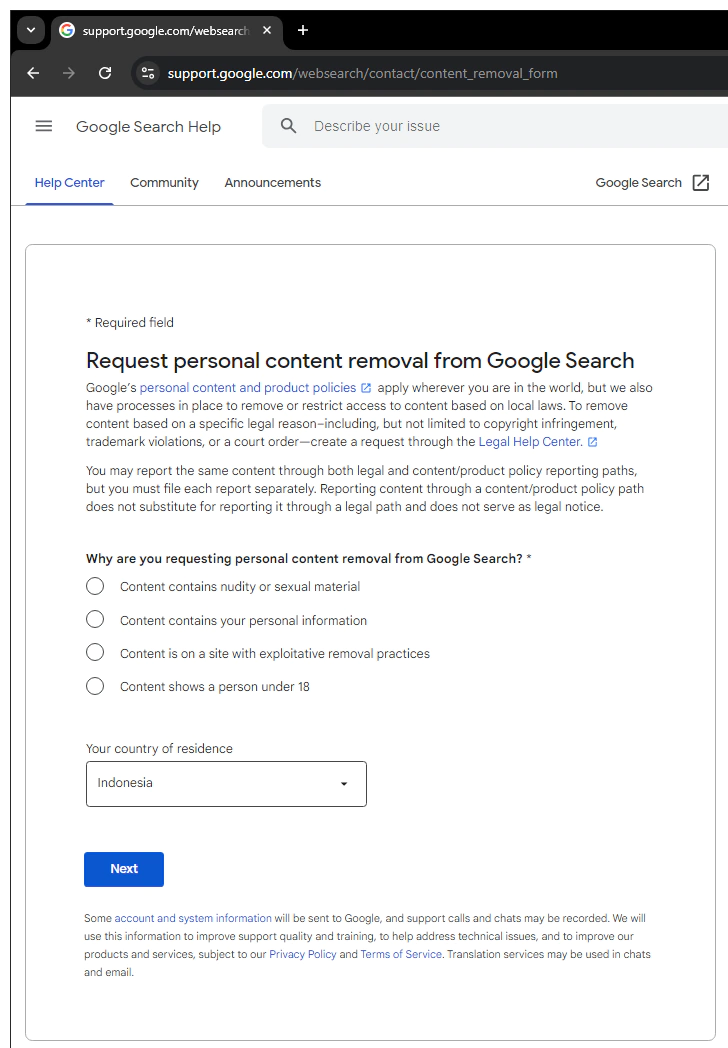
To ask Google to remove non-consensual explicit deepfake content:
- Visit the web form.
- Under the multiple options, choose the option that says 'Content contains nudity or sexual material'.
- Choose country of residence.
- Click on 'Google Search' from the drop-down menu and choose the option named 'Nudity of graphic sexual content'.
- Fill in the required information, including legal name, and some others.
- Provide an URL of the deepfake content, attach a screenshot, and explain the reason why it should be removed.
- Once done, click on the 'Submit' button.
If Google verifies that the information is true, it will have the URL removed from its search result, effectively preventing anyone to look for that same content on the web through Google.
"We recognize it can be distressing when explicit non-consensual fake imagery is discoverable in Google search results," said Google in a dedicated help page, pointing out as the reason why the company is making it easier for people to remove non-cencensual content from its search engine.
On top of that, Google is also "updating our ranking systems for queries where there’s a higher risk of explicit fake content appearing in Search."
The idea is to "better surface legitimate content and downrank explicit fake content."






















































































































































































































































































