
As more companies are adopting blockchain into their business, Google is not slowing down as it dives deep into Ethereum.
Here, the company has expanded its big data analytics with the inclusion of tools to explore the Ethereum blockchain. The company has made the Ethereum dataset available to enable the exploration of smart contract analytics, the company announced on a blog.
Google made this possible using BigQuery, which is Google’s web service that enables interactive analysis of massively large datasets, and works in conjunction with Google Storage.
"Ethereum and other cryptocurrencies have captured the imagination of technologists, financiers, and economists," said Google. "Digital currencies are only one application of the underlying blockchain technology."
Previously, services already exist that show information about wallet addresses and transactions, but with Google embracing Ethereum analysis, people can investigating the full breadth of data stored on the Ethereum blockchain, something that has been a cumbersome process.
It also extracts data daily from the Ethereum blockchain ledger, including token transfers, and stores partitioned data for efficient exploration on BigQuery.
BigQuery can also connect directly with the Parity client, an Ethereum client for building applications, the blog noted.
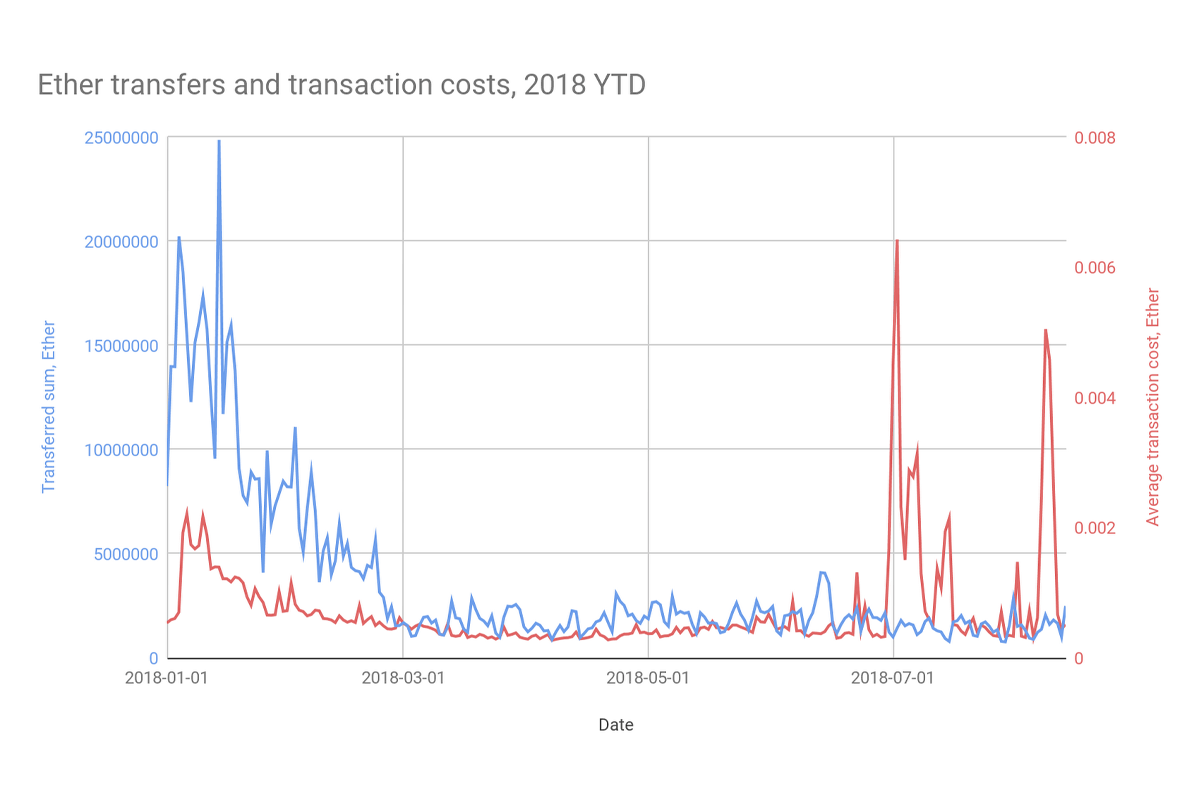
To make this possible, Google Cloud has a built-in system which "synchronizes the Ethereum blockchain to computers running Parity in Google Cloud, performs a daily extraction of data from the Ethereum blockchain ledger, including the results of smart contract transactions, such as token transfers, and de-normalizes and stores date-partitioned data to BigQuery for easy and cost-effective exploration."
Google demonstrated a few examples of how this data could be put to use.
The first was Google querying the dataset’s transactions and contracts tables to find the most popular smart contracts, like the most popular Ethereum collectibles ERC721 measured by transaction count:
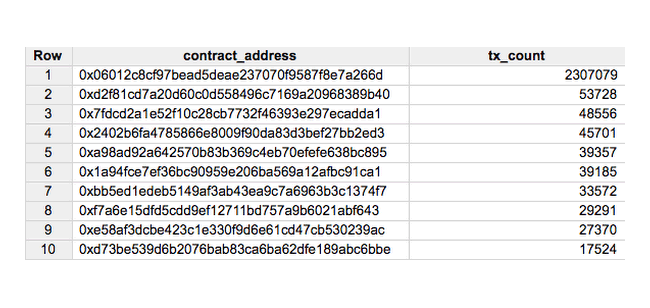
This data can then be analyzed deeper to find out more information, in the form of some charts.
Another example was a query for measuring a token statistic (transaction count) by time window. Shown below, Google visualizes data of the ERC20 token OmiseGO (OMG) as a time series from inception through August 2, 2018:
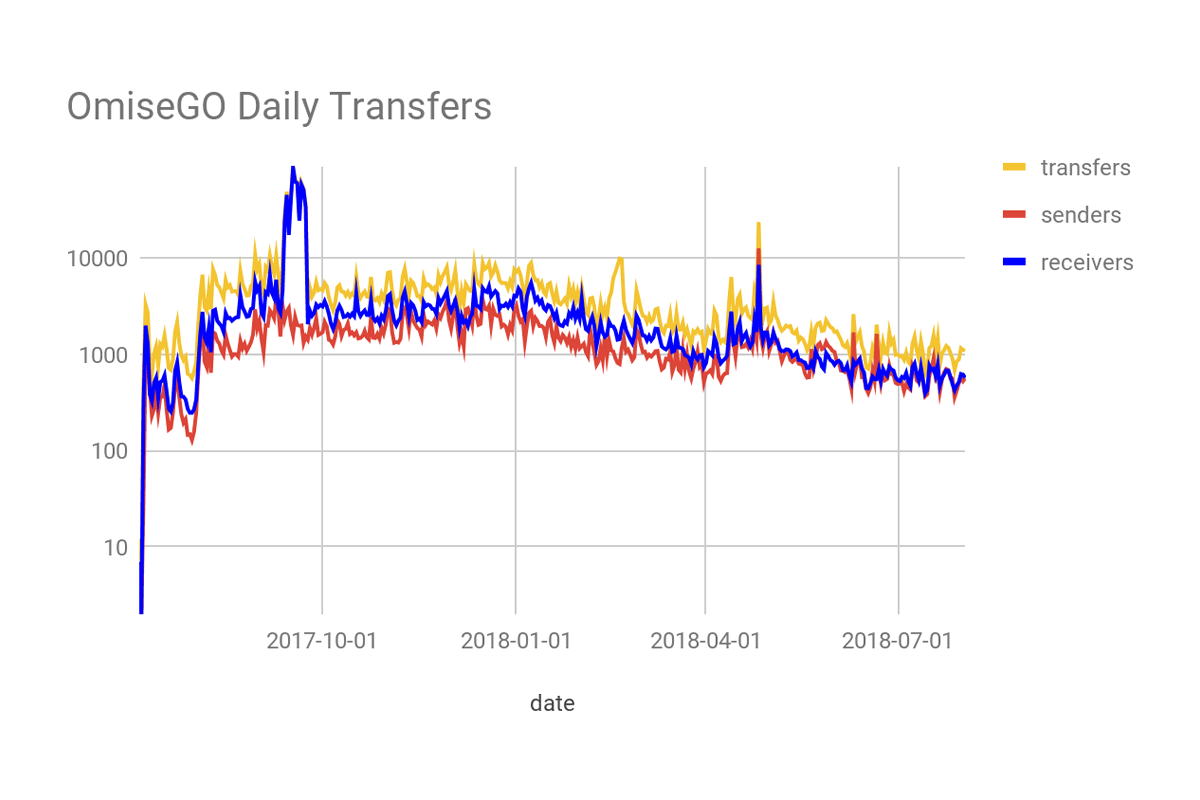
"A visualization like this (and the underpinning database query) is useful for making business decisions, such as prioritizing improvements to the Ethereum architecture itself (is the system running close to capacity and due for an upgrade?) to balance sheet adjustments (how quickly can a wallet be rebalanced?)."
Graphs like these are useful, even the development of the Ethereum architecture itself. With the tool, people can check whether their Ethereum system is running at capacity or needs upgrading, all with a simple database query.
Much of the smart contract source code is available for free, allowing users to discover what functions contracts perform based on the name, even if those functions don’t have the source since common function names use a common signature.
Google in integrating Ethereum with BigQuery focuses on bringing the freedom that comes with big data and a large suite of analytic tools.
Chrome users are also capable of accessing and reading all of the data stored on Ethereum’s blockchain. Using BigQuery Python library, users can query data tables in Kernels, a free in-browser coding platform on the public data science platform Kaggle. A knowledge of database programming is definitely helpful, as all queries are made using SQL.






















































































































































































































































































