The LLM war saw millions of users overnight with its fluent, context-aware responses.
Since the launch of ChatGPT by OpenAI, tech giants and startups responded in kind, rolling out competing models, with each promising improvements in reasoning, speed, or specialized capabilities.
Browser maker Opera, long an early adopter of AI tools, is now advancing its own approach by bridging external LLMs directly into the browsing experience rather than locking users into a single proprietary system.
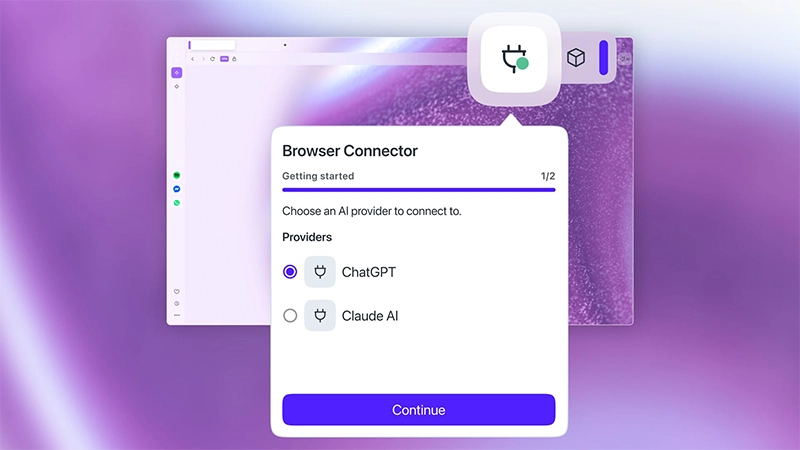
In a move, Opera has introduced 'Browser Connector,' a new feature available in Opera One and Opera GX.
According to the announcement, it allows users to connect popular third-party AIs such as ChatGPT and Claude to the browser via the Model Context Protocol, or MCP.
Once linked, these external models gain real-time access to the user’s open tabs, active page content, and even screenshots of visuals like charts or images, all without requiring manual copy-and-paste of context.
Users retain full control, selecting precisely which elements the AI can see and revoking access at any time.
AI is improving but your current setup hasn’t caught up yet. You’re still copy-pasting & losing productivity to retype the context.
There’s a smarter way now with Browser Connector: in the video example, Claude speaks with the tabs, gaining full context and helping to create a…— Opera (@opera) April 16, 2026
This addresses a persistent friction point in everyday AI use.
Researchers or shoppers often juggle multiple tabs, only to switch to a separate chat window and laboriously reconstruct the scene: summarizing pages, listing URLs, describing what's on screen. Browser Connector removes that step.
The connected AI can "see" the current session as it unfolds, drawing on live information to assist with tasks such as comparing products across sites, synthesizing research notes, or generating summaries grounded in the exact pages the user is viewing.
Opera's strategy builds on earlier steps it has taken in the AI space.
The company integrated ChatGPT shortly after its public launch in 2023 and later developed its own multi-LLM engine, now known as Opera AI, which dynamically selects from various models including those from Google and OpenAI. It also experimented with local, on-device LLMs to give users privacy-focused options that run without sending data to the cloud.
The real problem the Browser Connector solves:
Let’s say you’re reading something, or comparing across tabs. Normally, you would copy, paste, explain and repeat.
Now, with Browser Connector, your AI can access your open tabs, read context, and take screenshots when needed. So,…— Opera (@opera) April 16, 2026
Browser Connector extends this openness further, positioning the browser as a neutral platform where users can bring whichever AI best suits their needs rather than being confined to Opera's built-in assistant.
The feature draws on technology Opera first tested in its experimental Neon browser, where AI agents could act more autonomously inside the session.
Browser Connector, by contrast, focuses squarely on context sharing: the external AI observes and understands the browsing environment but does not control navigation or perform actions on the user’s behalf unless the user explicitly directs it. Implementation is straightforward: no complex setup or accounts beyond the existing ChatGPT or Claude credentials.
The feature rolls out initially to users in the Early Bird program for Opera One and Opera GX.
Available now in Opera One and GX (in Early Bird).
Enable it through the settings with Early Bird, connect your AI, and finally stop explaining your browser to your AI. pic.twitter.com/yVlashVWMo— Opera (@opera) April 16, 2026
By facilitating this kind of interoperability, Opera is emphasizing choice over proprietary lock-in at a time when many AI providers are building closed ecosystems.
It represents one practical way browsers can evolve from passive windows into the web into active facilitators between users and the expanding array of large language models.




















































































































































































































































































