The moment large language models (LLMs) burst onto the scene, it rewrote the rules of search, knowledge, and even browsers.
When OpenAI revealed ChatGPT, the process of people asking questions became conversational. Instead of typing keywords into Google, people were chatting with an AI. That shift has triggered what many are calling the new LLM war, a race among AI models and platforms to become the next default interface between humans and the digital world.
Into that battleground steps Perplexity, not with another chatbot or search app, but with a full-fledged browser: Comet.
Whereas previous AI integrations were tacked onto Chrome or Edge as plugins, Comet is built from the ground up to be "AI-native." It doesn’t just browse the web; it participates in it.
Where a traditional browser is passive, Comet is agentic, meaning that it is able to interpret what users see, help them act on it, and anticipate their next move.
It was a $200 price to experience this.
Now, it's free.
Comet is now available to everyone in the world.
In the last 84 days, millions have joined the Comet waitlist looking for a powerful personal AI assistant and new ways to use the internet.
The internet is better on Comet. pic.twitter.com/te82RnzssJ— Perplexity (@perplexity_ai) October 2, 2025
When Comet was first launched, access was highly restricted. At the time, only Perplexity Max subscribers and select invitees could use it.
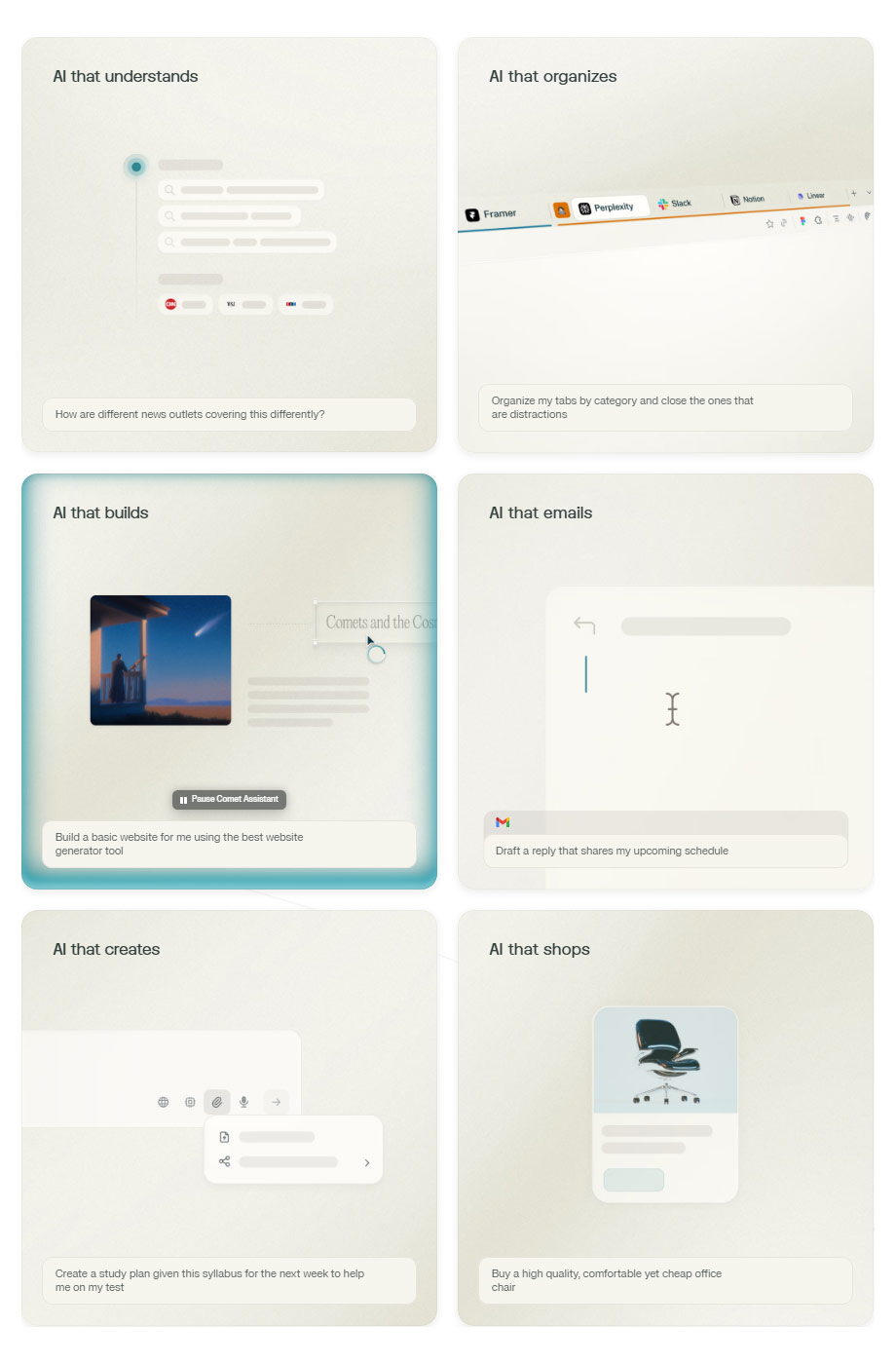
The browser came bundled with Perplexity’s AI search engine as its default, and its signature feature was the built-in Comet Assistant, an AI agent that lives in the sidebar, actively analyzing pages, summarizing content, answering queries, and even helping with tasks like composing emails or comparing products.
But what makes Comet stand out is not just the AI assistant, but how closely it’s woven into the browsing experience.
Highlight any text and the assistant can instantly explain it, help users spin off tangents without losing context, or carry forward relevant insights across multiple tabs.
In effect, the browser becomes a collaborator rather than just a tool.
Comet was one of the pioneers, the first of its kind, before a number of others followed suit.
Google has responded with Gemini in Chrome, giving Chrome users AI features more natively. Microsoft, meanwhile, added Copilot Mode into Edge, mixing search, navigation, and chat into a unified interface. Even the underdog Opera is also joining the fray with its own AI browser, Neon.
With all of them staking claims in the emerging domain of AI browsers, where agents don’t just respond but act, Perplexity is getting more than a handful of competitors trying to kick it out of the arena.
To remain relevant, Perplexity is making Comet free for everyone.
What this means, no more paywall to experiment with the future of browsing.
And to make things even more enticing, this free version of Comet coexists with Comet Plus, a $5/month add-on granting access to premium news publishers. And to sweeten the value to content creators, Perplexity promises to share 80% of subscription revenue with participating journalists and outlets.
Still, it’s not all smooth sailing.
Some critics and security audits have raised concerns about how Comet handles webpage content and user inputs, pointing out vulnerabilities such as potential injection of malicious commands during summarization.
Because Comet can execute actions based on user instructions tied to the content it analyzes, the lines between browsing and execution blur, and that demands very careful design.
Read: Agentic Browsers Like Perplexity Comet Vulnerable To Indirect Prompt Injection, Said Brave
The internet is better on Comet.
Now, it's available for everyone worldwide. https://t.co/1mJzeQxHCw— Comet (@comet) October 2, 2025
Perplexity, though, is ambitious.
The vision is that, browsers of the future is no longer passive, but an intelligent workspace that anticipates and helps users act, rather than just show them pages.
In the unfolding war of LLMs, Comet represents both a challenge to existing browser giants and an evolution of how people think about “surfing” the web.
It’s no longer about moving from URL to URL. Instead, it’s about conversations, context, and delegation.
At this time, Google Chrome still dominates the browser market, and it’s easy to see why: people are familiar with it, and it simply works. With Chrome now equipped with its own AI-powered features that can handle many of the same tasks as an agentic browser, Perplexity faces an uphill battle.
If Perplexity hopes to win users over, it’ll need to show that Comet is more than just another smart assistant. To succeed, Comet must feel truly indispensable.




















































































































































































































































































