Adobe has long been one of leaders in enterprise software companies. And thanks to AI, things tend to look good.
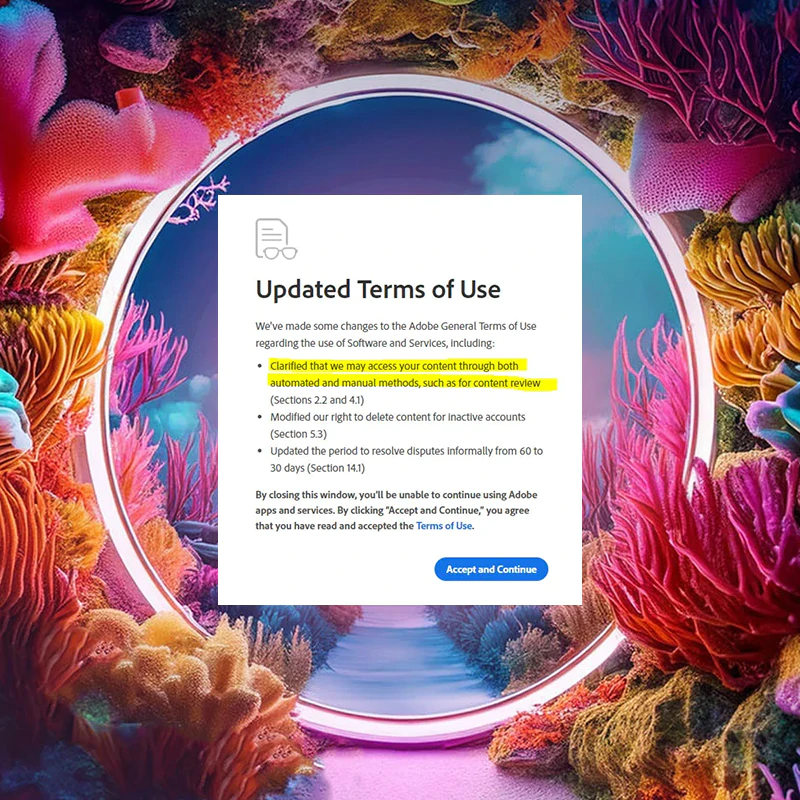
Until it isn't. This happens when the company found itself in hot water over its updated “Terms of Service” (ToS), which says that it "may access, view, or listen your content through both automated and manual methods", using techniques "such as machine learning".
The company's updated terms also say that it may use, replicate, or "create derivative works" based on what its users create on Adobe products like Photoshop and Illustrator.
Making things worse, it's requiring users to agree to those terms before continuing to use its apps.
It didn't take long until users spotted the change, and that the change quickly sparked outrage on social media.
Creatives began publicly pushing back against Adobe having full access to the work they create.
We recently made an update to our Terms of Use with the goal of providing more clarity on a few specific areas. We have received a number of questions resulting from this update and want to provide some clarity.
— Adobe (@Adobe) June 6, 2024
It’s Section 2.2 in the updated Adobe terms that has infuriated a handful of users on social media, namely X.
Adobe says that it needs to access users' data in order to "detect, prevent, or otherwise address fraud, security, legal, or technical issues", and that it's also needed to "enforce the Terms", and to "improve our Services and Software and the user experience".
Even when Adobe says in Section 4.1 that it will not review all content, and that it "may use available technologies, vendors, or processes, including manual review, to screen for certain types of illegal content (for example, child sexual abuse material) or other abusive content or behavior (for example, patterns of activity that indicate spam or phishing, or keywords that indicate adult content has been posted outside of the adult wall", users aren't pleased.
To many users which are infuriated, demanding access to users' content means that Adobe can both conduct surveillance on them, and of training AI on their content.
And what this also means, Adobe that demands users' content means that it can view confidential content that is protected under non-disclosure agreements or confidentiality clauses/contracts between said Adobe users and clients.
The focus of this update was to be clearer about the improvements to our moderation processes that we have in place. Given the explosion of Generative AI and our commitment to responsible innovation, we have added more human moderation to our content submissions review processes.
— Adobe (@Adobe) June 6, 2024
Access is needed for Adobe applications and services to perform the functions they are designed and used for and to deliver some of our most innovative cloud-based features such as Photoshop Neural Filters, Liquid Mode, or Remove Background.
— Adobe (@Adobe) June 6, 2024
Responding to this backlash, an Adobe spokesperson tries to clarify.
The person says that the policy has in fact "been in place for many years."
"As part of our commitment to being transparent with our customers, we added clarifying examples earlier this year to our Terms of Use regarding when Adobe may access user content. Adobe accesses user content for a number of reasons, including the ability to deliver some of our most innovative cloud-based features, such as Photoshop Neural Filters and Remove Background in Adobe Express, as well as to take action against prohibited content. Adobe does not access, view or listen to content that is stored locally on any user’s device."
Shortly after the backlash, Adobe published a blog post further elaborating on what had changed, and said that it would not train Firefly AI models on user content.
Our commitments to our customers have not changed. Adobe does not train Firefly generative AI models on customer content, and Firefly generative AI models are trained on a dataset of licensed content, such as Adobe Stock, and public domain content.
— Adobe (@Adobe) June 6, 2024
We appreciate our customers who reached out to ask these questions which has given us an opportunity to clarify our terms and our commitments. We will be clarifying the Terms of Use acceptance customers see when opening applications.
— Adobe (@Adobe) June 6, 2024
"Adobe does not train Firefly Gen AI models on customer content. Firefly generative AI models are trained on a dataset of licensed content, such as Adobe Stock, and public domain content where copyright has expired".
"Adobe will never assume ownership of a customer’s work. Adobe hosts content to enable customers to use our applications and services. Customers own their content and Adobe does not assume any ownership of customer work".
But just like many times before, Terms of Services of various products and tools from various big companies have longed been a home for ambiguity.
Regardless, many social media users around the web have voiced their desires and intention to cancel their Adobe Creative Cloud or software app subscriptions.

















































































































































































































































































