Elon Musk’s ambitious plan to turn X, formerly Twitter, into a full-fledged super app is moving forward.
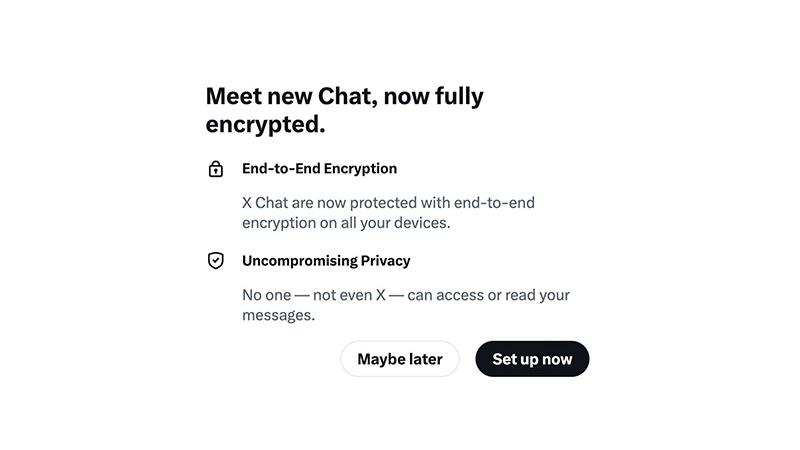
And with the rollout of XChat, a new instant messaging feature being marketed as the platform’s answer to WhatsApp, Telegram, and even China’s WeChat, is one of the ways to pave the path towards Musk's plan. At first glance, XChat seems like a major leap, and a major advantage for X users since it delivers convenience and deeper integration with the X ecosystem
For Musk, XChat is about more than private messaging.
It is another step toward turning X into a WeChat-style super app where posting, chatting, calling, and even financial transactions all happen in one place.
It’s a powerful vision, and for users already embedded in X, the convenience of XChat is undeniable. But when it comes to privacy, the bold claims about “Bitcoin-style encryption” do not hold up under scrutiny.
But there is more (and also much less) than meet the eyes.
First and foremost, XChat allows users to communicate way beyond text.
The service adds disappearing messages, the ability to unsend, file sharing of any type, voice notes, audio and video calls without needing a phone number, and even emoji reactions. In short, it blends elements of WhatsApp, Telegram, and Snapchat into the X ecosystem, where users can post, chat, and interact all in one place.
While it doesn't come as a standalone chat, it's baked right into the X app, designed to significant upgrade X’s existing direct messaging system.
If the story ends here, at this stage, XChat is a promising messaging feature for communication.
It can rival, or even become a replacement to Signal or even WhatsApp.
The service may evolve as Musk pushes X deeper into the super app model, but for now, its security promises are more marketing spin than revolutionary reality.
But things somehow fell short when Musk said that XChat uses a "Bitcoin-style encryption" model to protect private conversations.
This raises questions, if not eyebrows.
You can do audio/video calls without a phone number across all platforms
— Elon Musk (@elonmusk) June 1, 2025
The term “Bitcoin-style encryption” is where things get confusing.
Bitcoin does not encrypt conversations; instead, it uses public key cryptography to verify transactions. When Musk describes XChat this way, experts argue he is relying more on marketing language than technical reality. Reports show that XChat uses standard encryption methods, not blockchain, which makes the branding more about hype than groundbreaking innovation.
Security researchers have raised several red flags that put XChat far behind services like Signal.
The first issue is that private keys are stored on X’s servers, protected only by a four-digit PIN, instead of being stored locally on user devices. This creates the risk of tampering, especially if hardware security modules are not properly implemented. While X engineers have claimed HSMs are in use, they have yet to provide proof, leading experts like Matthew Garrett to describe the system as “trust us, bro” security.
Another concern is the possibility of adversary-in-the-middle attacks, which X itself admits could compromise conversations if a malicious insider or even the company decided to interfere.
XChat also does not implement perfect forward secrecy, meaning if a private key is compromised, an attacker could decrypt past conversations, not just the most recent message. On top of that, none of XChat’s encryption design has been open-sourced or independently audited, unlike Signal’s, which means users cannot verify the system’s trustworthiness.
Long story short, XChat cannot be compared to encrypted messaging apps, and is more comparable to unencrypted DMs.
Researchers argue that while the feature looks good on the surface, the technical weaknesses undermine Musk’s promises of unmatched security.

In other words, at least at this time, XChat lacks when it comes to true security.
WhatsApp offers verified end-to-end encryption by default, Telegram at least provides “secret chats” with optional encryption, and Signal remains the gold standard with open-source protocols, forward secrecy, and strong independent audits. XChat, by contrast, remains closed, incomplete, and heavily reliant on trust in the company itself.
In the end, XChat, at least initially, is less about rewriting the rules of secure communication and more about consolidating convenience inside the X platform.
For everyday messaging, file sharing, and quick calls, it feels like a solid upgrade from standard DMs. But for those who care deeply about privacy and cryptographic integrity, the platform’s promises fall short of its hype. Until X delivers transparency, open-source code, and independent audits, XChat’s “Bitcoin-style encryption” will remain a catchy phrase rather than a true breakthrough.
Elon Musk may succeed in drawing users simply because of X’s massive reach and the appeal of an all-in-one super app. Yet, whether XChat can ever rival WhatsApp or Signal on trust and security is an open question.
It's something that won’t be answered by marketing alone.






















































































































































































































































































