When Bonnie Blue was deported from Bali over allegations of producing pornographic content, many Indonesians suspected it wouldn't be the last such incident.
That prediction proved accurate just a few months later. In early March 2026, a similar case erupted online when an explicit video made in Bali surfaced on social media platforms, once again igniting debate over foreign influencers pushing boundaries in a country where such content is strictly criminalized.
Netizens initially labeled the woman a bule Inggris, assuming she was British or English based on her appearance, and the filming location was soon nicknamed "Kiclik Gojekers" in Bali's Canggu area. The video triggered a wave of shock, memes, outrage, and heated discussions about morality, tourism ethics, and the exploitation of local imagery for profit.
Many speculated the driver was a genuine Gojek worker, amplifying concerns over cultural disrespect in a nation where conservative values dominate.

It was later realized that the video, which depicts a woman riding a online motorcycle taxi was dropped off at a location, to then engaged in sex acts with the rider, complete with the signature green jacket.
In what appeared to be a unstaged pickup scenario quickly turned hardcore. The video, watermarked with an OnlyFans-linked account, spread rapidly across Indonesian online communities.

The police was quickly dispatched.
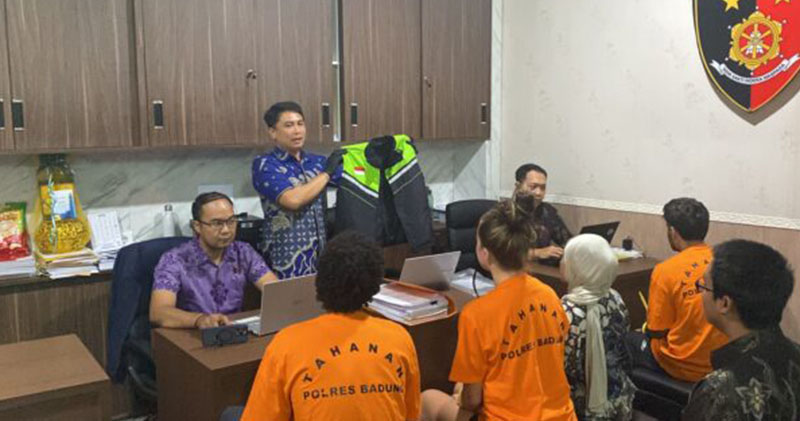
On March 13, immigration officers intercepted the woman and a man at I Gusti Ngurah Rai International Airport as they attempted to flee to Thailand.
Another man was arrested days later in Canggu.

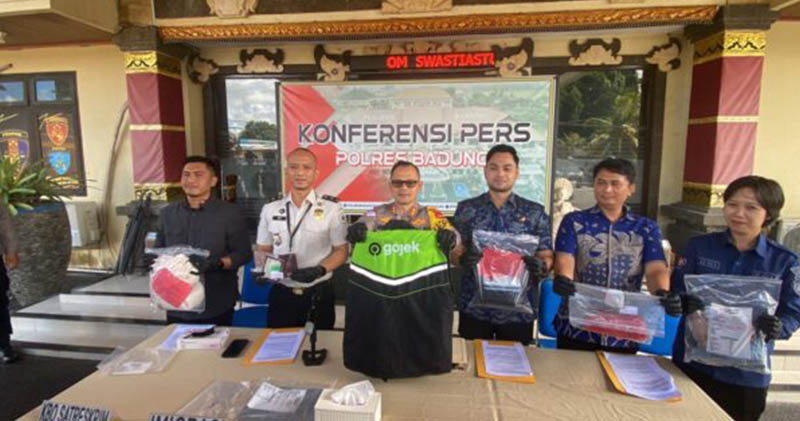
Seized evidence included 3 iPhones, a DJI camera, a MacBook, a Gojek vest used as a prop, and other production items.
The suspects face processing at Badung Police Headquarters, with potential blacklisting from Indonesia for at least a decade if convicted.


Police swiftly held a press conference, meant to clarify some of the records.
First and foremost, the woman, the central figure of the case, was not British at all but a 23-year-old French woman identified as Melisa Mireille Jeanine (abbreviated as MMJL), an OnlyFans content creator known online as CallMeSlooo. And second, the Gojek driver, wasn't a real taxi driver at all.
Accompanying her were two accomplices: a 26-year-old Frenchman (referred to as ERB), who served as her manager and producer, and a 24-year-old Italian man (NBS, named Nadir ben Said in reports), who portrayed the delivery driver in the video.
The production allegedly occurred at Villa Pande in Pererenan, Canggu, within Badung Regency. Authorities stated the primary motive was financial gain through uploading the content to subscription-based adult platforms.
"Their motivation to do the alleged crime is seeking profit from adult film video content," said police official Joseph Edward Purba said at a press conference.
“The suspects were then secured at the airport and taken to Badung Police Headquarters for further legal processing,” Purba said.
This case mirrors the high-profile deportation of British adult star Bonnie Blue in late 2025, who faced similar suspicions before her charges were downgraded to a minor visa infraction, resulting in expulsion and a long-term entry ban.
Such incidents highlight Bali's delicate balance: the island thrives as a global tourist haven famous for its beaches, nightlife, and relaxed vibe, yet it operates under Indonesia's overarching conservative framework, deeply influenced by cultural, religious, and legal norms that view explicit content as a threat to societal decency.
Indonesia's laws on pornography are among the strictest in the region.
The primary legislation is the Pornography Act (Law No. 44 of 2008 on Pornography), which broadly prohibits producing, reproducing, distributing, broadcasting, importing, exporting, offering, selling, renting, or providing pornographic materials or services. Pornography is defined as media, whether images, videos, writings, sounds, animations, gestures, or other forms, shown publicly with salacious content or sexual exploitation that violates societal moral values.
In this particular case, producing or distributing pornographic content can result in imprisonment from a minimum of 6 months to a maximum of 12 years, and/or fines ranging from Rp250 million (about US$16,000) to Rp6 billion (about US$380,000).
Additionally, the Electronic Information and Transactions Law (UU ITE, Law No. 11 of 2008, as amended) criminalizes the intentional and illegal distribution, transmission, or making accessible of electronic content that violates decency, often overlapping with pornography cases.
Violations here can add penalties of up to several years in prison and substantial fines, especially when content spreads online, and these laws apply to both citizens and foreigners, with no exemptions for tourists misusing visas for commercial activities like adult content creation.
Authorities emphasize that producing such material on a tourist visa constitutes an abuse of entry privileges, compounding charges.
Enforcement has intensified in recent years amid concerns over online exploitation, with platforms facing fines for failing to moderate prohibited content.
The trio's case serves as a stark reminder: while Bali welcomes millions seeking freedom and adventure, crossing into explicit production for profit invites severe legal repercussions, swift arrests, and potential long-term exclusion from the country.
As investigations continue, the incident reinforces Indonesia's unwavering commitment to protecting its moral and cultural standards, even as global digital trends test those boundaries.