
GitHub has updated its policy on how it handles user interaction data with Copilot, its AI-powered coding assistant.
In an announcement, the company said that it will use certain data from interactions with Copilot Free, Pro, and Pro+ plans to train and improve its AI models, unless individual users choose to opt out. This change does not apply to Copilot Business or Enterprise users, whose data remains protected under existing agreements.
Students and teachers with access through educational programs are also exempt.
The data in question includes inputs sent to Copilot, such as code snippets and prompts, along with outputs that users accept or modify.
It also covers surrounding code context at the cursor position, comments, documentation, file names, repository structure, navigation patterns, and user feedback like thumbs-up or thumbs-down ratings on suggestions.
This information comes from active use of features such as inline suggestions and chat. Importantly, the policy focuses on interaction data rather than code stored at rest in repositories, though snippets processed during Copilot sessions can be included if the user has not opted out.
In the announcement, GitHub has clarified that it will not share this data with third-party AI providers, though it may be shared internally with affiliates, including Microsoft.
In parallel with the policy update, GitHub said that it has also revised sections of its Privacy Statement and Terms of Service.
These changes formalize how user content can contribute to AI development and improvement, while adding definitions for terms like inputs, outputs, and AI features. The updates emphasize safeguards, such as filtering and de-identification where applicable, and align with what the company describes as common industry practices.
Users who had previously disabled data collection for product improvements will find their preferences carried over, so their data will not be used for training unless they actively change the setting.
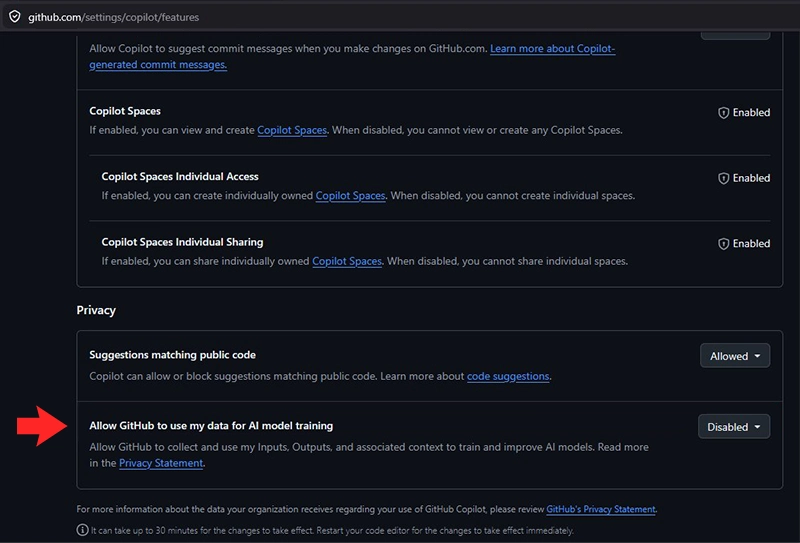
To opt out, users can visit their GitHub settings at github.com/settings/copilot (or directly under Copilot features), locate the section labeled "Allow GitHub to use my data for AI model training" in the Privacy area, and set it to Disabled.
This step must be completed for each account separately if someone manages multiple profiles. Once disabled, interaction data from that account will not be used for model training.
Data plays a central role in the development of modern AI systems.
Companies invest heavily in collecting and curating large volumes of real-world usage information because it helps models learn patterns, contexts, and nuances that static or publicly available datasets often miss.
Interaction data from actual developers, for instance, can improve an AI’s ability to suggest relevant code, understand workflow variations across languages and projects, and reduce errors in suggestions.
GitHub has pointed to internal testing with Microsoft employee data as evidence that such real-world inputs have already led to measurable gains, including higher acceptance rates for code suggestions.
This reflects a broader trend across the tech industry, where access to diverse, high-quality usage data is seen as essential for advancing AI capabilities that benefit users over time.
The shift to an opt-out model for individual and Pro users has drawn attention in developer communities, with some noting the contrast to stricter consent requirements in regions like the European Union.
GitHub maintains that the approach supports continued innovation in AI-assisted coding while giving users control over their preferences.
Those concerned about data usage are encouraged to review their settings promptly before the April 24 effective date. For enterprise customers or those under separate data protection agreements, the existing terms continue to apply without this change.






















































































































































































































































































