Jensen Huang has emerged as one of the most unexpected internet sensations in recent years.
The founder and longtime leader of Nvidia commands enormous respect in the worlds of technology, finance, and artificial intelligence. Yet it is not just Nvidia's trillion-dollar dominance or the global AI boom that has made Huang such a phenomenon. Instead, it is his joyful, spontaneous, and surprisingly relatable public persona, especially during his frequent street food adventures across Asia, that has transformed him into something few could have predicted: a tech CEO with genuine rockstar energy.
Fans across social media cannot get enough of the videos and photos showing one of the world's most powerful billionaires casually wandering through night markets, talking to ordinary people, accepting snacks from strangers, and lighting up over local food like an excited traveler rather than the architect of the AI revolution.
In an era where many corporate leaders appear distant and carefully managed, Huang feels refreshingly human.
And in China, that authenticity has further become the foundation of his online popularity.
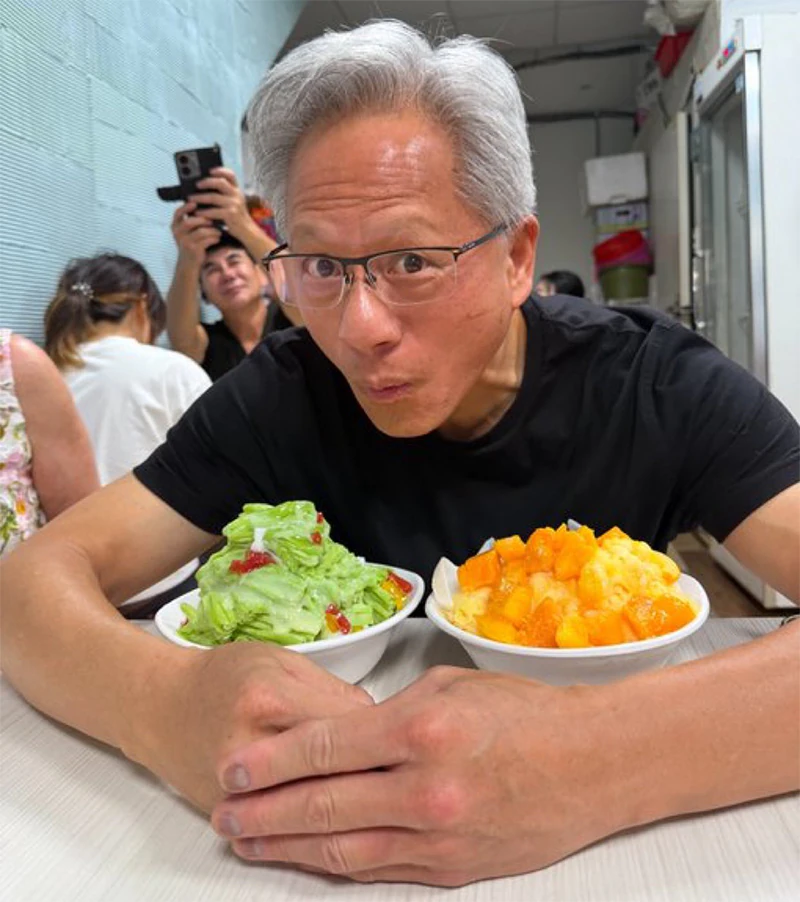
In mid-May 2026, Jensen Huang joined U.S. President Donald Trump on a high-profile business delegation trip to Beijing for a summit with Chinese President Xi Jinping.
The visit focused heavily on trade tensions, semiconductor restrictions, AI competition, and the future relationship between the U.S.-China. Huang boarded the Air Force One, traveled alongside some of the most influential figures in technology and finance as Nvidia remains deeply tied to the future of global AI infrastructure.
But after the formal meetings, banquets, and carefully choreographed political appearances ended, Trump returned to the U.S., but Huang decided to stay behind in Beijing.
That decision created the perfect setup for the internet phenomenon that followed.
Born in Taiwan, Huang moved to the U.S., before meeting this future wife, Lori Mills at Oregon State University. Then, in 1993, Huang eventually founded Nvidia. Over three decades, he transformed the company from a small graphics-chip startup into the dominant force powering the AI era. Nvidia's GPUs became essential not only for gaming, but later for machine learning, data centers, robotics, autonomous systems, and generative AI platforms that now shape modern computing itself.
Today Nvidia stands among the most valuable companies on Earth as demand for AI hardware continues exploding worldwide.
Despite his immense corporate influence, Huang's current popularity comes less from boardrooms and earnings calls than from his personality outside them.
Instead of retreating into luxury hotels or elite diplomatic dinners after the summit, Huang immersed himself directly into Beijing street life.
He wandered through famous areas including Nanluoguxiang and Shichahai, districts known for their traditional hutongs, crowded alleyways, snack stalls, and vibrant atmosphere.
The images quickly spread everywhere online.
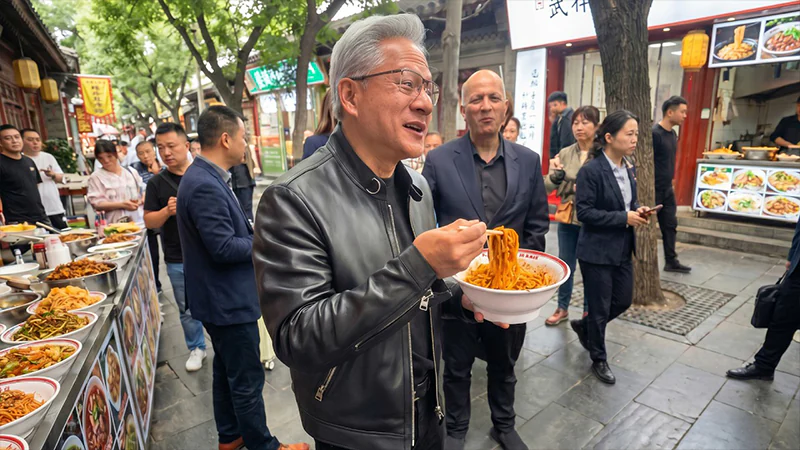
There was Huang, still wearing his signature black leather jacket despite Beijing's heat, standing outside restaurants, eating noodles on the sidewalk, smiling at crowds, and casually chatting with strangers as phones surrounded him from every angle.
Both Chinese and Western social media platforms exploded with clips of the Nvidia CEO behaving less like a billionaire executive and more like an enthusiastic food vlogger exploring the city.
One of the biggest viral moments came when Huang visited a famous noodle shop to try zhajiangmian, Beijing's iconic fried bean sauce noodles.
Standing outside the restaurant entrance with chopsticks in hand, he enthusiastically told people around him how good it tasted while finishing the bowl among cheering onlookers.
Among other viral clips, there is one that showed him trying douzhi'er, Beijing's notoriously divisive fermented mung bean drink. His exaggerated reaction immediately became meme material across social media. Huang visibly struggled with the taste before quickly buying a sweet drink afterward, making the moment even more relatable and funny to viewers.
After Beijing, Huang went to Taipei in Taiwan for some business-related events, and more street food.
Some people leave reviews. Jensen leaves his signature. pic.twitter.com/OX8L6LCUnA
— NVIDIA (@nvidia) May 24, 2026
But the food itself was only part of the story.
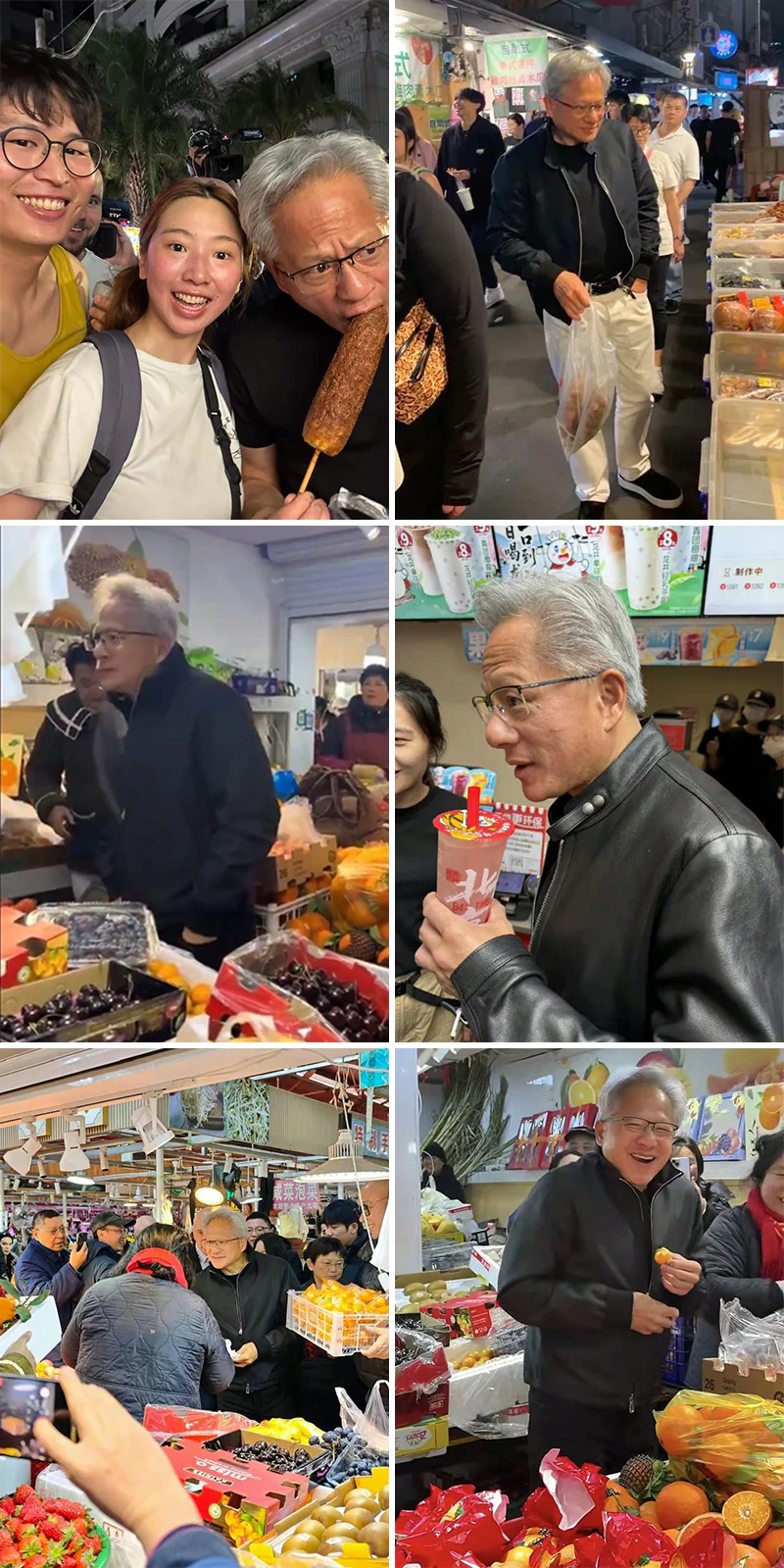
What truly captivated people was Huang's energy around crowds. Videos showed fans completely overwhelming the streets wherever he appeared. While security personnel attempted to maintain order, Huang repeatedly encouraged people to come closer. Crowds swarmed him like a rock god arriving at a concert.
People shouted for selfies, held out phones, offered him snacks and drinks, and asked for autographs on anything they could find.
Huang embraced all of it.
Spotted: A spontaneous stop from NVIDIA CEO Jensen Huang brought crowds out to Taipei’s Raohe St. Night Market tonight. pic.twitter.com/LiAAdmDpne
— NVIDIA Newsroom (@nvidianewsroom) May 24, 2026
He signed endlessly, posed for photos with genuine enthusiasm, accepted food from strangers, joked with vendors, and spoke with people in a relaxed and playful manner that felt entirely natural rather than staged. He even gave away some free Yakults, a fermented drink he loves drinking himself.
Huang even signed a tile in a toilet in Taipei.
Online users compared the scenes to a movie star walking through a fan convention. Others joked that Huang had somehow become the most beloved tech CEO in Asia.
The contrast only amplified the fascination.
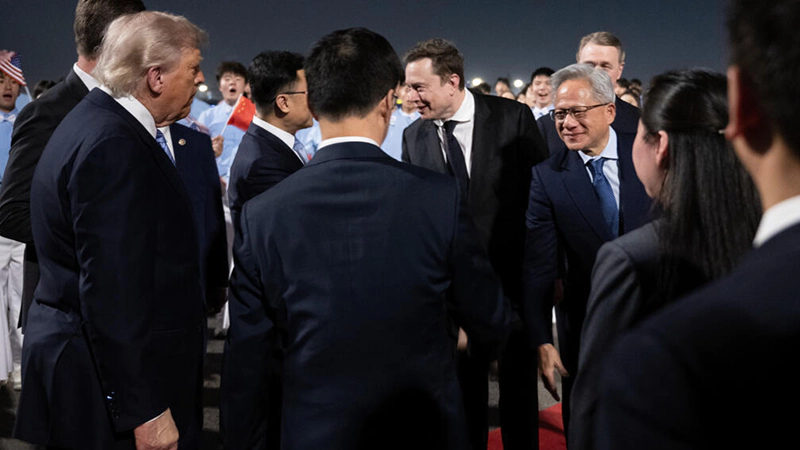
Just weeks earlier, Huang had been sitting beside presidents and participating in discussions involving AI chips, export restrictions, semiconductor geopolitics, and trillion-dollar industries capable of shaping the global balance of technological power. Yet later, he was happily eating street food on sidewalks surrounded by screaming fans and local street vendors.
That contrast became irresistible to the internet because it felt authentic.
Social media users repeatedly described Huang as someone who never seems trapped by billionaire status.
Despite controlling one of the most strategically important companies in the world, he still appears deeply connected to ordinary experiences involving family, food, culture, and people. That relatability, combined with his natural charisma and unmistakable rockstar presence, created a combination audiences found magnetic.
Online discussions exploded across platforms like Weibo, TikTok, X, Reddit, and YouTube.
Clips of Huang's Beijing adventures accumulated millions of views within hours. Many users praised how comfortable he seemed interacting with regular people instead of maintaining distance behind executive formality. Others admired how genuinely excited he appeared while exploring local culture and street food.
It's worth noting though, that Huang's food obsession has long been part of his public image.
Nvidia itself was famously founded during conversations at a Denny's restaurant in San Jose, something Huang often references proudly. Over the years, he has repeatedly been seen exploring local restaurants and street food scenes during overseas trips, especially throughout Asia.
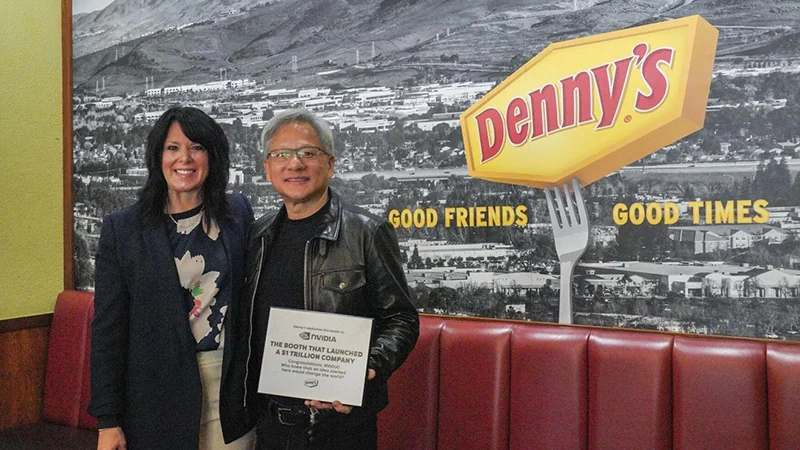
That consistency makes moments like Beijing feel less like a publicity stunt and more like an extension of who he genuinely is.
This multifaceted persona is exactly why Huang's popularity continues growing far beyond the tech world.
He is simultaneously the CEO steering the AI revolution, the immigrant success story born in Taiwan, the family-oriented businessman proud of his roots, the leather-jacketed tech icon with movie-star charisma, and the street-food enthusiast who still gets excited over noodles and snacks.
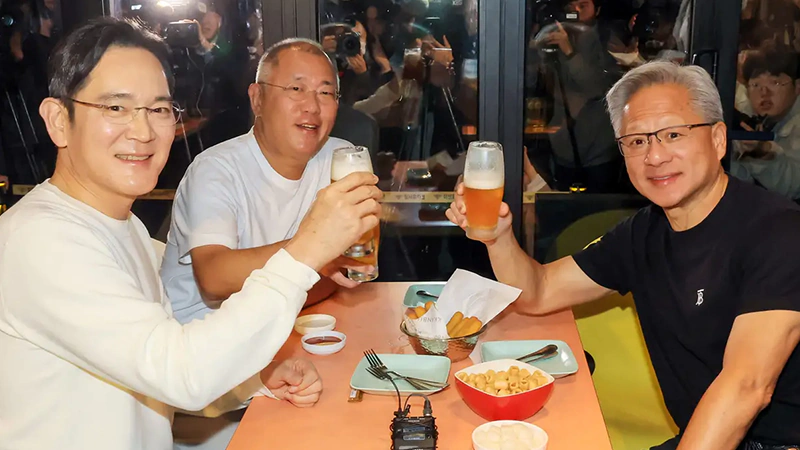
Few public figures combine those identities so naturally.
Whether he is on a high-profile business delegation trip, standing beside two presidents of two of the most powerful countries in the world, or smiling over a bowl of zhajiangmian on a crowded Beijing sidewalk, he radiates the same energy: curiosity, joy, and genuine human warmth.
That authenticity is rare, and the internet cannot get enough of it.
Back in 2024, Huang visited Taiwan, and also went viral when he was touted as the "Taylor Swift of Tech, and the "Rock God of AI," and controversially signed his autograph on a young woman's top, while she tucked her shirt up.
Dinner with the Huangs.
Jensen joined his parents for a family meal and took a moment to share fried mantou with local media gathered at the restaurant. pic.twitter.com/srjvAJX0XV— NVIDIA Newsroom (@nvidianewsroom) May 25, 2026

















































































































































































































































































