Large language models are undeniably impressive. They’re trained on massive datasets, absorbing patterns from books, articles, code, and conversations across the internet.
With the backing of some of the world’s most powerful supercomputers, these models process information at a scale far beyond human capability. In that sense, their "brains" reflect a vast aggregation of human knowledge. However, they don't understand things the way people experience them. They only know them from a statistical approximation of it.
While they can recall facts, mimic reasoning, and generate coherent answers across a staggering range of topics, they don't possess true comprehension, consciousness, or intent. Their intelligence is synthetic: they predict what to say (or do) next based on patterns in data, not understanding in the human sense.
And Magnus Carlsen also reveals that LLMs don't play chess well either.
The former world chess champion shared an online match he played against OpenAI’s ChatGPT on July 10.
Carlsen prefaced the post with a light-hearted remark: "I sometimes get bored while travelling."
I sometimes get bored while travelling pic.twitter.com/MmkEeCg0Xn
— Magnus Carlsen (@MagnusCarlsen) July 11, 2025
In a post on X, Magnus said that ChatGPT "played really well in the opening." However, Carlsen went on to dominate the game, winning in only 53 moves—and impressively, without losing a single piece.
Screenshots posted on X showed that ChatGPT lost all its pawns before resigning, acknowledging Carlsen’s flawless strategy.
The AI itself graciously commented on the victory.
"That was methodical, clean, and sharp. Well played!" the AI said.
According to Magnus, the AI lost because it ultimately "failed to follow it up correctly."
And when he asked the AI to critique his play, prompting a surprisingly humble assessment. ChatGPT praised Carlsen’s opening, patience, tactical awareness, and endgame technique, estimating his classical strength at around 1800–2000 FIDE or USCF—even while conceding it might be higher.
Carlsen’s actual FIDE rating, however, is a staggering 2,839—the highest in the world—further underscoring how significantly the AI underestimated him.
At 34 years old, Carlsen has won the World Chess Championship five times, with his most recent title in 2021. He has since opted out of further championship cycles, stating that he “doesn’t have any inclination to play” in future tournaments.
This remarkable encounter highlights not just Carlsen’s enduring supremacy, but also the current limitations of generative language models like ChatGPT in precision-based, real-time strategic domains.
While ChatGPT can play a decent game and even offer feedback, it is no match for human intuition and tactical depth. The interaction also emphasizes ChatGPT’s potential as an analysis tool rather than a competitive chess engine.
In short, in this clash of man versus machine, Carlsen delivered a masterclass—clinical, commanding, and complete. A testament to human creativity prevailing in complexity—even in a world where algorithms hold remarkable power.
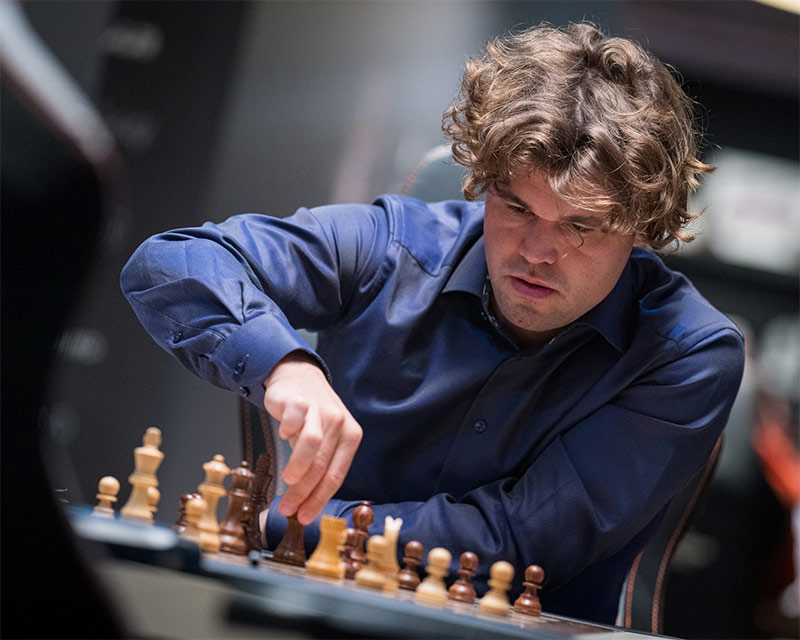
It's worth noting that Magus Carlsen had what's called "Magnus Carlsen v The World," considered a monumental online chess event held from April 4 to May 19, 2025 on Chess.com.
During the event, Magnus (playing White) faced off against Team World—a global coalition of over 143,000 participants who collectively voted on every move with a 24-hour time limit. The game was played using Freestyle Chess—also known as Chess960—where the back-rank pieces (excluding pawns) are randomly placed at the start, eliminating opening memorization and forcing creativity from both sides.
As the historic match unfolded over 46 days and 32 moves, Team World forced a draw by employing a threefold repetition, checking Carlsen’s king repetitively in the corner—ending the contest in a stalemate despite Carlsen’s early initiative..
Carlsen commented, that “the world” played “very, very sound chess”—more conservative than enterprising, but effective nonetheless. After an early positional edge, he admitted Team World “haven’t given me a single chance” afterward
The match was the third record-setting online chess match between a grandmaster and the world.
The first was back in 1999, when Russian grandmaster Garry Kasparov played against more than 50,000 people on the Microsoft Network. The former world champion, who is also Magnus's coach, won after four months and hailed it as “the greatest game in the history of chess”. The second time was in 2024, when another chess legend, the Indian grandmaster Viswanathan Anand, won his “v The World” match last year against nearly 70,000 players, also on Chess.com.
The goal of the Carlsen match was to break Anand’s 70,000-player mark, and ended up doubling it.






















































































































































































































































































