Physicists are those people who specializes in the field of physics, which encompasses the interactions of matter and energy at all length and time scales in the physical universe.
Their field of work makes them scientists, which means that they're the brainier part of the internet.
And when they come together, and speak their thoughts, the general internet may, or may not know what are they talking about.
This time, that is what happened when a team of South Korean physicists claimed they created a new material that could change the world. They call is the 'LK-99,' a room-temperature superconductor that 'should' help significantly advance humanity, due to its potential of unlocking new technologies.
"We believe that our new development will be a brand-new historical event that opens a new era for humankind," the authors wrote in their initial studies announcing the discovery, uploaded to the open-access repository of electronic preprints arXiv.
For starters, LK-99 (Lee-Kim-1999) is said to be a potential room-temperature superconductor that takes the appearance of a gray-black substance, made by slightly modifying lead-apatite, by introducing small amounts of copper.
On the outside, it has a hexagonal structure. But on the inside, it's said that the substance functions as a superconductor at ambient pressure, meaning that it has zero resistance when conducting current in room temperature.
This is why in the research, the LK-99 managed to 'levitate' because electrical charge passed through it became expelled magnetic flux fields.
Traditionally, superconductors can be created when cooling materials to near absolute zero, an attempt to decrease resistance.
But LK-99 shows superconductivity in room temperature, which is extremely rare for any substance known to man.
With researchers and scientists debating, and the internet listening, the noise they create make "LK-99" a trending topic on various social media platforms. And as news publications took notice and interviews were made, the hype continues towards uncovering the truth.
Researchers have longed for room-temperature superconductors, because they allow to persist energy indefinitely with no additional power source.
"Is this LK-99 a real superconductor?"
"Or is it just a hoax?"
Even the CEO of ChatGPT maker OpenAI, Sam Altman, weighed in, joking, "love these emails from recruiters asking for 2+ years of experience with lk-99."
love these emails from recruiters asking for 2+ years of experience with lk-99
— Sam Altman (@sama) August 1, 2023
The chemical composition of LK-99 is approximately Pb9Cu(PO4)6O.
Days after the virality of LK-99, no reported researches or conclusions were made public, and the synthesis of LK-99 and observation of its superconductivity at any temperature had not been peer-reviewed or independently replicated.
And because of the extraordinary nature of the claims, the scientific world was mostly skeptical.
In the past, the world has seen a number of similar claims, all of which were failures. None managed to show consistencies their papers show, and have yet to show real superconductivity in room temperature.
The main thing that made LK-99 viral, is the video of sample of the material partially levitating on top of a large magnet, which can correlated with superconductivity.
The name LK-99 is from the initials of discoverers Sukbae Lee and Ji-Hoon Kim, and the year of discovery, which was in 1999.
But the research became a hype, when a Korean-language paper, "Consideration for the development of room-temperature ambient-pressure superconductor (LK-99)", was submitted to the Korean Journal of Crystal Growth and Crystal Technology.
It was only after this, that two papers (1, 2) of academic publications summarizing initial findings came out in 2023, with later, a total of seven authors across four publications.
In August 2, The Korean Society of Superconductivity and Cryogenics established a verification committee as a response to the controversy and unverified claims of LK-99. On the same day, it's said that the measured properties do not prove that LK-99 is a superconductor as the published material, and does not fully explain how the LK-99's magnetization can change, demonstrate its specific heat capacity, or demonstrate it crossing its transition temperature.
An alternative explanation for LK-99's stated partial magnetic levitation could be solely from non-superconductive diamagnetism.
It's later realized that the original published articles do not claim to have seen definitive features of superconductivity, zero resistance and the Meissner effect.
The papers only said about the material exhibiting strong diamagnetic properties.
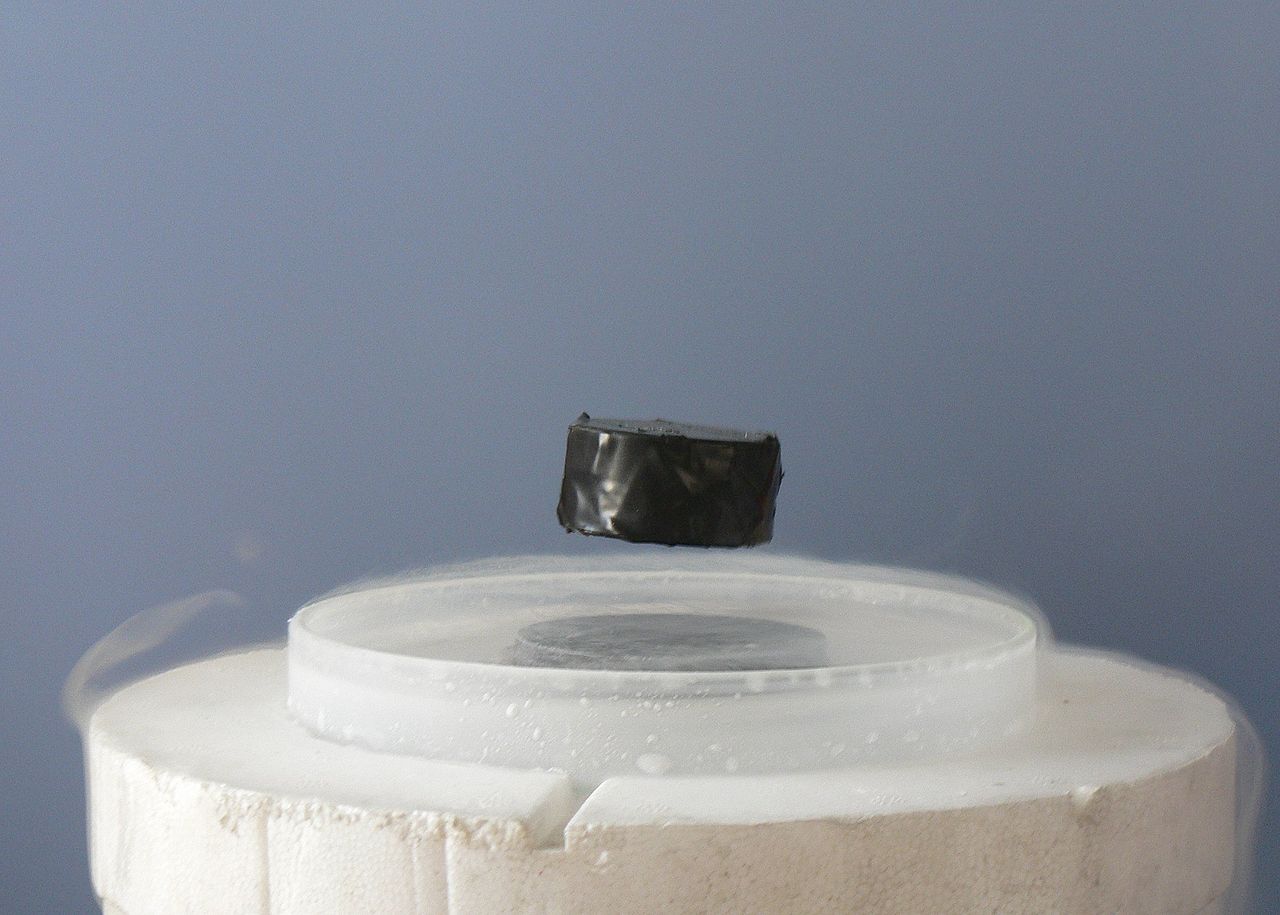
Electricity is typically conducted through wires, made of metals like copper, steel, or even gold. But no matter how efficient these metals are, the electrical current flows through them still let electrons to bounce and bump through the atoms, causing them to lose energy along the way.
Superconductors are materials that conduct electricity with zero resistance.
What this means, any current that is allowed to pass through it, indefinitely, because no atoms are jolted.
Traditionally, superconductors can be made through extreme low temperatures, close to absolute zero, where all atomic movement ceases. Or by exerting extreme pressures on the materials.
This allows the potential of creating new technologies, like fusion energy, next-generation batteries, quantum computing, and more.
But because of the requirement and cost of liquid-nitrogen cooling but rather operated at room temperature, the applications of superconductors are fairly limited.
This is why a room-temperature superconductor is "a game changer," if it's real that is.
The hype LK-99 created populates the internet with so many LK-99 opinions, many of which came from other researchers who are both puzzled and astonished. But on the web, where people have varying degrees of knowledge, many of them created memes from it, which further escalated the hype.






















































































































































































































































































