Indie games are developed by a much smaller team of developers. Games developed by these developers don't usually compete in the same league because the developers typically work with much lesser financial and technical support.
As a result, not many of them really get significant traction.
Iron Lung is a "short horror game where you pilot a tiny submarine through an ocean of blood on an alien moon." An original theme, but it didn't get that much visibility, until a newsworthy incident helped it shine.
This happens following the disappearance of OceanGate's Titan submersible vessel, which went missing after it descended to the site of the wrecked HMS Titanic.
The game's creator, David Szymanski, tweeted an image showing how his game experienced a significant spike in sales after incident.

It all began on 18 June 2023, when Titan, a submersible vessel operated by OceanGate, an tourism company based in the U.S. state of Washington, went missing.
At that time, company that provides crewed submersibles for tourism, industry, research, and exploration, submerged its Titan vessel on one clear day, to the depth of around 3,800 meters at the south-southeast off the coast of Newfoundland, to visit the wrecks of the infamous Titanic ship, which sank in 1912.
With a price tag of $250,000, five occupants boarded the vessel, the first of its kind that used a hull constructed of titanium and carbon fiber composite materials, to see in person, the condition of the ship that was once touted as "unsinkable."
Titan was made in 2018, and that it passed tests of depth and pressure at around 4,000 meters, and was already being used to visit the Titanic in several dives.
Typically, the descent would take two hours, with the full dive taking about eight hours.
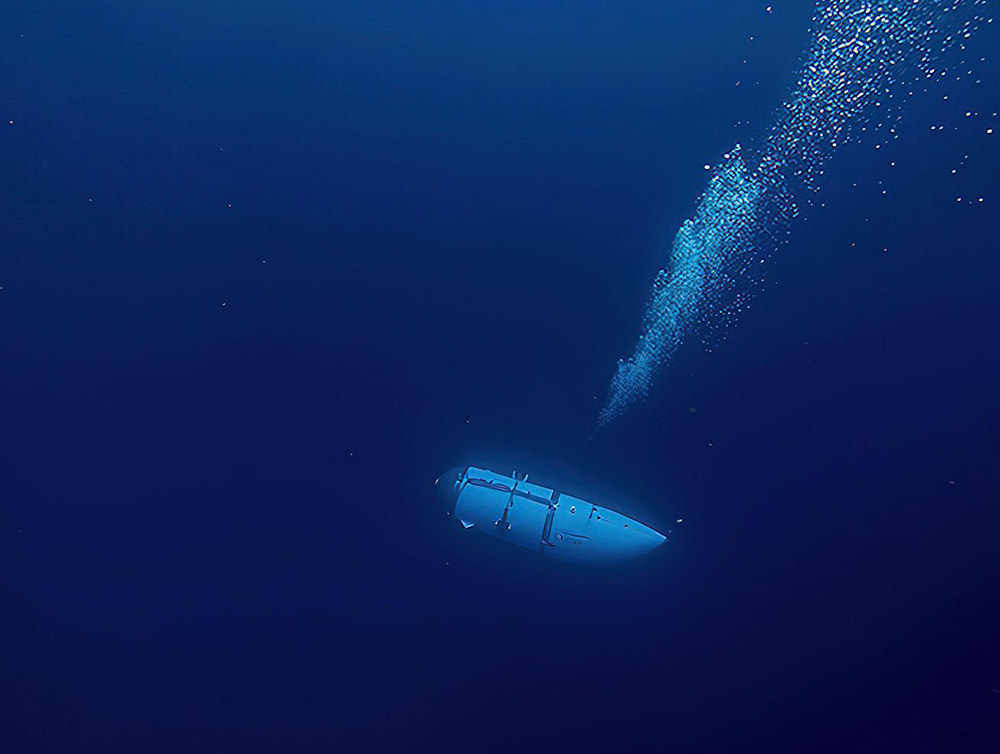
But it was only on that particular day, that the vessel went missing after only submerging for 1 hour and 45 minutes.
The Titan, equipped with a system that would ping the team at the surface every 15 minutes, suddenly stopped broadcasting its whereabouts.
The team at the surface only notified the authorities, after the vessel failed to resurface after its designated time.
According to OceanGate, Titan had seven backup systems that would help returning the vessel to surface in case of emergency, including ballasts that could be dropped, a balloon, and thrusters.
Some of the backup systems were even designed to work automatically, even if all aboard the submersible were unconscious.
For example, there were sandbags held by hooks that would dissolve after a certain amount of time, releasing the ballast to help the vessel resurface.
Since Titan did not resurface after, something must've happened.
And it was only after realizing this, that the incident caught international news headlines.
"This feels so wrong," Iron Lung creator said in the tweet.
This feels so wrong pic.twitter.com/SMAKC6sOfH
— David Szymanski (@DUSKdev) June 21, 2023
Being bolted in an air-tight submersible vessel, to venture into the depth of the ocean floor where no sunlight can penetrate, to then meet their doom, is a nightmare no one wishes to experience.
But following the disappearance of Titan, and during the large-scale search for the vessel and its crew, the game simply recreated the nightmare into the computer screen.
As a result, the previously-unknown, little horror game, shines because it has that eerie similarity to the real-life situation.
The horror-genre, survival game centers on the protagonist being in the depths of the ocean, uniquely fits into the incident.
So unsurprisingly, as the search for the Titan was still underway, gamers who were morbidly curious about the horror of the claustrophobic situation, began buying and playing Iron Lung, leading to a spike in its sales on Steam.
It's a win for the creator, but apparently, he isn’t quite sure about what to feel.
Like all the jokes I've been seeing are hilarious but also good lord nobody should have to die like that.
— David Szymanski (@DUSKdev) June 21, 2023
Szymanski has replied to those who asked him about the game, and how similar it is to the Titan incident.
While he admitted to have read and many of the jokes about the comparison of his game and Titan, and said that he found some to be "hilarious," but he still said that "nobody should have to die like that."
"I definitely see the dark humor in this whole Titanic sub thing," he tweeted.
"It’s just... like, I made Iron Lung the most nightmarish thing I could think of, and knowing real people are in that situation right now is pretty horrific, even if it was their own bad decisions."
Random outlets keep writing articles about me being uncomfortable with the Iron Lung sales spike and then the replies are filled with this gif, and... yeeeeah... pic.twitter.com/gVJroOrAZo
— David Szymanski (@DUSKdev) June 22, 2023
Titan was carrying five people, and its descent to the bottom of the ocean was part of a tourist expedition to observe the wreck of the Titanic.
The search-and-rescue operation was conducted by an international team led by the United States Coast Guard, United States Navy, and Canadian Coast Guard. More support was provided by aircraft from the Royal Canadian Air Force and United States Air National Guard, a Royal Canadian Navy ship, as well as several commercial and research vessels and ROVs.
They were all racing against time, because the vessel only had 96 hours-worth of oxygen for its five occupants.
The operation lasted about 80 hours. It was called off after an unmanned remote-operated underwater vehicle (ROV) discovered a debris field containing parts of Titan, located around 500 meters from the bow of the Titanic.
The findings were based on the U.S. Navy's declassified sonar detection, which suggests that Titan suffered an implosion, which crippled its fuselage to almost beyond recognition.
All people onboard were declared as deceased. They include:
- Stockton Rush, an American submersible pilot, engineer, and CEO and co-founder of OceanGate.
- Paul-Henri Nargeolet, a former French Navy commander, and among others, also the director of underwater research for E/M Group and RMS Titanic, Inc. which owns salvage rights to the wreckage site.
- Hamish Harding, a British businessman who had previously descended into the Mariana Trench, broken the Guinness World Record for a circumnavigation of the Earth, and flew commercially into space in 2022 on Blue Origin.
- Shahzada Dawood, a Pakistani-British businessman of the Dawood Hercules Corporation, a trustee at the SETI Institute, and one of the wealthiest people in Pakistan.
- Suleman Dawood, the son of Shahzada Dawood, a student at the University of Strathclyde.
What's worth noting here is that, first, Titan operated in international waters and did not carry passengers from a port. What this means, it wasn't subject to safety regulations.
Second, Titan was also not certified as seaworthy by any regulatory agency or third-party organization.
And third, all passengers who enter Titan and with to descent to the waters with it, must sign a waiver confirming their knowledge that it is an "experimental" vessel "that has not been approved or certified by any regulatory body, and could result in physical injury, disability, emotional trauma or death".
It is said that CEO Stockton Rush described the U.S. Passenger Vessel Safety Act of 1993 as "needlessly prioritized passenger safety over commercial innovation".
"At some point, safety just is pure waste. I mean, if you just want to be safe, don't get out of bed. Don't get in your car. Don't do anything," he said in an interview.
"I've broken some rules to make [Titan]. I think I've broken them with logic and good engineering behind me. The carbon fiber and titanium, there's a rule you don't do that. Well, I did," he said in another.






















































































































































































































































































