
Just like pretty much everything else, more performance can be achieved when more sources of power is obtained and can be utilized at the same time, and at will.
And if power is one thing, reliability and cost is another thing.
This was exceptionally true when the United States Air Force managed to create one of the world's fastest computers, right inside its own Air Force Research Laboratory.
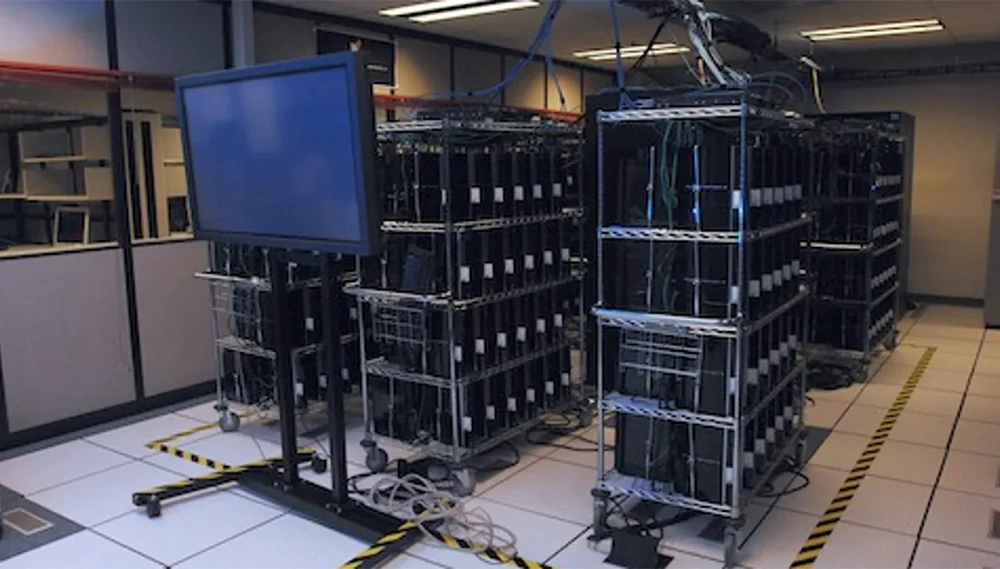
In a project they called "Condor Cluster," the Department of Defense hooked up 1,760 Sony PlayStation 3 consoles.
The Air Force then put the rig in operation in Rome, New York, near Syracuse.
It all happened during the time PlayStation 2 hit the market, when Sony released a Linux kit for the console so it could be transformed into a regular computer.
Craig Steffen, a senior researcher at the NCSA tried to make a supercomputer by combining 60-70 PS2s, but according to him, they were "okay" but "didn't work superbly well."
When Sony introduced the PlayStation 3 to the market, Steffen quickly saw the potential of repeating his experiment.
This is because PS3 is 37 times more powerful than the PS2, and that Steffen and his team found that it worked reliably with the Linux software.
All they have to do, was to hook them up together, and that's it.
Not only that the rig was so powerful, because it was also efficient and cheap.
At the time, a PlayStation cost $300, which means that together, the rig costs roughly $1 million, or about 10% of the price of a conventional supercomputer.
What's more, the video-game consoles also consumed 90% less energy than any alternative, meaning that it's a lot greener as well.
To ramp things up further, the team also connected it to subcluster heads of dual-quad Xeons with multiple GPGPUs (general-purpose graphics processing units).
By effectively adapting advanced gaming technology already on the market, the military managed to successfully leverage off-the-shelf equipment into remarkably affordable supercomputing.

In all, Condor Cluster consisted of 1,760 Sony PlayStation 3 consoles, 168 GPUs, and 84 coordinating servers, all connected using wires that span for kilometers.
The system that is capable of performing 500 trillion floating-point operations per second (500 TeraFLOPS), was then used to analyze high definition satellite imagery processing, radar enhancement, pattern recognition, and AI research.
The system also has improved algorithms that can better identify blurred flying objects in space than previous computers could.
It was the 33rd largest supercomputer in the world, and was the U.S. Department of Defense’s fastest interactive computer at the time of its creation.
With its immense power, the rig is able to analyze ultra-high-resolution images very quickly, at a rate of billions of pixels per minute.
This happens because the system utilizes the video game consoles' graphics capabilities.
It's worth noting that the PS3s the team used were the older, larger variety, since the newer slim models don't allow for the installation of Linux.

The system was introduced following a ribbon cutting on December 1, and is meant to be made freely available to all Department of Defense users on a shared basis.
Condor Cluster was inspired by the works of from Gaurav Khanna from the University of Massachusetts Dartmouth when he needed something to simulate theoretical astronomy. At the time, Khanna built a similar machine, but only using almost 200 PS3s.
While the system showed its massive potential, eventually, the Condor Cluster project was discontinued.
The PS3 which were all still functional, were released back into the wild.
Some went to collectors and according to the original report, some even made it back to Khanna.