
Social media users agree that social media is addictive. Experts have been calling for responsible use them for a long time, and Facebook as the giant of social media is obviously the most to blame.
In a step towards the right direction, and also to cease the problem, Facebook has announced the launch of a set of tools to help users manage their time spent on both Facebook's core app and Instagram. Technically, they are dashboards that tell users how much time they've spent inside their apps.
To find the features on Facebook, users need to tap the button with three vertical lines called the hamburger menu in the bottom-right corner of the app, and tap on the 'Your time on Facebook'.
On Instagram, users need to go to the settings menu to access the 'Your activity' option.
The feature are designed to address concerns that addictive feedback loops built into social apps have been messing with users' well-being.
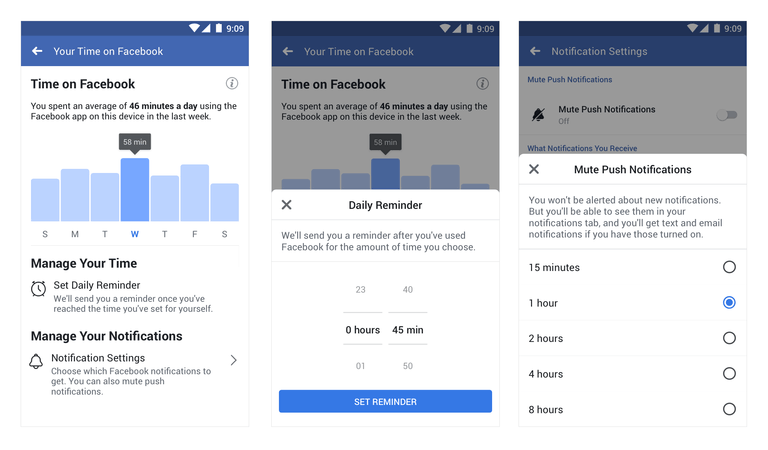
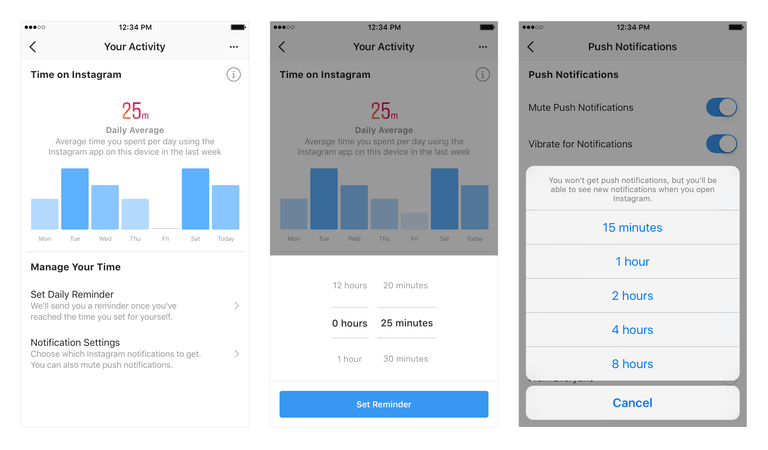
The Facebook version is similar to Instagram's, and somehow almost identical.
When opening the dashboard, both apps will show a bar chart of the time users have spent on each app over the past seven days. Users can tap on the bars to see the exact number. And from there, they can choose how much time they wish to spend inside the Facebook and Instagram apps, in five-minute increments.
A daily usage reminder is to let users know when they have hit a self-defined number of minutes using the apps. However, users can still continue using the app if they like.
Then there is a feature to mute notifications, which is just like WhatsApp, will stop the app from pushing notifications for a limited time of up to 8 hours.
"We want these tools to be widely available to the whole community, and to anyone that would benefit from using them," said Ameet Ranadive, who leads a team at Instagram devoted to users' well-being. "It’s really important for people that use Instagram and Facebook to feel like the time that they spend with us is time well spent. That’s the whole purpose of this release."
Social media has been proven to be addictive, and Facebook with other tech companies have faced intense criticism for how aggressively they managed to get users' attention throughout the day, much more than they have to.
Facebook acknowledged this back in December 2017, citing internal and academic research that passive consumption of the News Feed could make people feel bad.
"We want to empower people to make intentional decisions about how much time they spend, and how they want to engage with the app," Ranadive said. "There may be some trade-off with other metrics for the company. That’s a trade-off that we’re willing to live with. In the long run this is something that’s important for the community, and something we want to invest in."
While the company felt compelled to make the dashboard available despite the risk of it leading to further decreased usage of Facebook and Instagram, anything can be the trigger, considering that Facebook is involved.
The social giant has faced criticisms about how it gathered users' data. And regarding Cambridge Analytics scandal, the company that has updated many of its policies to restrict data access and put more API restrictions, didn't really affect the public's opinion about the company being cynical.
Still, it's better than nothing.
The feature is not going to change anything for good, but providing a way for users to know how much time they've spent on its apps is certainly a good move from Facebook. The company follows Google and Apple that have added system-level features to their apps respectively. The thing is, they want to help people understand how much time they spend in apps and to restrict that time, if they like.




















































































































































































































































































