
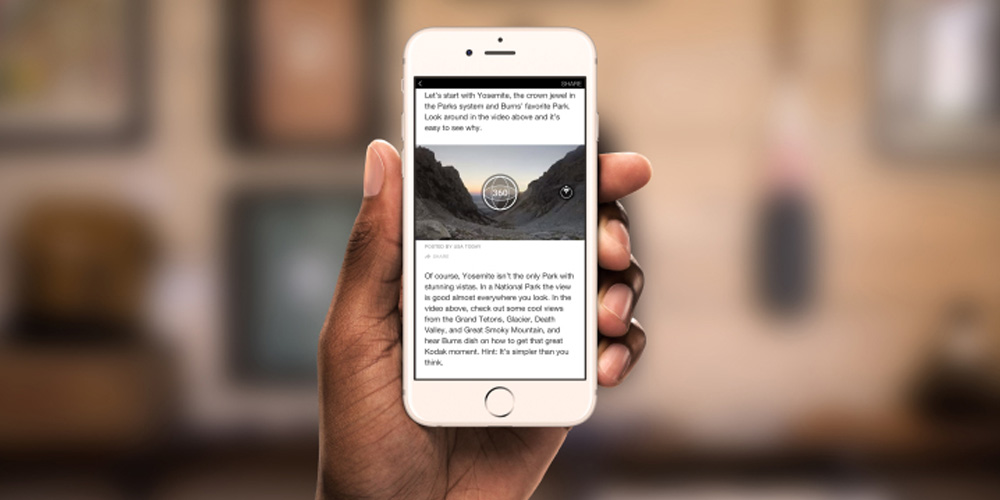
The social giant Facebook has launched 360 videos in 2015. On that same year, the company also launched 360 photos. Starting October 20th, 2016, the two can be implemented on Instant Articles.
Instant Articles is a feature than enables users to load content instantly. While the feature has increased content engagement on Facebook, the company doesn't want to miss out on features either. The less likely users are to open a browser, the more longer they will stay and interact with Facebook.
This is what Facebook wanted, and it's its priority to keep everyone inside its walled garden.
With instant 360-degrees media, "journalists and storytellers can share richer stories and paint more vivid scenes by joining 360 content with other Instant Articles elements that publishers are using to deliver their written, filmed, and spoken narratives."
Every Instant Article can contain multiple 360 photos and videos.
To use the feature, users just need to open the Facebook app on their iPhone or Android phone, to then search for Instant Articles. Tapping on one will load the content instantly using Instant Articles. Users can then explore the 360 media by tilting and panning their devices.
In the next coming months, Facebook is planning to introduce even more interactive feature to Instant Articles.
"We're excited to see how publishers experiment and innovate with these new storytelling tools," said Facebook
Instant Articles for media contents work pretty much similar to other contents on the News Feed. The Instant Articles here is meant to add more interactivity to Facebook's media and to its publishing system.
As the usual contents using Instant Articles have already attracted more publishers to use Facebook, adding the feature to more media means that the company is trying make users to share even more multimedia and high-bandwidth data into its platform.
Facebook has a high engagement, and anything can be seen fast and easy. But there is a downside to this Instant Articles.
With media contents having Instant Articles enabled, publishers may question themselves, and Facebook, on how should their content is handled for those who access it via ordinary web browser. Not everyone is using Facebook's app, and many people are still happy with Facebook using their favorite web browser.
Instant Articles works well inside Facebook's app, but outside, it isn't doing any good. For publishers, this could make user-experience a bit messy.
Publishers are expecting their contents to give the same engagement throughout the many platforms they use. But because Facebook has a lot of influence, publishers may craft their media content to suit Facebook's Instant Articles and 360 feature. While that is a good thing, however, the content won't appear correctly for people that are seeing it on the publishers' own website using a browser, for example.
One the other hand, publishers can also create their own 360 content to look great outside Facebook. While that content may suit their website better, having that media shared on Facebook may make it look messy. Furthermore, hosting it outside of Facebook can rise a question whether or not the content can slow down their website.
What is certain is that slow loading content on Facebook wouldn't be an issue because Facebook has Instant Articles. But there are still facts that people are still seeking news outside Facebook. For that reason, publishers still have the responsibility to flourish their own website, not only Facebook, because it's certainly usable for a wider audience.














































































































































































































































































