
Google Accelerated Mobile Pages, or AMP, is the search engine's way to speed the loading time of web pages by providing markups. It has been around, appearing as card carousels on its mobile results search list to showcase Top Stories.
At the end of 2016 without any fanfare from Google, the search giant has launched another type of AMP rich card, in addition to the original carousel.
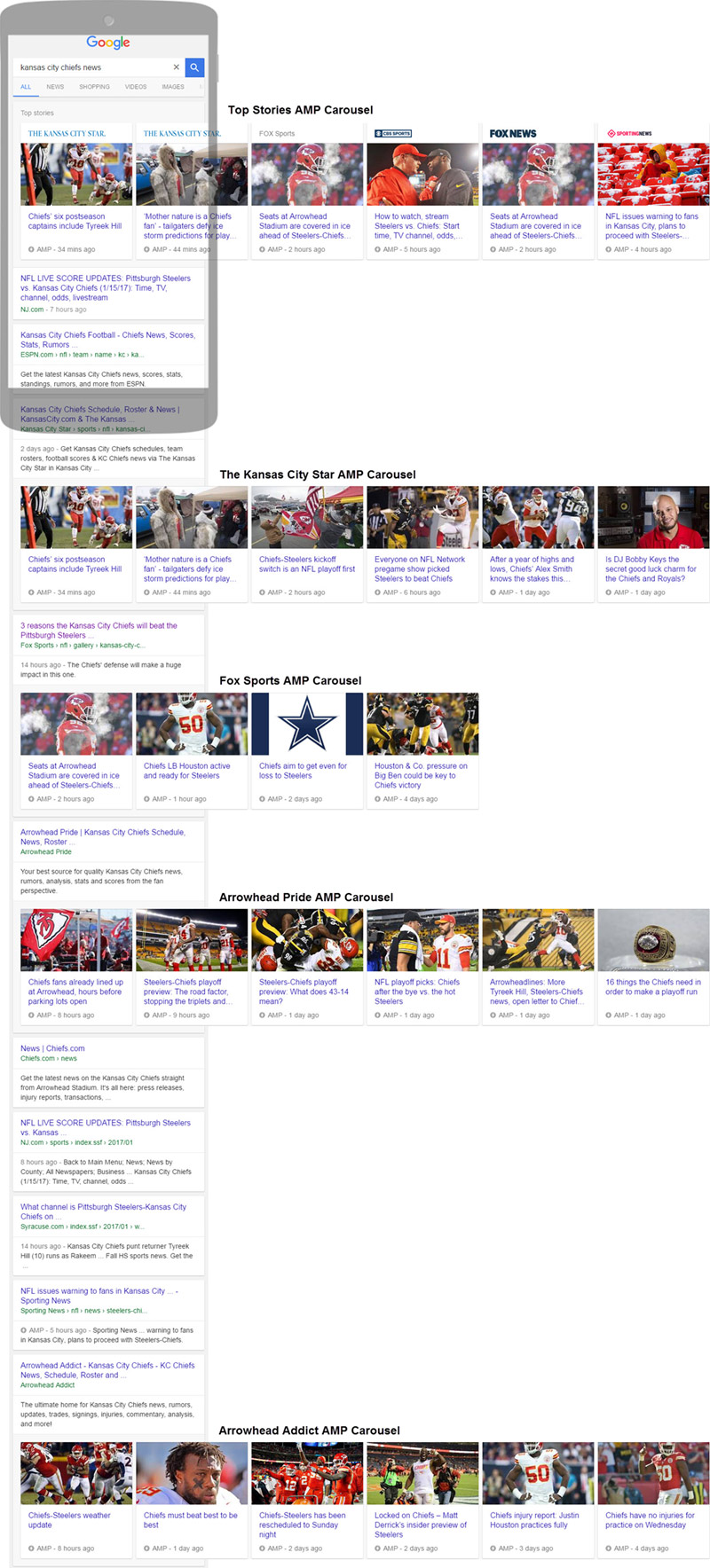
The new AMP carousels appear in the mobile results list, showcasing related articles from a single publisher. They're more likely to appear in results for popular search terms, particularly news stories. They also appear frequently for recipes as well.
Google is invoking the single-source AMP carousel when a publisher offers multiple AMP-enabled pages that have high relevancy to the search terms. But since the card carousels are created by algorithms, there is no guarantee that a publisher will get the carousel for a particular query, although if they have many pages with relevant results.
Unlike the Top Stories carousel where publishers compete for top part of the search engine's results page, the single-source carousels are shown at the lower bottom. While their position is a disadvantage, they can still offer high impact because cards have better opportunity for engagement than the usual Google's plain text link.
As for Google, this approach enables it to offer the promotion of Top Stories AMP but by also preserving the integrity of its result page experience. And because Google can show more pages as carousels, it will be able to get more data about user engagement for future enhancements.
AMP Lite, AMP Cache
Google's AMP optimizes and streamlines articles, galleries, and comment sections so they can be loaded more quickly. For users using high-powered smartphones, AMP won't be an issue. But to those that own low-powered handsets that frequently run out of memory, the original AMP can pose a few problems.
The search giant announced an improvement to the AMP platform in the form of AMP Cache and AMP Lite. They are the two speed-focused additions to the search giant's original Accelerated Mobile Pages platform, aimed to improve web page loading time for low-powered devices and those on slow internet connections.
AMP Lite removes data that is invisible to the user, such as thumbnail and geolocation metadata. It also downgrades image when the differences in quality aren't visible, and "when there is an indication that this is desired by the user or for very slow network conditions."
It targets images because they usually make a large portion of a page's size. Accounting to roughly 64 percent of a page on average, according to Google. The improvements to the AMP can reduce that number to as much as 40 percent.
AMP Cache optimizes the original caching of AMP, and also enabling the caching of external fonts. So when fonts of a web page is loaded from another sources, they can be displayed immediately regardless of whether they were previously cached.
"With caching, we can make content be, in general, physically closer to the users who are requesting it so that bytes take a shorter trip over the wire to reach the user," said Google's software engineers Huibao Lina and Eyal Peled in a blog post. "In addition, using a single common infrastructure like a cache provides greater consistency in page serving times despite the content originating from many hosts, which might have very different - and much larger - latency in serving the content as compared to the cache."




















































































































































































































































































